
Bitcoin has always been volatile. If you hold crypto for the long term, one move can wipe out weeks of gains and test your nerve. Many investors react by selling and later buying back at a worse price.
Hedging in crypto gives you a third option. Instead of selling your coins, you take a second position designed to gain when your main holding loses value. That gain can reduce downside risk while allowing you to stay invested.

This guide explains how to hedge crypto using spot and futures, what each method costs, and when it makes sense.
A crypto hedging strategy is a risk-management approach in which you open a position expected to gain if your main crypto holding loses value. The goal is to protect capital by using gains on the hedge to balance some or all of the loss on the original position.
Selling and hedging solve the same problem in different ways. When you sell, you exit the market completely. You avoid further losses, but you also give up any chance of benefiting from a quick rebound.
When you hedge, you stay invested. If Bitcoin keeps falling, your hedge position gains and softens the blow. If Bitcoin recovers instead, your hedge loses a little value, but your original holding gains it back.
Traders usually choose to hedge instead of sell for three reasons:
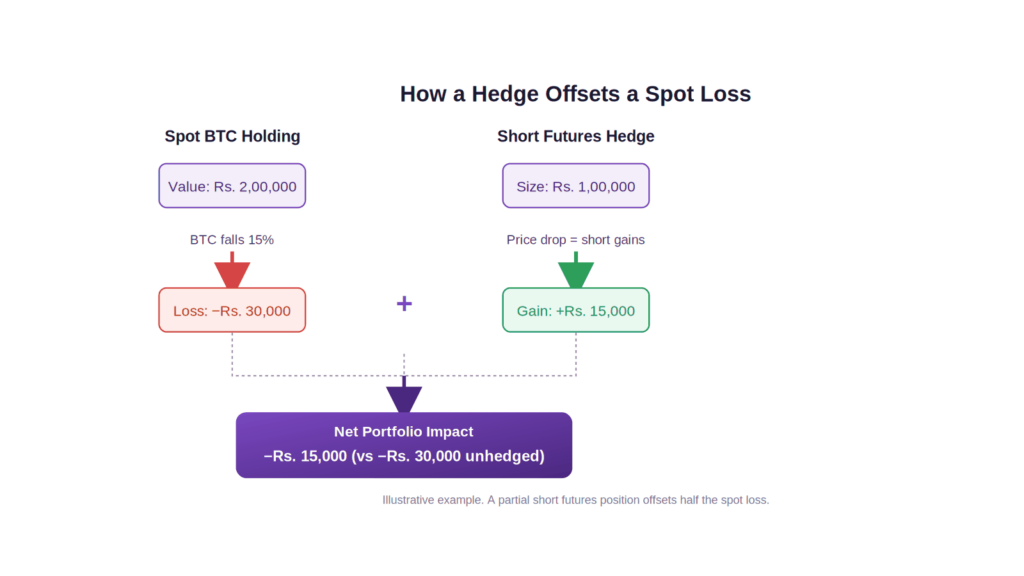
Look at the diagram above. It shows how a short futures position offsets a chunk of a falling spot position, so the combined loss to your portfolio is smaller than the spot loss alone.
Crypto hedging comes with its own vocabulary. Here are the terms used throughout this guide.
| Term | What It Means |
|---|---|
| Drawdown | How much your portfolio’s value falls from its recent peak. |
| Hedge Ratio | The size of your hedge position relative to your original holding (e.g., 50% = a partial hedge). |
| Position Size | The rupee or dollar value of the crypto you are hedging. |
| Correlation | How closely two positions move together. A useful hedge produces gains that offset the original position, either through an inverse relationship or an opposite trade direction. |
| Funding Rate | A recurring fee paid between long and short traders in perpetual futures, charged every few hours. |
| Margin Ratio | Your account equity divided by the margin used. It falls as a leveraged position moves against you. |
| Liquidation Price | The price at which an exchange automatically force-closes a leveraged position. |
| Unrealised PnL | Your paper profit or loss on an open position, before you close it. |
| Opportunity Cost | The upside you give up by hedging, if the market moves in your favor instead. |
Spot hedging crypto exposure means moving part of your capital out of a volatile coin and into a more stable asset. Strictly speaking, this is closer to de-risking or portfolio rebalancing than a perfect hedge because it reduces exposure instead of creating an equal and opposite position.
Some traders also use a gold-backed token such as PAXG. However, gold and Bitcoin can sometimes fall together, so historical stability does not guarantee that the token will offset crypto losses.
Worked example: Rahul holds ₹2,00,000 worth of Bitcoin. He gets uneasy after a rally followed by weakening momentum, so he moves ₹80,000 into a stablecoin and keeps ₹1,20,000 in Bitcoin.
| Scenario | BTC Allocation | Stablecoin Allocation | BTC Value After 15% Drop | Total Portfolio Value | Total Loss |
|---|---|---|---|---|---|
| No Hedge | ₹2,00,000 | ₹0 | ₹1,70,000 | ₹1,70,000 | ₹30,000 |
| Spot Hedge | ₹1,20,000 | ₹80,000 | ₹1,02,000 | ₹1,82,000 | ₹18,000 |
By moving 40% of his capital into a stablecoin, Rahul cuts his loss from ₹30,000 to ₹18,000. The tradeoff: if Bitcoin had risen 15% instead, only his ₹1,20,000 position would have benefited, not the full ₹2,00,000.
Futures hedging works by opening a short futures position that gains value when your spot holding falls, directly offsetting the loss instead of just reducing exposure. This is a more precise hedge than moving into stablecoins, since gains on the short side can match losses on the spot side almost exactly.
Worked example: Rahul holds ₹2,00,000 in Bitcoin and wants protection without selling. He opens a ₹1,00,000 short Bitcoin futures position on Mudrex Futures, using margin to control the position size.
| Scenario | Spot P&L (15% Fall) | Futures P&L (Short) | Net Portfolio Impact |
|---|---|---|---|
| No Hedge | −₹30,000 | ₹0 | −₹30,000 |
| Partial Futures Hedge (50%) | −₹30,000 | +₹15,000 | −₹15,000 |
Because the short position is sized at half his spot holding, it offsets half his loss. A short position sized at 100% of the spot holding would have offset nearly the full ₹30,000, minus fees and funding.
Two things affect how well a futures hedge performs in practice:
A stop-market order becomes a market order once its trigger price is reached. It prioritises execution, but the final fill price may be worse during a fast or illiquid market.
A stop-limit order submits a limit order once triggered. It gives you greater price control, but it can remain unfilled if the market moves past the limit price too quickly.
Leverage can make a hedge more capital-efficient, but it also increases liquidation risk. The CFTC warns that leveraged crypto futures can amplify losses and may force traders to add margin or close a position when the market moves against them.
In crypto portfolio hedging, a full hedge sizes the short position to match the spot holding, while a partial hedge protects only part of that exposure. A full hedge offers stronger portfolio protection, but it also removes most of the upside if the asset rises. A partial hedge preserves more upside while leaving part of the downside exposed.
Worked example: Rahul holds ₹2,00,000 in Bitcoin.
| Hedge Type | Futures Position Size | Impact if BTC Falls 20% | Impact if BTC Rises 20% |
|---|---|---|---|
| No Hedge | ₹0 | −20% | +20% |
| Partial Hedge (50%) | ₹1,00,000 | −10% | +10% |
| Full Hedge (100%) | ₹2,00,000 | ~0% | ~0% |
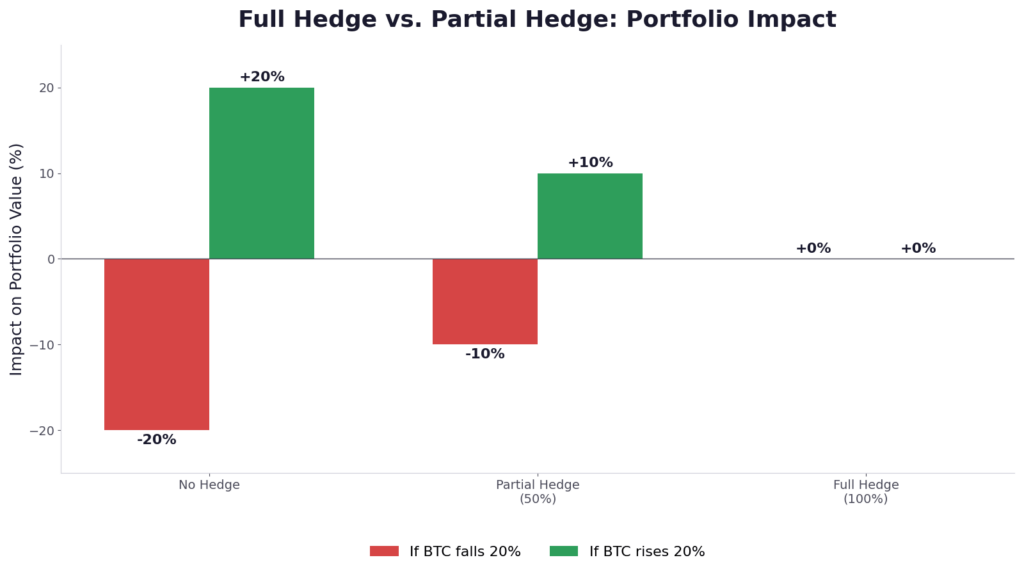
The chart above shows this tradeoff clearly. A full hedge flattens both your losses and your gains. A partial hedge leaves you with a smaller version of both.
Crypto volatility hedging makes sense when an ordinary market decline would cause more damage than you are willing or able to accept. It should be based on position size, time horizon, and defined risk limits—not simply on nervousness. Used carefully, hedging can provide drawdown control without requiring you to abandon a long-term position.
Definition: Risk Imbalance A situation where the potential downside of a position becomes disproportionately large compared to your capital, time horizon, or emotional comfort, even if your long-term outlook hasn’t changed.
Signs that a risk imbalance may be building:
Hedging may not be necessary when volatility is low and stable, your position size is small relative to your total capital, or you are genuinely comfortable sitting through a short-term loss.
Hedging is not free protection. The funding cost of a perpetual futures hedge can change over time, while margin requirements tie up capital that could otherwise be used elsewhere. You may also give up part of the profit if the market rises.
| Cost Type | What It Means | Impact on Your Portfolio |
|---|---|---|
| Missed upside | Your hedge loses value if the market rises, offsetting some spot gains | Reduced profit even in a rising market |
| Funding payments | Periodic fees to keep a perpetual futures position open | Slowly reduces portfolio value over time |
| Margin lock-up | Capital reserved as collateral for the futures hedge | Less capital free for other opportunities |
| Liquidation risk | An adverse price move can force-close an under-margined hedge | Protection can fail when you need it most |
Spot hedging has a simpler cost: whatever you move into stablecoins stops earning if the market rises. There is no funding fee, but there is no leverage either, so it takes a larger allocation to achieve the same protection a smaller futures hedge can offer.
A hedge should function as portfolio insurance, not as a separate attempt to generate extra profit. Increasing the hedge beyond the exposure being protected turns it into a speculative position.
Other common mistakes:
Start small and simple before adding complexity. Decide first whether you want a spot hedge (lower risk, no leverage) or a futures hedge (more precise, but needs margin management).
Crypto hedging lets you manage volatility without abandoning your long-term position. Spot hedging is the simpler route, moving capital into stablecoins or gold-backed tokens to lower exposure. Futures hedging is more precise because it uses a short position to offset losses directly, but it comes with margin requirements, liquidation risk, and ongoing funding payments.
Neither approach eliminates risk completely, and both come at a cost. The right choice depends on how much upside you are willing to trade away for downside protection, and how closely you want to manage the position.
Ready to manage your portfolio risk? Download the Mudrex app to trade spot and futures with real-time INR margin, or subscribe to the Mudrex YouTube channel for beginner-friendly walkthroughs on risk management.
Hedging is a strategy where you open a position that gains value when your main crypto holding loses value, offsetting some or all of the loss without selling.
Spot hedging with stablecoins is beginner-friendly. Futures hedging involves margin and leverage, so it needs more care and a solid grasp of liquidation risk first.
No. Hedging reduces the impact of adverse price moves; it does not remove risk, guarantee profit, or improve long-term returns on its own.
Yes. If the market rises, your hedge position typically loses value, offsetting some of the gains on your original holding. This is the tradeoff for downside protection.
A full hedge matches your entire position size, offsetting nearly all gains and losses. A partial hedge uses a smaller size, offsetting only part of both.
You can move part of your capital into a stablecoin or gold token (spot hedge), or open a short futures position sized against your holding (futures hedge).
Costs include missed upside if the market rises, funding payments on futures positions, margin locked up as collateral, and liquidation risk during sharp price spikes.
Crypto futures trading involves substantial risk, including the potential loss of your entire margin. Leverage magnifies both gains and losses, and hedging does not eliminate this risk. All figures, percentages, and worked examples in this article are illustrative and simplified for teaching purposes; they exclude fees, funding, and slippage. This article is not financial advice. Please assess your own risk tolerance and consult a qualified financial advisor before hedging or trading with leverage.