Open a ₹50,000 Bitcoin futures position with just ₹5,000 in your account, and a single bad afternoon can wipe out that ₹5,000 in minutes. That ₹5,000 is your margin, and it decides exactly how much you stand to lose before the exchange steps in and closes your trade for you.
Most beginners open their first leveraged position without knowing the difference between initial margin and maintenance margin, or when a warning turns into a full liquidation. That gap in understanding, not bad market timing, is what causes most first-trade wipeouts.
This guide breaks down what margin in crypto futures actually is, how initial and maintenance margin work together, how cross and isolated margin change your risk, and the exact math behind liquidation. Know your numbers before you place a trade, not after.
Key Takeaways
Margin is your collateral. It is the deposit you post with the exchange to open and hold a leveraged futures position.
Two margin levels matter. Initial margin opens the trade; maintenance margin is the floor that keeps it open.
Leverage sets your buffer. Higher leverage means a smaller price move can trigger liquidation.
Cross and isolated margin differ. Isolated margin caps your loss per trade; cross margin shares your full wallet balance across every position.
What Is Margin in Crypto Futures, Exactly?
Margin is the collateral you deposit with an exchange to open and hold a leveraged futures position. It is not a fee, and you do not lose it just for opening a trade. It is money the exchange sets aside against your position, ready to absorb losses if the market moves against you.
Every futures exchange requires margin for the same reason. Leverage lets you control a position much larger than your own deposit, so the exchange needs some guarantee that losses on that bigger position get covered. Your margin is that guarantee.
Two thresholds decide how that guarantee plays out over the life of a trade: initial margin, which opens it, and maintenance margin, which keeps it open. The rest of this guide walks through exactly how those two numbers work, and what happens when your balance gets too close to either one.
Key Terms and Metrics to Know
Term
What It Means
Initial Margin
The deposit needed to open a leveraged position.
Maintenance Margin
The minimum balance needed to keep that position open.
Margin Balance
Your current account value assigned to a position, including unrealized profit or loss.
Margin Ratio
Your margin balance divided by the margin required. Falling too low triggers liquidation.
Leverage Ratio
The multiplier between your margin and your total position size.
Position Size / Notional Value
The full value of the trade you control, not just your deposit.
Wallet Balance / Available Balance
Total funds in your futures wallet, including the amount not yet committed to a trade.
Account Equity
Your wallet balance adjusted for unrealized profit or loss across all open positions.
Unrealized PnL / Realized PnL
Paper profit or loss on an open trade, versus profit or loss locked in once you close it.
Mark Price
A smoothed, fair reference price used to calculate PnL and trigger liquidation, not the last traded price.
Liquidation Price
The exact price at which your position gets force-closed.
Margin Mode (Cross / Isolated)
Whether your collateral is shared across positions (cross) or fixed to one trade (isolated).
How Does Margin Work in Crypto Futures Trading?
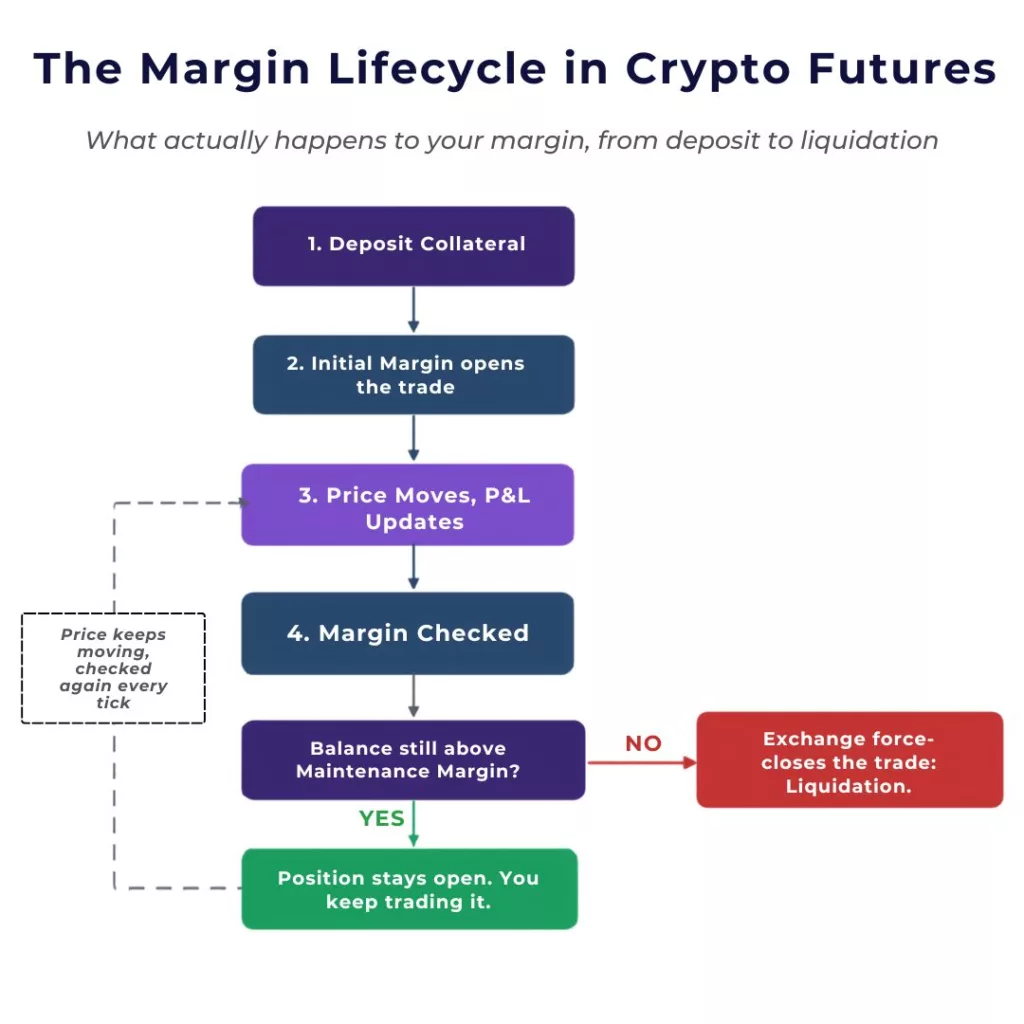
Margin works in four steps: you deposit collateral, that collateral opens a leveraged position, price moves change your unrealized profit or loss, and the exchange constantly checks whether your balance still covers the position.
Here’s what that cycle looks like in practice-
What actually happens to your margin, from deposit to liquidation
Look at the diagram above. Step 4 is the one most beginners forget about. The exchange checks your margin balance against the maintenance margin every time the price moves, not just once when you open the trade.
Once your balance stays above the maintenance margin, your position stays open no matter how many times price swings against you temporarily. The moment it dips below that line, the cycle ends at liquidation, automatically, without a phone call or a warning email.
This is why margin is called the foundation of crypto futures trading. It is not just an entry fee. It is a running scorecard that the exchange checks on every price update.
If you want to see this cycle in a live account rather than on paper, you can trade crypto futures directly in INR on Mudrex, with your margin balance and liquidation price both visible in real time.
What Is Initial Margin in Crypto Futures?
Initial margin is the minimum deposit an exchange requires from you before it lets you open a leveraged futures position.
Say Bitcoin is trading at ₹50,00,000 and you want to control a full BTC-sized position using 10x leverage. Instead of paying the full ₹50,00,000, you only need to post ₹5,00,000 as your initial margin. The exchange treats the rest as leverage.
Initial margin scales directly with leverage. Choose a higher leverage ratio, and the initial margin required for the same position size drops. Choose a lower leverage ratio, and it rises. Either way, the position size you control does not change, only how much of it comes from your own deposit.
What Is Maintenance Margin in Crypto Futures?
Maintenance margin is the minimum balance you must keep in a position once it’s open, or the exchange will force-close it.
Maintenance margin is always lower than initial margin in crypto. It exists purely as a floor, a line that ends the trade automatically once it’s crossed. Most exchanges set it as a small percentage of your position’s notional value, often between 0.5% and 2%, depending on the asset and your leverage tier.
The table below makes the distinction concrete.
Feature
Initial Margin
Maintenance Margin
Purpose
Opens the position
Keeps the position open
Relative size
Higher
Lower, a fraction of initial margin
When it applies
Once, at trade entry
Continuously, for as long as the trade is open
What breaching it does
Trade cannot open
Trade gets liquidated
What’s the Difference Between Cross Margin and Isolated Margin in Crypto Futures Trading?
Isolated margin limits your risk to one trade. Cross margin in crypto shares your entire futures wallet balance across every open position instead.
With isolated margin, you assign a fixed amount of collateral to a single position. If that trade gets liquidated, you lose only what you assigned to it, and the rest of your wallet stays untouched.
With cross margin, every open position draws from the same pool: your full wallet balance. This can help one losing trade survive a temporary dip, since profits elsewhere in your account can cover it. But it also means a single bad trade can eat into money you meant to keep for something else entirely.
What Happens During a Margin Call in Crypto Futures?
A margin call in crypto futures is a warning that your balance is approaching the maintenance margin level, telling you to add funds or reduce your position before the exchange steps in.
In practice, many crypto exchanges skip a formal margin call and move straight to automatic liquidation once your balance crosses the maintenance threshold. Crypto markets move fast enough that a manual warning window, common on traditional stock margin accounts, is often not built into the system at all.
That makes the difference between a margin call and liquidation worth knowing in advance, not after your position has already closed.
Feature
Margin Call
Liquidation
What it is
A warning that your margin balance is low
The forced closing of your trade
When it happens
Before balance drops below maintenance margin
After balance drops below maintenance margin
Can you act on it?
Yes, by adding funds or reducing the position
No, the exchange has already closed the trade
Outcome
Trade can stay open if you respond
Trade is closed, and margin is used to cover the loss
What Is Liquidation in Crypto Futures, and How Is It Calculated?
Liquidation in crypto futures is the exchange automatically closing your position once your margin balance drops below the maintenance margin level.
The price at which this happens, your liquidation price, depends on your entry price, leverage, and the maintenance margin rate set by the exchange. It moves closer to your entry price as leverage increases, since less of your own capital is cushioning the trade.
Liquidation checks typically run against the Mark Price, a smoothed reference price, rather than the last traded price on a single exchange. This protects you from being liquidated by a brief, one-exchange price wick that doesn’t reflect the broader market.
The table and chart below show how this plays out at different leverage levels, using a fixed ₹1,00,000 position and a 1% maintenance margin rate for illustration.
Leverage
Initial Margin Needed
Maintenance Margin (1% of position)
Approx. Adverse Move That Triggers Liquidation
5x
₹20,000
₹1,000
~19%
10x
₹10,000
₹1,000
~9%
20x
₹5,000
₹1,000
~4%
50x
₹2,000
₹1,000
~1%
Position size fixed at ₹1,00,000 across all rows. Figures use the standard illustrative approximation and exclude fees and funding, which push the real liquidation price slightly closer to entry.
How Much Margin Do You Need to Trade Crypto Futures?
The margin you need depends entirely on your leverage choice and the position size you want, not a fixed rupee amount set by the platform.
A ₹1,00,000 position needs ₹1,00,000 in margin at 1x leverage, but only ₹10,000 at 10x, or ₹2,000 at 50x. Mudrex Futures supports leverage up to 100x on select pairs, so the minimum margin for the same position size can shrink further still. Higher leverage always comes with a thinner liquidation buffer, as the chart above shows.
A safer starting point for beginners is to size margin around how much you can afford to lose entirely, not around the smallest amount the exchange will accept. Many experienced traders stick to 2x-10x leverage for this exact reason, keeping a wider cushion between entry and liquidation price.
How Can You Avoid Getting Liquidated in Crypto Futures?
You avoid liquidation mainly by keeping a wide buffer between your entry price and your liquidation price, and by using isolated margin so one bad trade cannot drain your whole account.
Use isolated margin so a losing trade only costs you the amount you assigned to it, not your full wallet balance.
Choose lower leverage. Dropping from 50x to 10x can turn a 1% buffer into a 9% one, as shown in the chart above.
Set a stop-loss based on Mark Price, not the last traded price, since that’s what liquidation actually uses to trigger.
Know your order type. A stop-market order always executes but can fill at a worse price during a fast move, which is slippage. A stop-limit order protects your fill price but can fail to execute at all if the market skips past your limit, leaving your position exposed with no exit.
Monitor your margin ratio, not just your entry price, since that ratio tells you how close you actually are to the maintenance margin line.
Margin is what makes crypto futures trading possible, and understanding it is what keeps you in control of it. Initial margin opens your trade, maintenance margin decides how long it survives a bad move, and your margin mode decides how much of your account is actually on the line.
None of this needs to be memorized under pressure. Once you know your liquidation price before you click confirm, margin stops being a mystery and becomes just another number you manage, like your entry price or your stop-loss.
Ready to put this into practice? Download the Mudrex app for Android or Apple to trade crypto futures with real-time INR margin tracking, or subscribe to the Mudrex YouTube channel for more beginner-friendly breakdowns of margin, leverage, and risk management.
FAQs
What’s the difference between margin and leverage?
Margin is the collateral you deposit; leverage is the multiplier that decides how large a position that deposit can open. If you’re still deciding which term applies to your setup, see how crypto margin trading compares with crypto leverage trading on Mudrex.
Which is safer, cross margin or isolated margin?
Isolated margin is generally safer for beginners since it caps your loss at the amount assigned to one trade. Cross margin can lower the odds of that one trade closing early, but it risks your entire wallet balance if the trade keeps losing.
What’s the real difference between a margin call and liquidation?
A margin call is a warning that your balance is close to the maintenance margin level. Liquidation is the forced closing of your trade once that balance drops below it, and many crypto platforms skip the warning step entirely.
Can you lose more money than your margin in crypto futures?
In most retail cases, no, since exchanges liquidate positions before your balance goes negative. Rare events like flash crashes or thin liquidity can occasionally push losses beyond your margin; see can you lose more than your margin for the exceptions.
Does margin work differently for INR-margin crypto futures in India?
The mechanics of initial margin, maintenance margin, and liquidation stay the same. The only difference is that your collateral and P&L show directly in Indian Rupees instead of a stablecoin like USDT; read more about INR-margined crypto futures.
What’s a safe margin buffer to keep before liquidation risk rises?
Many experienced traders aim to keep at least a 10-20% price move between their entry and liquidation price. The exact buffer you need depends on the asset’s usual volatility and your chosen leverage.
Disclaimer: Crypto futures trading involves substantial risk of loss. Leverage magnifies both gains and losses, and you can lose your entire margin on a single trade. The figures, prices, and worked examples in this article are simplified for teaching purposes only. They are illustrative, not financial advice, and not a guarantee of any outcome. Please assess your own risk tolerance before trading crypto futures.
Siri is a writer venturing into the exciting realms of blockchain technology, cryptocurrency, and decentralized finance (DeFi), eager to explore the transformative potential of these innovations. She brings a unique perspective that bridges traditional industries and cutting-edge technology, often infused with a touch of humor through memes. She has a rich background in real estate and interior design, having previously contributed to NoBroker, where she crafted blogs and assets on these topics.