You open a leveraged Bitcoin position, pick “cross margin” from a dropdown, and move on. Three days later, an 8% dip against that one trade starts eating into money you had set aside for a completely different position.
That is cross-margin in crypto futures. Every open position on your account shares the same collateral pool: your full wallet balance.
It gives your trades more room to survive normal price swings. It also means one bad call can reach into funds you never meant to risk on that trade.
This guide covers how cross margin works, how it differs from isolated margin, and when it actually helps rather than hurts your account.
Key Takeaways
Cross margin shares your entire futures wallet balance as collateral across every open position.
Isolated margin caps your loss at the amount assigned to one trade; cross margin does not.
Liquidation only happens once your full account balance drops below the combined maintenance margin required.
Cross margin lowers the odds of any single position getting liquidated early, but raises what you can lose overall.
What Is Cross Margin in Crypto Futures?
Cross margin is a margin mode where your entire futures wallet balance acts as shared collateral for every open position, instead of a fixed amount set aside per trade.
Definition: Cross Margin Cross margin is a margin mode where your full futures wallet balance backs every open position instead of just one trade.
In practice, this means:
Draws automatically from your full wallet balance to keep a losing position open
Applies across every open position at once, not just a single trade
Removes the need to manually top up margin to save a position from liquidation
Widens your buffer before liquidation, while also widening what you stand to lose
Isolated margin works the opposite way: you assign a fixed amount to one trade, and only that amount is ever at risk. Most crypto futures trading platforms let you switch between the two modes per position.
How Does Cross Margin Work in Crypto Futures?
Cross margin works by pooling your entire wallet balance as collateral, then automatically pulling from that pool to support any losing position until your total account balance drops below the combined maintenance margin.
Here is a simple worked example. Say a trader, Rohan, has a ₹50,000 futures wallet balance and opens one position.
Input
Value
Futures wallet balance
₹50,000
Position
BTC long
Capital earmarked for this trade
₹10,000
Leverage
5x
Position size
₹50,000
Margin mode selected
Cross margin
Rohan mentally set aside ₹10,000 for this trade. Under cross margin, the exchange does not treat that ₹10,000 as a hard limit. Here is what happens as the price moves against him.
Stage
What Happens
Remaining Wallet Balance
Trade opens
₹10,000 earmarked, ₹40,000 sits unused
₹50,000 total
BTC drops, loss grows
Unrealized loss eats through the ₹10,000 first
₹40,000 available as backup
Loss exceeds ₹10,000
Exchange automatically pulls more margin from the remaining balance
Drops below ₹40,000
Liquidation
Only triggers once total wallet balance falls below the required maintenance margin
Near zero buffer left
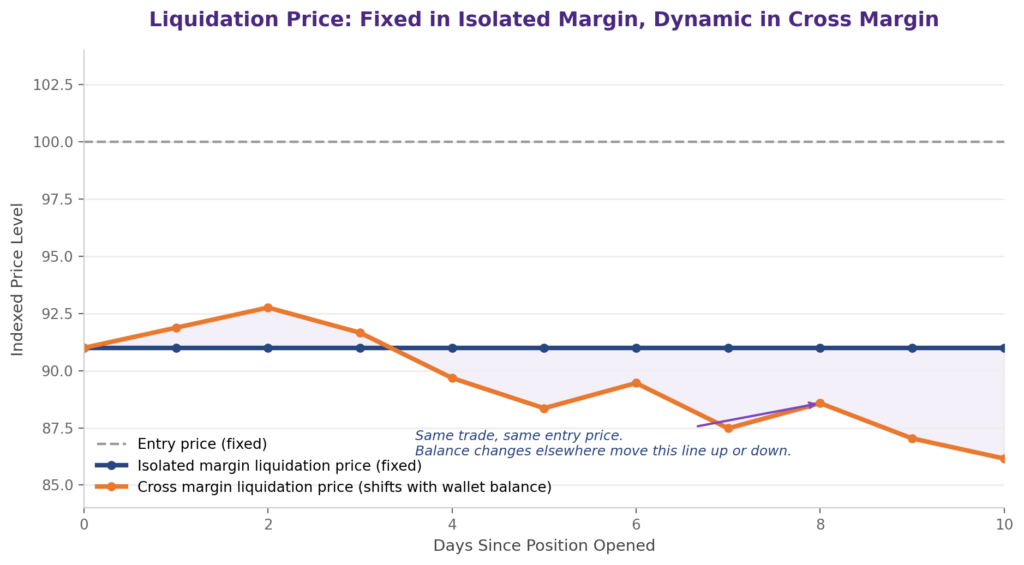
The chart below shows the same idea from a different angle: how a fixed isolated margin liquidation price compares with a cross margin liquidation price that moves as your overall wallet balance changes.
Same entry price, same trade. Under isolated margin, the liquidation price never moves. Under cross margin, it shifts as money elsewhere in the wallet gets added or drawn down.
Rohan gets more breathing room during a normal dip. But the trade can also draw down funds meant for his other positions. That trade-off sits at the center of cross margin.
What Is the Difference Between Cross Margin and Isolated Margin?
The core difference is collateral source: cross margin draws on your full wallet balance, while isolated margin locks in a fixed amount per trade and never touches the rest.
Feature
Cross Margin
Isolated Margin
Collateral source
Full wallet balance
Only the margin you assign
Liquidation price
Shifts as wallet balance changes
Fixed at the moment you open the trade
Maximum loss
Can reach your full wallet balance
Capped at the assigned margin
Margin top-up
Automatic, drawn from available balance
Manual, you add funds yourself
Best suited for
Hedges, correlated trades, swing holds
Beginners, single high-conviction trades
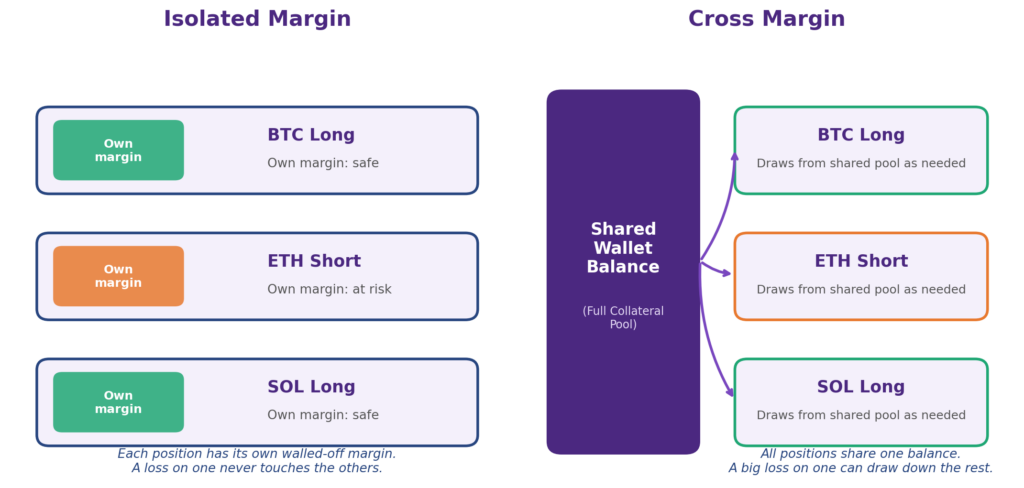
The visual below lays out the same contrast: isolated margin walls off each position’s own pocket of funds, while cross margin lets every position draw from one shared pool.
Isolated margin ring-fences each trade. Cross margin treats your whole wallet as one collateral pool.
Neither mode is universally safer. Isolated margin caps your downside per trade. Cross margin reduces the odds of an early, forced exit on any single position, at the cost of exposing more of your account if the trade keeps losing.
Is Cross Margin Riskier Than Isolated Margin?
Cross margin is riskier at the account level, even though it is often safer at the individual-trade level, because a single losing position can pull from funds meant for everything else in your wallet.
The expanded buffer comes with a matching expansion in risk. Your full wallet backs every trade, so one position moving sharply against you can drain your entire balance before the exchange steps in.
This compounds when you run several positions at once. Crypto markets are often correlated, so a market-wide drop can pressure multiple cross-margin trades together, accelerating the drain on your shared pool. Leverage makes this worse, since even a small adverse move consumes a large share of your available balance at high leverage.
Risk Factor
Isolated Margin
Cross Margin
Loss on a single bad trade
Capped at assigned margin
Can extend to full wallet balance
Effect of correlated positions
Each trade isolated
Losses can compound across positions
Need for active monitoring
Lower, loss is capped
Higher, full account is exposed
Isolated margin keeps risk contained and predictable. Cross margin turns your risk question from “how much can I lose on this trade” into “how much of my total capital am I willing to expose.”
How Is the Liquidation Price Calculated in Cross Margin?
Cross margin liquidation is not based on one trade’s margin alone; it is triggered when your total account equity, wallet balance adjusted for unrealized profit and loss across all positions, falls below the combined maintenance margin required.
In isolated margin, the liquidation price is fixed the moment you open the trade, based only on the margin you assigned to it. In cross margin, the effective liquidation price for any one position depends on your whole account:
Margin Mode
What Sets the Liquidation Trigger
Isolated margin
Fixed price, based only on the margin assigned to that trade
Cross margin
Moves with total wallet balance, other positions’ unrealized PnL, and accumulated funding costs
Two traders holding the identical BTC position, at the same entry price and leverage, can end up with different liquidation prices this way. Exchanges display your live liquidation price on the trade screen; treat that number, not a manual estimate, as the one to trust while trading.
When Should Traders Use Cross Margin in Crypto Futures?
Traders reach for cross margin when the goal is portfolio-level stability rather than capping risk on one trade, typically for hedges, correlated positions, and trades meant to be held through short-term noise.
Is Cross Margin Good for Hedging Positions?
Yes, cross margin can reduce forced liquidations on a hedge because gains on one leg can offset losses on the other in real time. If you hold spot BTC and open a short BTC futures position to protect it, a price drop that hurts your spot holding is offset by a gain on the short.
Under isolated margin, that short position must independently maintain its own margin. A short volatility spike could force a premature liquidation on the hedge, even though the overall position is working as intended. Cross margin lets the shared wallet balance absorb that spike instead.
Should You Use Cross Margin for Multiple Correlated Positions?
Cross margin suits traders running several positions built on one shared market view, since profitable positions can support weaker ones during a temporary pullback. Bitcoin, Ethereum, and Solana, for example, tend to move together in broad market cycles.
Under isolated margin, a sharp but temporary dip could liquidate your weakest or highest-leverage position first, locking in a loss even if your overall view later proves right. Cross margin lets your entire balance absorb that dip instead, as long as total account equity stays above the maintenance requirement.
Is Cross Margin Better for Longer Swing Holds?
Cross margin suits longer holding periods because it absorbs short-term volatility without requiring constant manual margin top-ups. A multi-week directional trade will usually see several intraday swings that look alarming in isolation but do not change the bigger picture.
Under isolated margin, surviving those swings means manually adding funds each time a position nears liquidation. Under cross margin, the broader wallet balance does that work automatically, though it still draws down funds you may want for other trades.
Can Beginners Use Cross Margin Safely?
Beginners can use cross margin, but isolated margin is generally the safer starting point since it caps losses at a known amount and forces a clearer read on risk per trade.
Cross margin asks a harder question: not “how much am I willing to lose on this trade,” but “how much of my total capital am I willing to expose.” A few habits help while you build that judgment:
Start with isolated margin until you can consistently predict your liquidation price and comfortably size positions
Track your total wallet exposure across every open position, not just the one you are watching
Set your own stop-loss even in cross margin; a wider buffer is not a substitute for a risk management strategy, and you can lose more of your balance than expected without one
Avoid stacking high leverage across several correlated trades at once, since a single market-wide move can hit all of them together
Conclusion
Cross margin in crypto futures shares your entire wallet balance as collateral across every open position, buying more room to survive normal price swings at the cost of exposing your full account if a trade keeps losing. Isolated margin trades that flexibility for a hard cap on loss per position. Neither is universally better; the right one depends on whether you are managing one trade or a portfolio of related ones.
Ready to put this into practice? Download the Mudrex app for Android or Apple to trade crypto futures with real-time INR P&L and built-in risk controls, or subscribe to the Mudrex YouTube channel for more beginner-friendly breakdowns of margin and leverage.
Frequently Asked Questions
What is cross margin in crypto futures?
Cross margin is a margin mode where your entire futures wallet balance is shared as collateral across all open positions, instead of a fixed amount per trade.
Can cross margin use my full wallet balance?
Yes. If a position keeps losing, the exchange keeps drawing from your available wallet balance until your total account equity falls below the maintenance margin required.
Does cross margin reduce liquidation risk?
It reduces the chance of any single position being liquidated early, since your full balance backs it. It does not reduce your overall risk of losing money; it shifts where that risk sits.
What happens during liquidation in cross margin?
Liquidation happens only when your total account balance, adjusted for unrealized profit and loss across all positions, drops below the combined maintenance margin required.
Which is safer: cross margin or isolated margin?
It depends on the definition of safer. Isolated margin caps loss per trade and is easier to reason about. Cross margin lowers early liquidation risk on a single position but risks your full balance if the trade continues losing.
Disclaimer: Crypto futures trading involves substantial risk of loss, and leverage magnifies both gains and losses. The figures, names, and worked examples in this article are illustrative only and are not financial advice or a guarantee of any outcome.
Siri is a writer venturing into the exciting realms of blockchain technology, cryptocurrency, and decentralized finance (DeFi), eager to explore the transformative potential of these innovations. She brings a unique perspective that bridges traditional industries and cutting-edge technology, often infused with a touch of humor through memes. She has a rich background in real estate and interior design, having previously contributed to NoBroker, where she crafted blogs and assets on these topics.