How Volatility Impacts Crypto Futures Position: A Beginner’s Guide (2026)
A single sharp candle can wipe out a leveraged crypto futures position in seconds. That is what crypto futures volatility does: it turns a normal price swing into a forced exit before you even get a chance to react.
Most beginners think a stop-loss protects them from this. It often does not. Volatility can push your margin below the maintenance level and trigger liquidation faster than your order can fill.
This guide breaks down exactly how volatility hits your position, your margin, and your liquidation price, and what you can do to stay in control when the market moves fast.
Key Takeaways
Volatility shrinks the price gap between your entry and your liquidation price, especially at high leverage.
Margin erodes faster than most beginners expect once a move goes against an open position.
Liquidation can fire before your stop-loss fills, because the two run on different mechanics.
Funding rates spike during volatile stretches, adding a hidden cost to positions held on either side.
Smaller position sizes and lower leverage are the most reliable defenses against sudden volatility.
What Is Volatility in Crypto Futures Trading?
Volatility in crypto futures trading is how fast and how far a coin’s price moves within a given time. High volatility means big swings in minutes; low volatility means the price barely moves. Crypto futures amplify the effect of that volatility because leverage is layered on top of it.
Definition: Volatility Volatility is a measure of how much a price moves up and down over a set period, regardless of direction.
A 5% move on the spot market barely registers for someone holding coins outright. The same 5% move on a 20x leveraged futures position can wipe out most of the margin behind it. This is the core reason volatility and futures deserve separate treatment: the underlying asset has not changed, but your exposure to its swings has multiplied.
What Are the Key Metrics and Terms to Know?
Before going further, here are the terms this guide leans on. Knowing them makes the rest of the article far easier to follow.
Term
What It Means
Leverage
Borrowed capital that lets you control a bigger position than your own margin alone
Initial Margin
The money you put up to open a leveraged position
Maintenance Margin
The minimum balance needed to keep that position open
Margin Ratio
Your remaining margin as a percentage of what is required to stay open
Liquidation Price
The price level at which the exchange force-closes your position
Mark Price
A smoothed, multi-exchange average price used to decide liquidations, not the last traded price
Funding Rate
A periodic payment between long and short traders that keeps futures prices close to spot
Average True Range (ATR)
A common indicator of how much an asset typically moves over a given period
How Does Crypto Futures Volatility Affect Your Margin?
Crypto futures volatility affects your margin by eating into it every time the price moves against your position, and the faster the move, the faster your margin disappears. Your account does not lose value gradually here. It can lose a large chunk of its buffer in a single sharp candle.
Margin acts as a cushion between your position and liquidation. Every leveraged trade has an initial margin (what you put up) and a maintenance margin (the minimum needed to stay open). Volatility is what pushes your account from one toward the other, fast.
Definition: Margin Erosion Margin erosion is the ongoing reduction of your account’s buffer as an open position moves against you, shrinking the room left before liquidation.
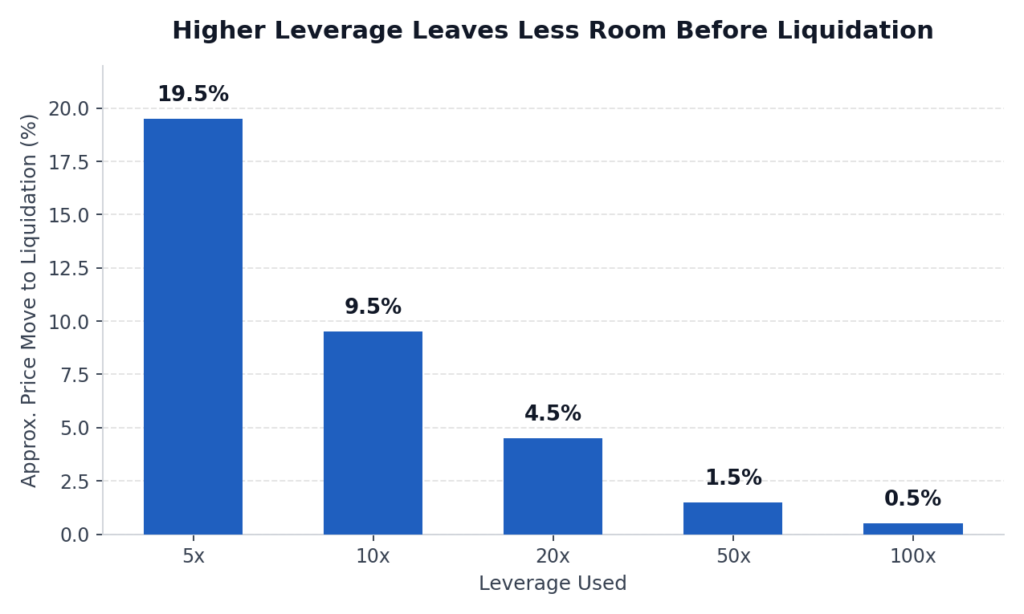
The table below shows how little room is left as leverage climbs, using the standard exchange approximation: distance to liquidation is roughly (1 ÷ leverage) minus the maintenance margin rate, before fees and funding are added in.
Leverage Used
Approx. Price Move to Liquidation*
5x
~19.5%
10x
~9.5%
20x
~4.5%
50x
~1.5%
100x
~0.5%
*Illustrative, using a 0.5% maintenance margin rate and excluding fees and funding. Actual figures vary by exchange and always include fees and funding on top of this base calculation; your exchange’s own liquidation price display, not a manual formula, is the most reliable number to trade against.
Illustrative example only. Actual liquidation price depends on margin mode, fees, and funding
Why Does Leverage Increase Liquidation Risk During Volatile Markets?
Leverage increases liquidation risk during volatile markets because it magnifies every price move, so the same swing that costs a spot trader little can wipe out a leveraged trader’s entire margin. The math is not opinion here. It is a direct result of how liquidation price is calculated.
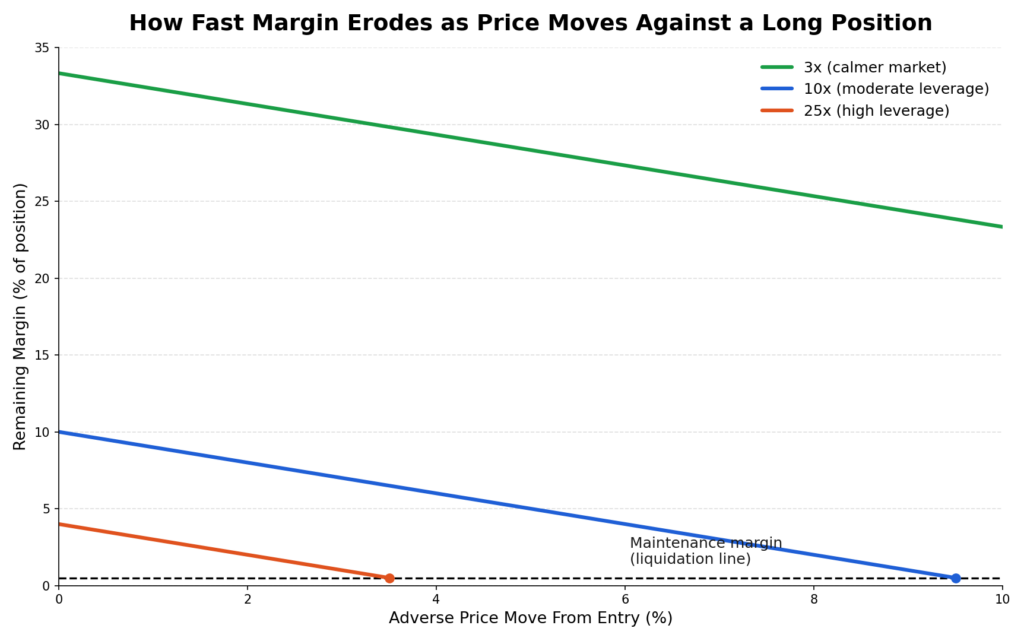
The chart below shows this in a different way: how fast your remaining margin drops as price moves against a long position, at three different leverage levels.
How Volatility Impacts Your Crypto Futures Position: A 2026 Guide
At 3x leverage, a 5% adverse move still leaves a real cushion. At 25x, that same 5% move has already pushed the position close to the maintenance margin line, the point where liquidation kicks in. This is why volatile markets punish high leverage far more than calm ones.
Worked example, using the standard approximation (Liquidation Price ≈ Entry Price × (1 − 1/Leverage + Maintenance Margin Rate) for a long):
Input
Value
Entry price
$65,000
Leverage
20x
Margin
$2,275
Maintenance margin rate
0.5%
Liquidation price
~$62,075
A single 4.5% move against this position, well within range for a volatile day in crypto, closes it entirely. This is simplified for teaching purposes; real exchanges also factor in fees and funding, which push the liquidation price slightly closer to entry.
Can Crypto Futures Volatility Trigger Liquidation Before Your Stop-Loss Fires?
Yes. Crypto futures volatility can trigger liquidation before your stop-loss fires, because a stop-loss is only a request to sell, while liquidation is the exchange’s guarantee that it will close your position no matter what. During fast moves, that gap between “requested” and “guaranteed” is where most surprise liquidations happen.
Four mechanics explain most of these cases:
Mechanic
Why It Beats Your Stop-Loss
Price gapping
Price jumps straight past your trigger level with no trades in between
Slippage
Your order triggers, but fills at a far worse price in a thin order book
Mark Price mismatch
Liquidation runs on Mark Price; your stop-loss may be set against Last Price
Stop-limit failure
A stop-limit order can go unfilled entirely if price moves through it too fast
Each of these is a known, mechanical failure point, not bad luck. We cover the full breakdown, with worked examples for each mechanic, in our guide on why crypto futures positions get liquidated even with stop losses in place. The short version: prefer stop-market orders over stop-limit in fast markets, base your trigger on Mark Price, and leave real distance between your stop-loss and your liquidation price.
How Do Funding Rates Change During High Volatility?
Funding rates rise sharply during high volatility, because more traders crowd into one side of the market, and that imbalance is exactly what funding rates are designed to correct. In calm markets, funding often sits in a narrow, low range. During sharp moves, it can spike several times higher.
Definition: Funding Rate A funding rate is a periodic payment (commonly every 8 hours) exchanged between long and short traders, used to keep a perpetual futures price close to the spot price.
The formula is simple: Funding Fee = Position Size × Funding Rate. Leverage does not change the formula, but it does change your effective position size, which is what actually gets charged.
Scenario
Position Size
Funding Rate
Fee per 8-Hour Interval
Calm market, no leverage
$8,000
0.01%
$0.80
Calm market, 10x leverage
$80,000
0.01%
$8.00
Volatile market, 10x leverage
$80,000
0.30%
$240.00
The third row is the one that catches beginners off guard. Funding is usually charged every 8 hours, so across a full day (three intervals), that same 10x position can go from paying about $24 a day in a calm market to $720 a day in a volatile one, purely because the funding rate jumped, not because the price moved. For the full mechanics and how to track this across exchanges, see our guide on how crypto funding rates work.
Can a Volatile Crypto Futures Market Trigger a Liquidation Cascade?
Yes, a volatile crypto futures market can trigger a liquidation cascade, where one forced sale pushes price into the next trader’s liquidation zone, and the chain reaction repeats until the leverage clears out. This is the mechanism behind crypto’s fastest, sharpest crashes.
The largest example on record is the October 10, 2025 event, where a tariff announcement triggered gradual selling for hours before the market fell through a wall of liquidation levels in just 40 minutes.
Even traders who never use high leverage can get caught in a cascade, since the forced selling widens spreads and can move price straight through a stop-loss. Our full breakdown of how liquidation cascades form and how to spot one building covers the warning signs, including open interest spikes and crowded positioning.
How Can You Manage a Crypto Futures Position During High Volatility?
You manage a crypto futures position during high volatility by lowering leverage, sizing your position around your stop-loss distance, and watching your margin ratio directly instead of trusting a stop-loss alone. None of this removes risk completely, but it puts the odds back in your favor.
Lower your leverage when volatility rises. A setup that was fine at 10x in a calm market may need 3x to 5x in a volatile one.
Size your position around your stop-loss distance, not the other way around. Decide your risk per trade first, then let position size follow.
Use isolated margin so a single bad trade cannot drain your full account balance.
Base your stop-loss on Mark Price, not Last Price, so it lines up with what liquidation actually uses.
Keep real distance between your stop-loss and your liquidation price so slippage has room to work without ending your position.
Crypto futures volatility is not random background noise. It is the direct force behind margin erosion, liquidation risk, funding rate spikes, and cascades, and every one of those mechanics is predictable once you know what drives it. Lower leverage, tighter position sizing, and a Mark-Price-based stop-loss are still the most reliable ways to trade through it.
If you want to check your live margin ratio and liquidation price before opening your next position, download the Mudrex app on Android or Apple. For walkthroughs on safer leverage and risk management, visit the Mudrex YouTube channel.
FAQs
What is volatility in crypto futures trading?
Volatility is how fast and far a coin’s price moves in a given period. In futures, leverage magnifies the effect of that movement on your margin.
Why does volatility increase liquidation risk?
Volatility increases liquidation risk because sharp price moves eat into your margin faster, pushing your account toward the maintenance margin level sooner, especially at higher leverage.
Can volatility trigger liquidation before my stop-loss fires?
Yes. Liquidation runs on Mark Price and forces a close regardless of pending orders, while your stop-loss can fail to fill due to slippage, gaps, or a mismatched price index.
What is the best leverage during high volatility?
There is no single “best” leverage, but lower leverage (roughly 1x to 5x) gives more room for price swings and is generally safer during volatile stretches.
Should beginners trade futures during volatile markets?
Beginners can, but should use lower leverage, smaller position sizes, and a Mark-Price-based stop-loss, since volatile markets leave less room to recover from mistakes.
How can I reduce risk in volatile crypto futures markets?
Reduce risk by lowering leverage, using isolated margin, sizing positions around your stop-loss distance, and keeping distance between your stop-loss and liquidation price.
What is a volatility-adjusted stop-loss?
A volatility-adjusted stop-loss sets its distance based on how much an asset typically moves (using a tool like ATR), rather than a fixed percentage, so it fits current market conditions.
Disclaimer: Crypto futures trading carries a high risk of loss, and leverage magnifies both gains and losses. The numbers, prices, and worked examples in this article are simplified and illustrative, meant to explain mechanics, not financial advice or a guarantee of outcomes. Always assess your own risk tolerance and consult a qualified financial advisor before trading crypto futures.
Siri is a writer venturing into the exciting realms of blockchain technology, cryptocurrency, and decentralized finance (DeFi), eager to explore the transformative potential of these innovations. She brings a unique perspective that bridges traditional industries and cutting-edge technology, often infused with a touch of humor through memes. She has a rich background in real estate and interior design, having previously contributed to NoBroker, where she crafted blogs and assets on these topics.