Quick answer: Oracle (NASDAQ: ORCL) is the market’s loudest “AI backlog vs. balance sheet” debate. As of September 24, 2026, ORCL trades near $140, down about 57% from its high, even as revenue grew 30% and its cloud backlog hit a staggering $664 billion. Wall Street’s average target sits far above the stock at $238 to $255, but the market is discounting heavily until the cash shows up. The whole debate: is this the cheapest AI compounder around, or a company that has promised more than it can deliver?
Timeframe
Likely Range
Move from ~$140
Today (Sep 2026)
$140
—
12-month target
$238–$255
+70% to +82%
End of 2026
$114–$165
−19% to +18%
2027
$165–$280
+18% to +100%
2030 (bull case)
$300–$400+
+114% to +186%
Key Takeaways
If you own Oracle stock, you probably have one question: after a brutal 57% drop despite booming fundamentals, is this a bargain or a warning? This Oracle stock price prediction walks you through the numbers, the bull case, the bear case, and the risks so you can make up your own mind.
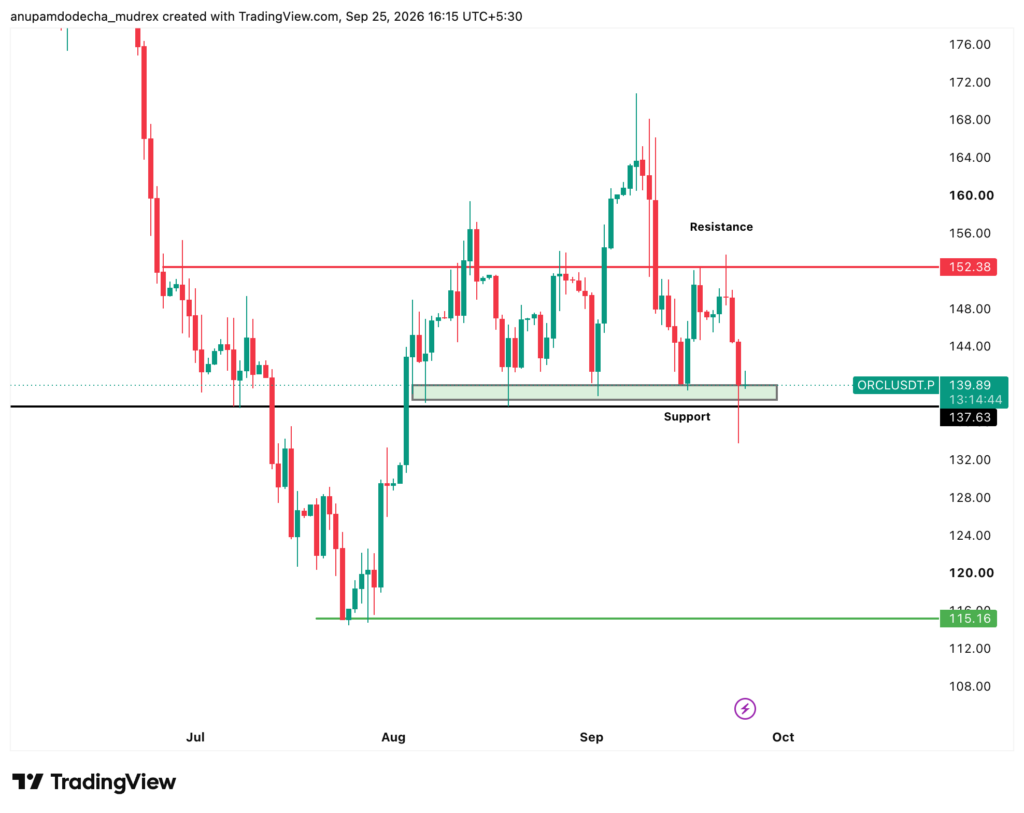
Oracle Price Chart
Where Oracle Stock Stands Right Now
Before any Oracle stock price prediction can seem meaningful, let’s look at where things stand today.
Oracle (ORCL) closed at $139.54 on September 24, 2026, down 3.47% on the day. The company is now worth about $422 billion. Here’s the striking part: the stock is down roughly 50% over the past year and about 57% from its high of $322.54, even though its business is growing faster than ever.
Metric
Value
Price (Sep 24, 2026)
$139.54
Market cap
~$422 billion
52-week range
$114.50 – $322.54
P/E ratio (trailing)
22x
Forward P/E
16–18x
Dividend yield
1.4% ($2.00/yr)
Next earnings
~Dec 8, 2026
Quick snapshot
The big talking point for any ORCL stock prediction is the disconnect. Fundamentals exploded while the share price collapsed. Oracle’s cloud backlog (remaining performance obligations, or RPO) hit $664 billion, yet quarterly revenue is only about $19 billion. This is where the debate really comes in: either the backlog is real and Oracle is one of the cheapest growth stories in the market, or investors are right to question whether Oracle can actually deliver on it and fund all that spending.
Oracle’s Latest Earnings: The Numbers Behind the Forecast
Every Oracle stock forecast starts with the most recent earnings. On September 10, 2026, Oracle reported Q1 FY2027 results. It beat on almost everything, and the stock fell anyway.
Metric
Result
Change
Revenue
$19.3 billion
+30%
Non-GAAP EPS
$1.92
+30% (beat estimates)
Total cloud revenue
$11.6 billion
+62%
OCI (cloud infrastructure)
$7.4 billion
+121%
RPO (backlog)
$664 billion
+$209 billion YoY
Free cash flow
−$5.4 billion
Negative
Capex
~$28.5 billion
Very high
Q1 FY2027
The story here is booming growth funded by enormous spending. Oracle’s cloud infrastructure (OCI) grew an eye-popping 121%, and multi-cloud database revenue grew 353%. The company booked over $30 billion of new AI cloud contracts in a single quarter.
But the market focused on the cost. Free cash flow was negative $5.4 billion because capex hit $28.5 billion, and Oracle sold $20 billion of new stock to help fund the buildout. That dilution, plus questions about delivering the $664 billion backlog, overrode the strong headline numbers.
Oracle raised its FY2027 revenue guidance to at least $90 billion, roughly 34% growth, while planning around $40 billion of new funding through debt and equity to pay for its AI data-center expansion.
Here’s how fast Oracle’s cloud segments are growing:
Q1 FY2027
The growth is undeniable, especially in cloud infrastructure. The question every Oracle stock price prediction has to answer is whether that growth is worth the massive spending and dilution required to fund it.
Oracle Stock Price Prediction 2026
So where could ORCL finish the year? Here’s a simple Oracle stock price prediction 2026, broken into three scenarios.
The stock stays choppy and range-bound below its key moving averages as the market waits for proof. Reasons: ORCL trades below every major moving average (its 50-day near $142, 200-day near $164), with RSI around 42 and a negative MACD. Immediate support sits at $133 to $136. Until Oracle reclaims $149, this looks like a downtrend with a value bid, so a choppy range in the $130s to high $140s fits the current setup unless December earnings change the story.
Bull case ($149–$165)
This is the first real sign of a recovery. Reclaiming $149 and then $160 to $165 would signal the downtrend is breaking. Reasons: If Oracle’s December quarter converts more of the $664 billion backlog into revenue, keeps OCI growth triple-digit, holds net capex at or below $70 billion, and shows free cash flow improving, confidence could return. The Street’s average target sits far higher at $238 to $255, so even a partial repair of sentiment could lift the stock toward its overhead resistance near $165.
Bear case ($114–$128)
A slide toward the 52-week low at $114 if the concerns deepen. Reasons: Another equity sale (dilution), a higher capex guide, backlog growth without matching infrastructure revenue, or any sign that its largest customer is renegotiating could all pressure the stock. Losing support at $133 opens the door to $128, then $114. A break below $114 would fully reset the AI-driven re-rating of 2025 to 2026.
For 2026, the technical trend is bearish while the analyst view is very bullish. That tension makes the range unusually wide, and December earnings are the key catalyst.
The trend points sharply upward over time if the story plays out, but notice how wide the range gets, and how the near-term low sits below today’s price. That’s the uncertainty of a high-spending AI infrastructure bet in action.
Latest Analyst Price Targets for ORCL
Here’s what makes Oracle unusual: Wall Street is strongly bullish while the stock keeps falling. The consensus rating is Buy / Moderate Buy, and targets sit far above the current price.
The average 12-month target is around $238 to $255, roughly 70% to 80% above today’s price. Here are some notable targets:
Firm
Price Target
Rating
Guggenheim / Mizuho
$400
Street high
Wells Fargo
$280
Buy
Barclays
$252
Buy
Consensus (avg)
$238–$255
Buy
Redburn
$110
Sell (Street low)
Consensus Rating
The bullish view rests on the enormous backlog, triple-digit OCI growth, and the cheap forward multiple after the crash. The bearish view focuses on negative free cash flow, heavy dilution, single-customer concentration, and the huge lease commitments. The gap between the $238+ average target and the $140 stock price shows just how much the market distrusts the story right now.
Bull Case vs Bear Case: The Honest View
Every good Oracle stock forecast weighs both sides. Here’s the fair version.
The Bull Case (Why ORCL Could Recover)
Massive backlog. $664 billion in RPO gives huge revenue visibility.
Explosive cloud growth. OCI up 121%, total cloud up 62%.
Cheap after the crash. Only ~17x forward earnings post-drawdown.
Big analyst upside. Average target 70%+ above the stock.
Prepay structure. Customer prepayments help fund the buildout.
The Bear Case (Why ORCL Could Fall Further)
Negative free cash flow. FCF was −$5.4 billion last quarter.
Heavy dilution. $20 billion of new stock sold in one quarter.
Customer concentration. One giant tenant is a large part of the backlog.
Hidden leverage. ~$288 billion of future lease commitments looming.
Broken chart. Price is below every major moving average.
Is Oracle Stock Overvalued or Undervalued?
This is the question behind every Oracle stock price prediction, so let’s tackle it head-on.
After a 57% crash, Oracle no longer looks expensive on traditional metrics. At about 17x its FY2027 earnings guidance, it trades in line with or below many software and cloud peers, despite growing revenue 30% and cloud infrastructure over 120%. For value-minded investors, that’s the appeal.
But the low multiple reflects real risks: negative free cash flow, big dilution, huge lease commitments, and reliance on one massive customer. So the honest answer is: undervalued if the backlog converts and cash flow turns positive, expensive if the buildout disappoints or dilution continues. The market is demanding proof before it pays up.
A qualified financial advisor should help make the final call for your situation.
The Bottom Line
Here’s the simple version of this Oracle stock price prediction. Wall Street is very bullish, with an average target of $238 to $255, implying 70%+ upside, but the stock has crashed 57% as investors worry about spending, dilution, and delivery. Oracle’s business is booming, with a $664 billion backlog and 121% cloud infrastructure growth.
But free cash flow is negative, the company keeps raising money, and much of the backlog rests on one giant customer. The upside is real, and so is the risk of further declines. If you believe Oracle can convert its backlog and turn cash-flow positive, the post-crash price looks like an opportunity. If you doubt the delivery, the falling chart is a warning. The next big checkpoint is the December earnings report.
Disclaimer: This article is for educational purposes only and is not investment advice. Prices are volatile and can fall as well as rise. Do your own research and consult a qualified financial advisor before investing. Invest only what you can afford to lose.
FAQs
What is the Oracle stock price prediction for 2026?
Most analysts expect Oracle stock to stay volatile through 2026, with a base case of $130 to $149. The bull case reaches $149 to $165 if the downtrend breaks and backlog conversion improves, while the bear case sees $114 to $128 if dilution and spending fears deepen. Wall Street’s average 12-month target is much higher, around $238 to $255.
What is the latest analyst price target for ORCL?
The average 12-month analyst target is around $238 to $255, roughly 70% to 80% above the current price near $140, with a consensus rating of Buy. Targets range widely, from $110 on the low end (Redburn) to $400 on the high end (Guggenheim, Mizuho).
Is Oracle stock a good investment for Indian traders?
It depends on your risk appetite. Oracle has explosive cloud growth and a massive backlog, but also negative free cash flow, heavy dilution, and customer-concentration risk. It’s a high-volatility AI infrastructure bet, not a steady compounder right now. It’s not investment advice, so do your own research first.
What could make ORCL stock rise?
Converting more of the $664 billion backlog into revenue, keeping OCI growth triple-digit, holding net capex under control, turning free cash flow positive, proving it has more than one mega-customer, and insider buying could all push Oracle stock higher.
What are the biggest risks for Oracle stock?
The main risks are negative free cash flow, ongoing stock dilution to fund spending, reliance on one giant customer for much of the backlog, roughly $288 billion of future lease commitments, and a broken technical chart trading below all major moving averages.
Can Oracle stock reach a new all-time high?
It’s a long way off. Oracle’s all-time high is $322.54, and the stock trades near $140 after a 57% drop. Reaching a new high would require years of strong backlog conversion, positive free cash flow, and restored market confidence. Analysts see the mid-$200s as a more realistic medium-term target.
Anupam has over 3 years of experience in the crypto industry, having worked with top indian crypto exchanges. He writes about Bitcoin, altcoins, AI, and emerging tech, helping readers understand what’s driving markets and where the digital asset ecosystem is headed.