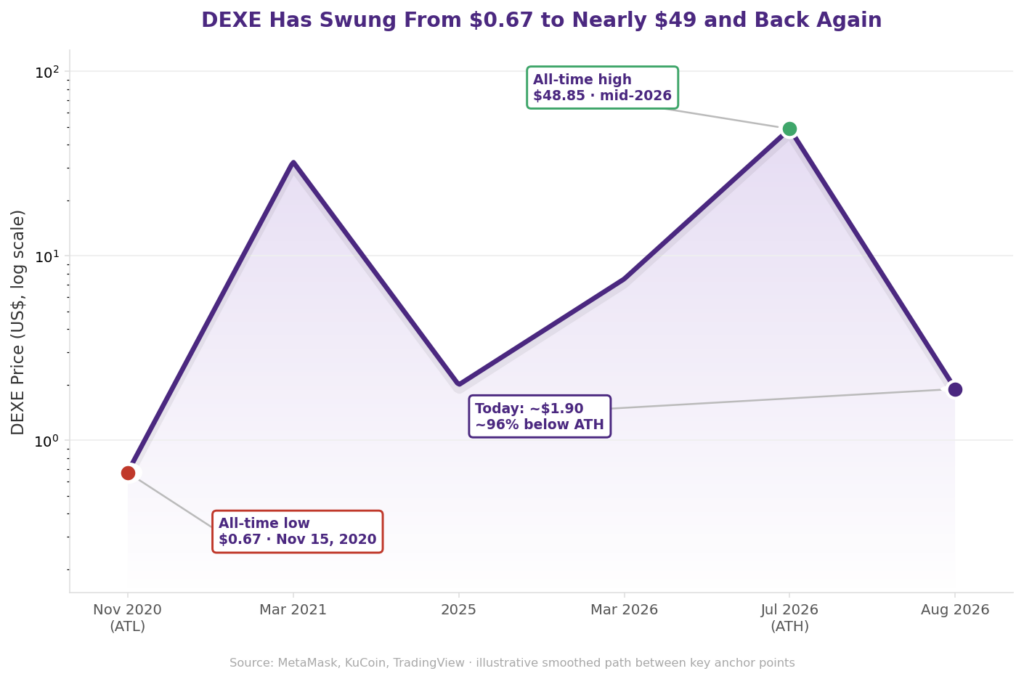
DEXE coin has had one of the wildest price charts in crypto this year, swinging from under $2 to nearly $49 and back to under $2 again within months, and that volatility often overshadows what DeXe actually builds. Strip away the price action and DeXe Protocol is genuinely useful infrastructure: a no-code toolkit for launching and running DAOs, plus a separate decentralized social trading platform where users can copy strategies from other traders without ever handing over their private keys. Here’s what DEXE coin is, how the protocol actually works, and what to know before using or holding DEXE.
TL;DR
DeXe is a decentralized governance and social trading protocol, and DEXE is its native token, first traded in September 2020.
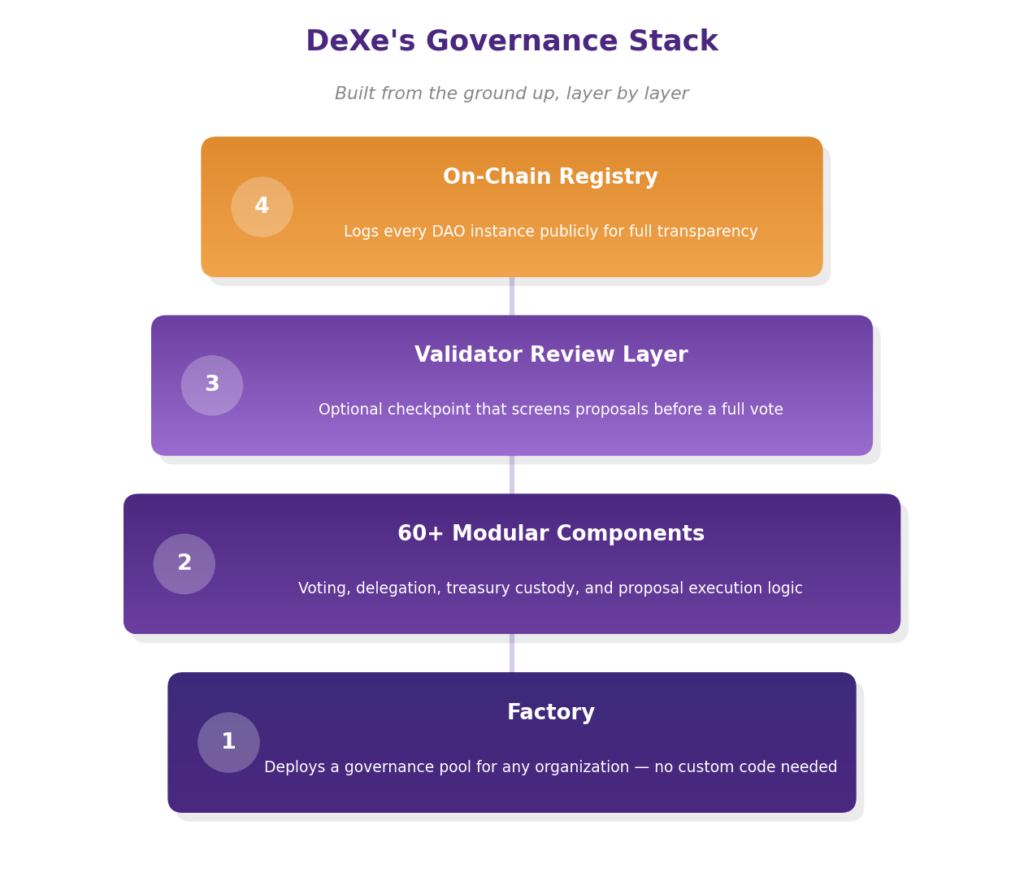
DeXe Protocol works as a “DAO factory”: it deploys individual governance pools for organizations, using over 60 modular smart contract components to handle voting, delegation, treasury management, and proposal execution, all without custom coding.
DEXE token holders can vote in DeXe DAO, stake across five lock-up tiers, and use DEXE to insure against trading losses on the platform’s social trading feature.
DEXE is extremely volatile and highly concentrated: a small number of wallets hold a majority of supply, which has directly triggered sharp crashes when large holders moved funds to exchanges.
What Is DeXe Coin?
DeXe (DEXE) is the native token of DeXe Protocol, a decentralized infrastructure platform that provides no-code tools for creating and governing DAOs, alongside a separate decentralized social trading feature.
DeXe Protocol has traded on exchanges since September 28, 2020.
It functions as a “DAO constructor”: organizations can launch a fully functional DAO without writing custom smart contracts.
A second, distinct product line offers decentralized social trading, letting users copy strategies from other traders.
DEXE is used for governance voting, staking, fee mechanics, and insurance within the ecosystem.
Definition: DAO (Decentralized Autonomous Organization) A blockchain-based organization that uses smart contracts and token-based voting to make collective decisions, without a traditional centralized management structure.
How Does DeXe Work?
DeXe works as a modular “factory” system: instead of building a DAO from scratch, an organization deploys its own governance pool through DeXe Protocol’s smart contract factory, then customizes it using more than 60 pre-built components.
What Is DeXe (DEXE) Coin? How DeXe Actually Works
Definition: Governance Pool An individual, self-contained DAO instance deployed through DeXe Protocol’s factory system, configured with its own voting rules, membership, and treasury, independent of every other DAO on the network.
Each governance pool handles its own proposal creation, voting rules, delegation of voting power, treasury custody, and automatic execution of passed proposals. A registry tracks every DAO instance created through the protocol, keeping the entire system auditable on-chain. DeXe also includes an optional validator review layer, an added checkpoint some DAOs use to screen proposals before they go to a full vote, which the project itself positions as a differentiator against governance tools like Snapshot, Aragon, or OpenZeppelin’s Governor framework.
What Are DeXe’s Main Use Cases?
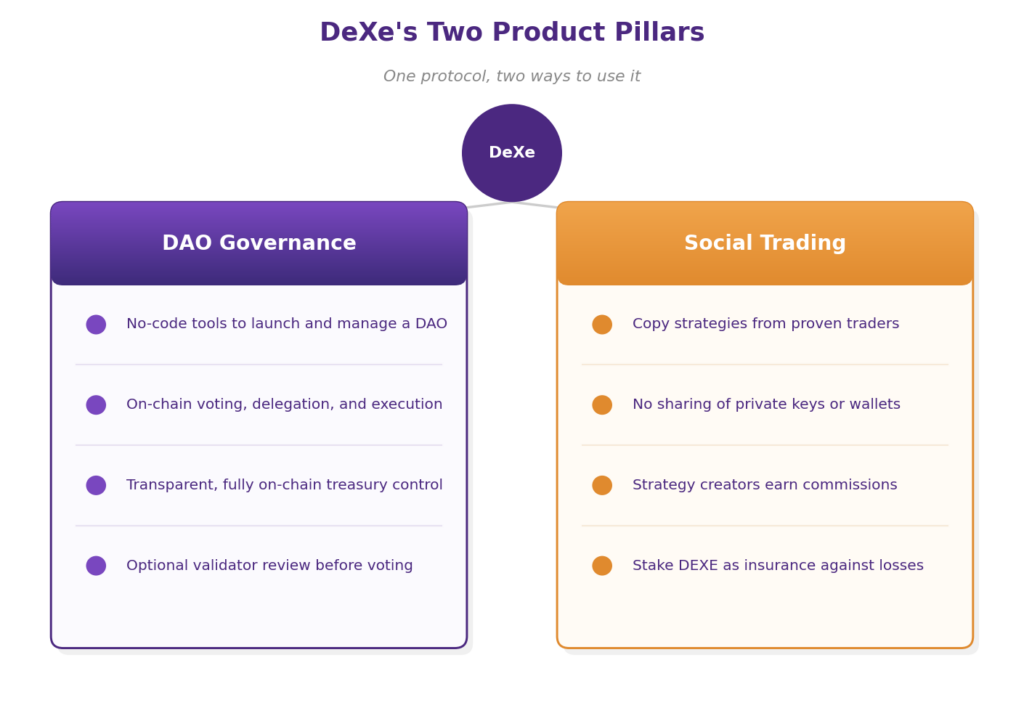
DeXe serves two genuinely distinct use cases: infrastructure for building and running DAOs, and a decentralized social trading platform where users can follow other traders’ strategies without giving up custody of their funds.
What Is DeXe (DEXE) Coin? How DeXe Actually Works
On the governance side, DeXe is used by organizations that want transparent, on-chain decision-making without building custom infrastructure, covering everything from token launches to treasury management to coordination between multiple DAOs. On the trading side, DeXe operates a decentralized copy-trading system: users can subscribe to strategies run by other traders, with the underlying trades executed on-chain rather than through a custodial intermediary, meaning followers never hand over private keys or direct wallet access. Strategy creators earn commissions from subscribers, and DEXE holders can optionally stake up to 10% of their funds as insurance against losses on copied trades.
What Blockchain Does DEXE Use?
DEXE exists on two blockchains simultaneously: as an ERC-20 token on Ethereum and as a BEP-20 token on BNB Chain, giving holders flexibility in where they hold and transact the token.
Following a 2025 treasury consolidation, roughly 60% of total DEXE supply resides on Ethereum, where DeXe Protocol’s DAO treasury and organizational assets were formally moved into the protocol’s own smart contracts. The project has also indicated planned expansion to additional networks including Solana, Polygon, and Arbitrum. Multi-chain availability broadens accessibility, but it also means checking the correct contract address and network before sending or receiving DEXE, since assets sent to the wrong chain can’t easily be recovered.
What Is DEXE Token Used For?
DEXE functions as a governance token, a staking asset, and an insurance mechanism, with each role tied directly to actual usage of the DeXe platform rather than existing purely as a speculative instrument.
Governance voting: DEXE holders vote on proposals within DeXe DAO itself, in addition to any individual DAO built on the protocol.
Staking: DEXE can be staked across five lock-up tiers (1, 3, 6, 12, and 24 months), with pools available on both Ethereum and BNB Chain; staked tokens retain voting power.
Insurance: traders and followers on the social trading platform can stake DEXE (up to 10% of funds) to hedge against potential losses.
Fee capture: DEXE is tied to protocol fee mechanics, linking token value to real platform usage rather than issuance alone.
DeXe Tokenomics Explained
DeXe’s tokenomics have shifted meaningfully during 2026: circulating supply grew from roughly 46.75 million tokens in the first half of the year to approximately 83.7 million by August 2026, out of a total/max supply of roughly 96.5 million DEXE.
What Is DeXe (DEXE) Coin? How DeXe Actually Works
Metric
Value
All-time high
~$48.85 (mid-2026)
All-time low
$0.67 (Nov 15, 2020)
Total / max supply
~96.5 million DEXE
Circulating supply (Aug 2026)
~83.7 million DEXE
Circulating supply (early-mid 2026)
~46.75 million DEXE
That near-doubling of circulating supply within a matter of months is a significant structural detail: a large amount of previously locked or unaccounted-for DEXE entered active circulation during 2026, independent of price movement, and is worth understanding before treating any older supply figures as current.
Who Created DeXe?
DeXe Protocol is developed by DeXe DAO, an organization commonly associated with Kyiv, Ukraine, though public sourcing on the founding team and exact founding date is inconsistent, with some records citing formal incorporation as recent as 2023 despite the DEXE token having traded since 2020.
Rather than a single named founder being widely publicized, DeXe positions itself as a community- and DAO-governed project, with protocol direction determined through on-chain proposals and voting by DEXE holders rather than a traditional corporate structure.
What Makes DEXE Different From Other Cryptocurrencies?
DeXe’s main differentiator is combining two distinct products, no-code DAO governance infrastructure and decentralized social trading, under a single token, rather than specializing in only one.
Within the governance tooling space specifically, DeXe competes with established players like Snapshot, Aragon, and OpenZeppelin’s Governor framework, and points to its optional validator review layer as a meaningful point of difference, adding a structured review step before proposals reach a full vote. Few competing governance protocols also offer an integrated social trading feature with a built-in insurance mechanism, making DeXe’s combined scope unusual even if each individual feature has direct competitors of its own.
What Are the Risks of Using or Investing in DeXe?
Extreme wallet concentration: DEXE’s holder base is highly concentrated, and large wallet movements have directly triggered sharp price crashes in the past.
High volatility: DEXE has swung from under $2 to nearly $49 and back within a single year, among the most volatile price patterns of any actively traded token.
Thin liquidity relative to derivatives activity: futures trading volume on DEXE regularly runs several times higher than spot volume, amplifying price swings.
Multi-chain complexity: holding DEXE across two active blockchains adds operational risk around contract addresses and bridging.
Competitive governance tooling market: DeXe competes directly with several established, well-funded alternatives in the DAO infrastructure space.
How to Buy and Store DEXE in India
DEXE is available on regulated Indian crypto platforms that support INR deposits, including Mudrex, where you can buy DeXe starting from as little as ₹100 via UPI or bank transfer.
Given DEXE’s demonstrated volatility and the risks tied to its concentrated holder base, treating any position as high-risk and sizing it accordingly is worth doing regardless of which platform you use. Our analysis of DEXE’s liquidation map covers the additional risks specific to trading DEXE with leverage, and our recent look at August 2026’s most volatile cryptocurrencies explains exactly what triggered DEXE’s sharpest recent crash.
Conclusion
What is DeXe coin and how does it work? Underneath a genuinely chaotic price chart sits real, functioning infrastructure: a no-code DAO governance toolkit used by real organizations, and a decentralized social trading platform with a built-in insurance mechanism. DEXE the token ties governance rights, staking, and insurance together across two blockchains. But that legitimate product doesn’t cancel out DEXE’s extreme volatility and concentrated ownership, both of which have already caused real, sharp price crashes. Understanding what DeXe actually does is useful context, not a reason to treat the token itself as any less risky.
DeXe is a decentralized protocol offering no-code DAO governance infrastructure and a separate social trading platform; DEXE is its native token, traded since September 2020.
How does DeXe work?
DeXe deploys individual “governance pools” through a smart contract factory, using over 60 modular components to handle voting, delegation, treasury management, and proposal execution.
What is DEXE used for?
DEXE is used for governance voting, staking across five lock-up tiers, and as an optional insurance mechanism for users of DeXe’s social trading platform.
Who created DeXe?
DeXe Protocol is developed by DeXe DAO, commonly associated with Kyiv, Ukraine; the project is governed on-chain by DEXE holders rather than a single publicized founder.
What blockchain does DEXE use?
DEXE exists on two chains: as an ERC-20 token on Ethereum and a BEP-20 token on BNB Chain, with roughly 60% of the supply on Ethereum following a 2025 treasury consolidation.
How many DEXE tokens are in circulation?
Circulating supply was around 83.7 million DEXE as of August 2026, out of a total/max supply of roughly 96.5 million, up sharply from about 46.75 million earlier in the year.
Is DeXe secure?
DeXe’s smart contract architecture and validator review layer are designed for transparency, but the token itself carries real risk from extreme wallet concentration and high volatility, which have already caused sharp price crashes.
Risk Disclaimer
Cryptocurrency investments carry a high risk of loss and are highly volatile, and DEXE specifically has shown some of the most extreme price swings of any actively traded token. Any use of leverage or futures magnifies both potential gains and potential losses. The figures, comparisons, and scenarios in this article are illustrative and for educational purposes only; they are not financial advice or a guarantee of future performance. Please consult a qualified financial advisor before making any investment decisions.
Siri is a writer venturing into the exciting realms of blockchain technology, cryptocurrency, and decentralized finance (DeFi), eager to explore the transformative potential of these innovations. She brings a unique perspective that bridges traditional industries and cutting-edge technology, often infused with a touch of humor through memes. She has a rich background in real estate and interior design, having previously contributed to NoBroker, where she crafted blogs and assets on these topics.