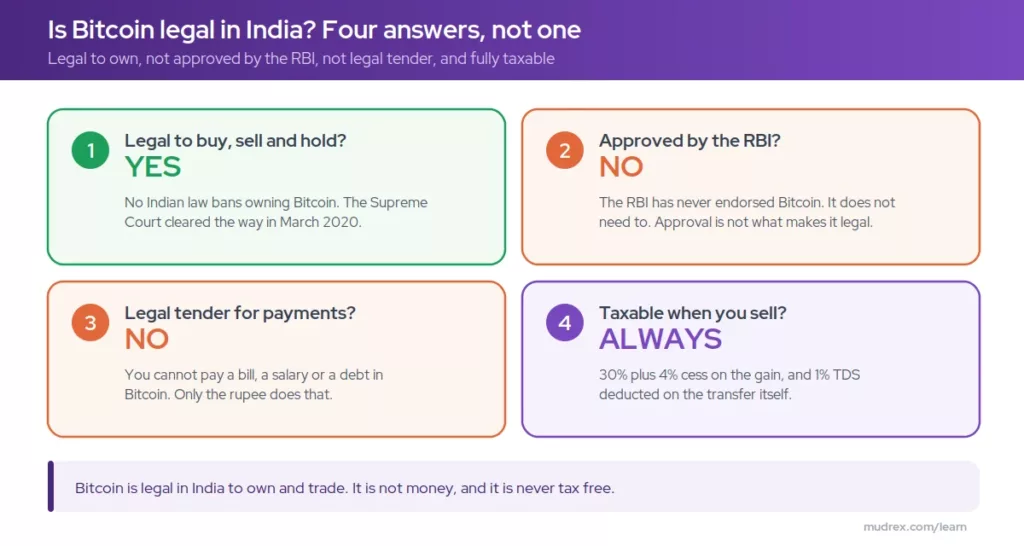
Is Bitcoin legal in India? Yes—you can generally buy, sell, hold and trade Bitcoin (BTC) in India. It falls within India’s Virtual Digital Asset (VDA) framework for tax and certain compliance purposes.Bitcoin-related activity is subject to rules that already apply to virtual digital assets (VDAs), taxation, tax deducted at source (TDS), anti-money-laundering checks, banking, foreign exchange, fraud and cybersecurity. In short: Bitcoin is not banned, but it is neither official money nor risk-free.
However, It is neither issued nor approved by the Reserve Bank of India (RBI), nor does it carry sovereign backing or bank-deposit protection. Therefore, BTC is not legal tender, meaning that no merchant or creditor is legally required to accept it as payment

Quick answer: Indians can buy, sell, hold and trade Bitcoin (BTC), provided they comply with applicable tax, KYC/AML, banking and other laws.
| Question | Short answer |
|---|---|
| Can Indians buy, sell or hold Bitcoin? | Generally, yes—there is no blanket central-law ban. |
| Is Bitcoin legal tender in India? | No. |
| Is Bitcoin issued or approved by the RBI? | No. |
| Is Bitcoin taxed in India? | Yes. VDA tax and TDS rules can apply. |
| Are crypto platforms subject to compliance rules? | Relevant VDA service providers must comply with PMLA/FIU-IND obligations. |
| Is Bitcoin risk-free or government guaranteed? | No. |
This guide explains the position in plain language. For the status of crypto assets more broadly, read Mudrex’s guide to crypto legal status in India.
Yes, Indians can generally buy, sell, hold and trade Bitcoin in 2026. It is considered as VDA under IT Act and it is subject to 30% tax on profit.
Bitcoin transactions remain subject to existing laws and compliance requirements. VDA transfers may attract tax and TDS, while covered service providers must follow applicable PMLA and FIU-IND obligations. Banks may also apply KYC, AML, fraud-prevention and risk checks. Depending on the transaction, laws concerning contracts, consumer protection, cybercrime, proceeds of crime and foreign exchange may also apply.
This distinction matters. Taxing an asset or requiring service providers to report activity does not convert that asset into legal tender or government-approved money.
The legality usually depends on both the activity and the facts surrounding it.
| Activity | General position in India | Important qualification |
|---|---|---|
| Buy Bitcoin with INR | Generally permitted | Use your own KYC-verified account and a provider that meets applicable compliance requirements. |
| Hold Bitcoin | Generally permitted | Secure your account or private keys and keep acquisition records. |
| Sell Bitcoin for INR | Generally permitted | Tax and TDS can apply; use a KYC-linked bank account. |
| Trade Bitcoin | No blanket ban | Every disposal, including some swaps, can have tax consequences. |
| Keep Bitcoin in a personal wallet | No blanket ban | You are responsible for key security and records; platform terms and cross-border facts may matter. |
| Mine Bitcoin | No blanket central-law ban specifically on mining | Electricity, equipment, business, local and tax rules can apply. |
| Transfer Bitcoin to another person | Fact-dependent | Tax, gift, PMLA, fraud, FEMA and other rules may apply. |
| Pay a willing merchant in Bitcoin | Not the same as legal-tender payment | No one is compelled to accept it; the transfer may create tax, GST, accounting or contractual consequences. |
| Use Bitcoin for fraud, laundering or tax evasion | Illegal | Bitcoin does not exempt conduct from generally applicable criminal or financial laws. |
Yes, Indians can generally buy and hold Bitcoin because no blanket central-law prohibition applies. Buying Bitcoin is not itself a taxable transfer, although the way it was received—such as a gift, reward or business receipt—can have separate tax consequences. Use a provider that meets the compliance requirements applicable to its activity, complete KYC with accurate information and pay from an account in your own name.
Holding Bitcoin in an exchange account or a personal wallet is also not subject to a blanket ban. In either case, keep acquisition and wallet records so that you can establish ownership and cost when you later sell, swap or spend it.
Also Read: What is Bitcoin wallet Address
Yes it is legal to trade in Bitcoin through FIU – IND registered exchanges. The important complication is that each disposal can have a tax consequence. Selling BTC for INR, swapping BTC for another crypto asset and using BTC to obtain goods or services can all amount to transfers. Active traders should reconcile every order, wallet movement, INR value and TDS entry rather than relying only on a closing portfolio value.
This permission does not protect fraudulent, deceptive or manipulative conduct. Platform rules, banking controls and generally applicable criminal and financial laws continue to apply.
Curious to know How many Bitcoins are there in the world? Read the detailed guide.
Yes, usually. Bitcoin is divisible into 100 million smaller units called satoshis, so a buyer does not need to purchase one whole BTC. A ₹1,000 order buys a fraction based on the current market price and the platform’s spread or fees.
Minimum order and deposit limits can change by platform and payment method. Check the current amount shown in the app before adding funds; do not rely on an old article or screenshot for the minimum.
Before placing an order, you can check the live Bitcoin price in INR on the dedicated price page.
| Feature | Bitcoin | Digital Rupee (e₹) |
|---|---|---|
| Issuer | No central issuer | Reserve Bank of India |
| Legal tender in India | No | Yes |
| Sovereign liability | No | Yes—RBI liability, like sovereign currency |
| Value | Market-determined and volatile | Denominated at par with the Indian rupee |
| Supply system | Protocol-based | Issued and managed by the RBI |
| Main legal character | VDA/crypto-asset for relevant tax and compliance purposes | Central bank digital currency |
The RBI describes the Digital Rupee as sovereign currency and legal tender. Read the RBI’s CBDC concept note for the official distinction.
No. Bitcoin is not legal tender in India, and the RBI does not issue, approve or guarantee it. RBI warnings have consistently distinguished private virtual currencies from sovereign currency and highlighted financial, operational, legal and security risks.
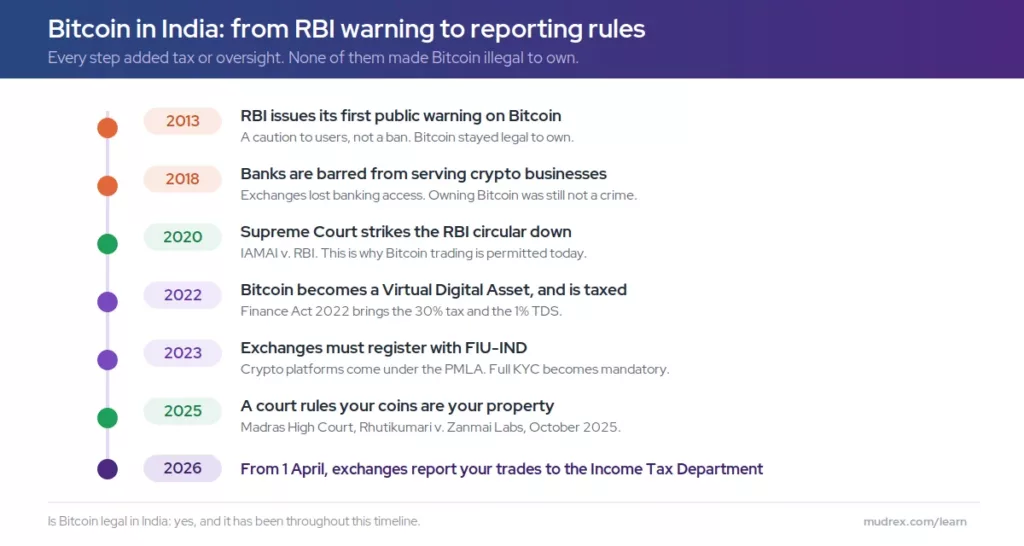
The Supreme Court’s 2020 decision did not make Bitcoin RBI-approved. It set aside an RBI circular from 2018 that had restricted RBI-regulated entities from providing banking services to businesses or people dealing in virtual currencies. In May 2021, the RBI confirmed that the 2018 circular was no longer valid, while also stating that banks could continue customer due diligence under KYC, AML, PMLA and FEMA rules. See the RBI’s 31 May 2021 clarification.
That means a Bitcoin transaction is not automatically prohibited, but a bank can still examine, delay, reject or report a transaction under applicable risk and compliance controls.
Want to know the bitcoin price in 2009 to 2026? Read the price history guide
For Indian income-tax purposes, Bitcoin falls within the definition of a virtual digital asset, and the current Income-tax Act also defines a crypto-asset within that framework. This classification enables specific tax, withholding and reporting rules to apply.
VDA classification makes it a legal category used for specified statutory purposes.
The exact treatment of a particular arrangement can depend on the transaction, the parties and whether the activity is personal, business-related or cross-border.
In Rhutikumari v. Zanmai Labs Pvt. Ltd. & Others, a 2025 Madras High Court order concerning crypto assets held through a platform treated cryptocurrency as property capable of being owned, enjoyed and held in trust. The decision is relevant to private-law questions such as custody and beneficial ownership.
It should not be stretched beyond its context. A High Court property ruling does not make Bitcoin legal tender, amount to RBI approval or create a complete national regulatory code. See the official Madras High Court order.
India’s Bitcoin framework is spread across several laws and regulators rather than one standalone “Bitcoin Act.” The main areas are banking oversight, anti-money-laundering obligations, tax and cross-border rules.
The RBI oversees banks and payment systems; it does not license or approve Bitcoin itself. After the 2020 Supreme Court decision, banks cannot rely on the invalidated 2018 circular as a reason by itself to deny services. They can, however, apply ordinary KYC, AML, fraud, source-of-funds, sanctions and FEMA checks.
Use a bank account in your own name, make sure the transaction description is accurate and retain platform statements and payment records. These steps cannot guarantee that a bank will never review a transaction, but they make legitimate activity easier to explain.
Since March 2023, specified VDA service activities have been brought within India’s anti-money-laundering framework. Covered providers—whether based onshore or serving Indian users from offshore—must register with the Financial Intelligence Unit–India as reporting entities when the activity falls within the rules. They must perform prescribed customer due diligence, keep records and report specified or suspicious transactions.
For a user, this is why a compliant platform asks for PAN, identity, bank and other KYC information. FIU-IND registration is a compliance requirement; it is not a government guarantee of a platform, a licence for Bitcoin, or protection against market loss. The FIU-IND download hub carries the current VDA guidelines and registration circulars. The Government’s PIB explanation of VDA service-provider obligations provides additional official context.
To evaluate a provider, read what makes a crypto exchange compliant in India.
The Income-tax Act, 2025 came into force on 1 April 2026, and section 509 now contains a transaction-reporting framework for prescribed crypto-asset reporting entities. Rules 241–244 set out which crypto-asset service providers are covered, the due-diligence process and the information to be reported.
The scope needs careful wording. Under rule 241, a “reportable person” is principally an individual or entity resident outside India for tax purposes. The section 509 framework should therefore not be described as proof that every domestic Indian user’s trade is automatically reported under that provision. It is, however, a clear move towards more structured cross-border crypto-asset information reporting.
For affected users and providers, reportable data can include fiat acquisitions and disposals, crypto-to-crypto exchanges, specified retail-payment transactions and transfers. The practical lesson is to keep complete residence, account, trade and wallet records. See the Income Tax Department’s official section 509 and rules 241–244.
Sending Bitcoin to or receiving it from a person outside India can raise questions under the Foreign Exchange Management Act, remittance rules, tax, sanctions and AML requirements. The legal analysis can differ depending on the counterparties, purpose, location, source of funds and whether a business is involved.
Do not assume that an on-chain transaction sits outside Indian law. Obtain professional advice before a material cross-border transfer or business arrangement.
| Year | Development | What it means |
|---|---|---|
| 2013 | RBI issued its first public caution on virtual currencies | Users were warned about operational, financial, legal and security risks. |
| 2017 | RBI repeated that it had not licensed or authorised Bitcoin schemes | Bitcoin was not RBI-approved currency. |
| 2018 | RBI restricted regulated entities from providing services related to virtual currencies | This was a banking restriction, not a statute criminalising ownership of Bitcoin. |
| 2020 | The Supreme Court set the 2018 RBI circular aside | The banking restriction could no longer operate, but the judgment did not make Bitcoin legal tender. |
| 2021 | RBI told banks not to cite the invalidated 2018 circular | Banks could continue KYC, AML, PMLA and FEMA due diligence. |
| 2022 | Parliament introduced a specific tax framework for VDAs | Transfer income became subject to a 30% rate and a 1% TDS framework, subject to the statute. |
| 2023 | Specified VDA service providers were brought under PMLA reporting obligations | Covered businesses became subject to FIU-IND registration, KYC, recordkeeping and reporting duties. |
| 2025–2026 | FIU-IND updated its VDA AML/CFT and registration guidance | Providers serving Indian users must follow the current activity-based compliance framework. |
| 2026 | The Income-tax Act, 2025 came into force, with Finance Act 2026 amendments | Current VDA tax, TDS and crypto-asset reporting provisions should be read in the new Act for tax year 2026–27 onwards. |
Bitcoin is taxed as a VDA under India’s income-tax framework. Paying tax on an asset does not make it legal tender or government approved; it means taxable transactions fall within specified rules.
Under the Income-tax Act, 2025 as amended by the Finance Act 2026, income from transferring a VDA is taxed at 30%. Surcharge, where applicable, and health and education cess are additional.
When calculating that transfer income:
For periods governed by the earlier Income-tax Act, 1961, these principles were commonly referenced through section 115BBH. The numbering changed under the new Act, so articles that cite only the older provision should be read with care.
A 1% TDS generally applies to consideration paid for the transfer of a VDA. It is a withholding/credit mechanism, not an additional 1% final tax on top of the ultimate liability.
Under section 393(4), Table 12 of the current Act, no deduction is required where aggregate consideration does not exceed:
Who must deduct, how an exchange facilitates TDS and which threshold applies can depend on the parties and transaction. Check the platform’s tax statement and obtain professional advice where necessary.
Suppose a person buys Bitcoin for ₹1,00,000 and later sells it for ₹1,50,000.
| Item | Illustrative amount |
|---|---|
| Sale consideration | ₹1,50,000 |
| Less: cost of acquisition | ₹1,00,000 |
| VDA transfer income | ₹50,000 |
| Tax at 30% | ₹15,000 |
| Health and education cess at 4% | ₹600 |
| Illustrative tax before TDS credit | ₹15,600 |
| 1% TDS on ₹1,50,000, if applicable | ₹1,500 credit |
| Illustrative balance after TDS credit | ₹14,100 |
This simplified example assumes no surcharge, prior TDS credit, other adjustments or special facts. TDS applies to consideration, while the 30% rate applies to transfer income; they are not calculated on the same base.
| Event | Possible Indian tax treatment |
|---|---|
| Sell Bitcoin for INR | A transfer that can produce taxable VDA income; TDS may apply. |
| Swap Bitcoin for another crypto asset | Can be a disposal/transfer even when no INR is received. |
| Spend Bitcoin on goods or services | Can amount to a transfer and may also create GST/accounting questions for the parties. |
| Receive Bitcoin as a gift | The recipient may have tax consequences unless an exemption applies; donor facts can also matter. |
| Move Bitcoin between wallets you beneficially own | Usually does not by itself change beneficial ownership, but retain evidence that both wallets are yours. |
| Merely hold Bitcoin while its price changes | Unrealised appreciation is generally not transfer income, although acquisition or receipt facts can differ. |
Keep trade confirmations, wallet addresses, timestamps, INR values, bank records, TDS certificates/statements and evidence of cost. For a broader explanation, see Mudrex’s crypto tax guide for India and the official Income-tax Act, 2025 as amended by Finance Act 2026.
No central law specifically imposes a blanket ban on Bitcoin mining in India as of 2 September 2026. That does not make every mining setup automatically compliant.
A miner may need to consider:
Tax treatment can depend on whether the activity is occasional, organised as a business, provided as a service or part of another arrangement. Maintain equipment, power, wallet and disposal records and seek professional advice for a commercial operation.
There is no separate blanket central prohibition that makes every peer-to-peer (P2P) Bitcoin trade illegal. P2P trades do, however, carry greater fraud, identity and banking risk because the buyer and seller deal directly.
Reduce avoidable risk by:
A legitimate user can still encounter a review or temporary freeze if funds are linked to a fraud chain. Clear records do not prevent every review, but they help establish the source and purpose of funds.
Yes—Bitcoin can be sold for INR and the proceeds withdrawn to a KYC-linked bank account. In everyday search language, this is usually what “convert Bitcoin to cash” means.
A compliant cash-out process is straightforward:
An informal exchange for physical currency is different. Physical cash is not automatically a separate Bitcoin offence in every circumstance, but an off-platform deal can create serious evidence, tax, fraud, source-of-funds and anti-money-laundering problems. It also gives a victim much less recourse if the counterparty uses counterfeit notes, stolen funds or a false identity.
Do not use an unrelated person’s bank account, split payments to hide the transaction or accept funds from a third party who is not the buyer. For platform steps, read how to sell Bitcoin in India.
Bitcoin is not legal tender, so a merchant, employee or creditor cannot be compelled to accept it as money. Two willing parties may agree to transfer Bitcoin in a private arrangement, but that does not give the payment the legal status of the rupee.
Using Bitcoin to buy goods or services can also be a transfer of a VDA for tax purposes. The parties may need to consider fair INR valuation, invoicing, GST, accounting, TDS, consumer law and contractual terms. Cross-border payments can raise additional FEMA and remittance questions.
For routine consumer payments, do not assume that paying in Bitcoin is legally or financially equivalent to paying in INR.
No. Legality does not make Bitcoin safe, and neither FIU-IND registration nor a security certification can remove market or counterparty risk.
| Risk | What it means | Practical control |
|---|---|---|
| Price volatility | Bitcoin can lose a substantial part of its value quickly | Use a position size you can afford to lose; avoid return assumptions |
| Phishing and scams | Fake apps, support accounts and links can steal credentials | Verify domains, never share OTPs or recovery phrases, enable 2FA |
| Custody risk | A platform failure or a lost private key can block access | Understand platform custody; secure backups if self-custodying |
| P2P and banking risk | Fraud-linked funds can lead to a review or freeze | Avoid third-party payments and retain complete counterparty records |
| Regulatory and tax risk | Rules, reporting duties and tax treatment can change | Use official sources and recheck before material transactions |
| Liquidity and execution risk | The final price can differ from the quoted market price | Review spread, depth, fees and withdrawal terms before confirming |
No bank-deposit insurance protects a Bitcoin balance, and no authority guarantees its price. Security controls reduce avoidable operational risk; they do not prevent investment loss.
Use this practical checklist:
For step-by-step platform instructions, see how to buy Bitcoin in India and how to sell Bitcoin in India.
Bitcoin itself is not subject to a blanket ownership ban, but illegal conduct does not become lawful merely because it uses Bitcoin. Examples include:
The applicable offence and penalty depend on the facts and the law breached. Avoid universal penalty claims without a case-specific legal assessment.
Merely holding Bitcoin is not a criminal offence under a blanket central prohibition, so ordinary ownership does not by itself create criminal liability. Buying or selling Bitcoin through a compliant process also does not automatically expose a person to arrest.
Criminal consequences can arise from the conduct surrounding the asset—for example, cheating, theft, hacking, laundering proceeds of crime, financing prohibited activity, using mule accounts or deliberately evading tax. The relevant offence, evidence and penalty depend on the facts; there is no universal “Bitcoin penalty.”
An account review, tax notice or temporary bank restriction is not the same as a criminal conviction. If funds are frozen or an authority contacts you, preserve every order, bank entry, message and transaction hash and obtain qualified legal advice rather than attempting to move or conceal the funds.
Mudrex gives Indian users an INR-accessible way to buy and sell Bitcoin while completing the KYC and transaction records required for platform use.
FIU-IND registration and security certifications are compliance and control signals; they do not mean that Bitcoin is government approved, eliminate market or custody risk, or guarantee returns. Verify current features, fees and limits on the platform before transacting.
Bitcoin is not subject to a blanket ban in India as of 2 September 2026, so Indians can generally buy, sell, hold and trade it. But that is only half the answer: Bitcoin is not legal tender, is not approved or guaranteed by the RBI, and remains subject to VDA tax, TDS, KYC/AML, banking, foreign-exchange and general criminal and commercial laws.
Use a compliant platform, transact through accounts in your own name, secure your assets, maintain complete records and obtain professional advice for material, business or cross-border activity. Most importantly, do not confuse legal access with safety or guaranteed returns—Bitcoin remains a high-risk asset.
Disclaimer: The information in this article is educational and reflects sources reviewed on 2 September 2026. It is not legal, tax, financial or investment advice. Laws, regulatory positions, platform features and tax treatment can change, and their application depends on individual facts.
No blanket central-law ban on buying, holding or selling Bitcoin applies as of 2 September 2026. Tax, TDS, KYC/AML, banking, fraud, FEMA and other laws can still apply to the activity.
Unrealised appreciation while you simply hold Bitcoin is generally not income from a transfer. Selling, swapping or spending it can create taxable VDA income, while gifts, rewards, mining and business receipts can have different consequences.
There is no blanket central prohibition on keeping Bitcoin in a self-custody wallet. You are responsible for securing the recovery phrase and maintaining evidence of ownership, acquisition cost and transfers. See Mudrex’s guide to Bitcoin wallets in India.
A bank can apply KYC, AML, fraud and risk controls and may review, reject, delay or freeze a suspicious or fraud-linked payment. Use an account in your own name, avoid third-party transfers and keep complete records. Seek legal help if an account is restricted.
No one can state that with certainty. Policy proposals, speeches and media reports do not change the law until the relevant measure is enacted and notified. Check RBI, FIU-IND, tax-department and Gazette sources for current rules.
No. FIU-IND registration means a covered reporting entity has compliance obligations under the anti-money-laundering framework. It is not an endorsement of Bitcoin, a guarantee that an exchange cannot fail or protection against market losses.