You place a market order to close a Bitcoin futures position. You expect a fill near $65,000. You get filled at $64,700 instead. Nothing went wrong with your trade idea; you just traded in a thin market.
This is what liquidity in crypto futures controls. It sets your entry price, your exit price, and how much you lose to slippage on every trade. That loss grows fast once you add leverage. If you trade futures often, learn this before your next trade, not after a bad one.
Key Takeaways
Liquidity means how easily you can buy or sell a futures contract without moving its price.
Order book depth and the bid-ask spread are the fastest ways to check liquidity before you trade.
Low liquidity widens spreads, raises slippage, and can push funding rates off track in perpetual futures.
Trading volume and open interest help you gauge liquidity, but neither one tells the whole story alone.
Bitcoin and Ethereum futures usually have the deepest markets. Smaller altcoin futures carry more execution risk.
Is Liquidity the Same as Trading Volume in Crypto Futures?
No. Liquidity and trading volume measure two different things, and mixing them up is a common mistake. Trading volume counts how many contracts changed hands over a set time, like the last 24 hours. Liquidity counts how many orders sit on the book right now, ready to fill your trade.
A market can show high volume from one hour of panic selling, then thin out again by the time you place your order. Deep, steady liquidity protects your execution price. A volume spike from six hours ago does not.
Key Terms and Metrics to Know
Term
What It Means
Order book
The live list of buy (bid) and sell (ask) orders waiting to be matched on an exchange.
Order matching engine
The exchange system that pairs a buy order with a matching sell order.
Market depth
The total size of buy and sell orders sitting near the current price.
Bid-ask spread
The gap between the highest price a buyer offers and the lowest price a seller accepts.
Slippage
The difference between the price you expect and the price you actually get.
Trading volume
The total value traded over a set time, usually 24 hours.
Open interest
The total number of futures contracts still open and not yet closed.
Market makers / liquidity providers
Traders or firms that place both buy and sell orders to keep a market liquid.
Funding rate
A regular payment between long and short traders in perpetual futures. It keeps the contract price close to the spot price.
VWAP
Volume-Weighted Average Price. A benchmark that shows whether your trade filled at a fair price.
Order book imbalance
The ratio of buy orders to sell orders near the top of the book. It hints at short-term price pressure.
What Is Liquidity in Crypto Futures Trading?
Definition: Liquidity Liquidity is how easily you can open or close a futures position near the price you see on screen. Your own order should not move that price.
A liquid market fills your order fast, at a price close to the last trade. A thin market fills your order at several prices, one after another, before it’s done. Traders call this “walking the book.”
This matters even more in futures than in spot trading. Futures positions often use leverage, so a small slippage cost hits your margin harder. That’s why liquidity in crypto futures needs closer attention than liquidity in crypto trading on the spot side alone.
How Does the Order Book Reveal Liquidity in Crypto Futures?
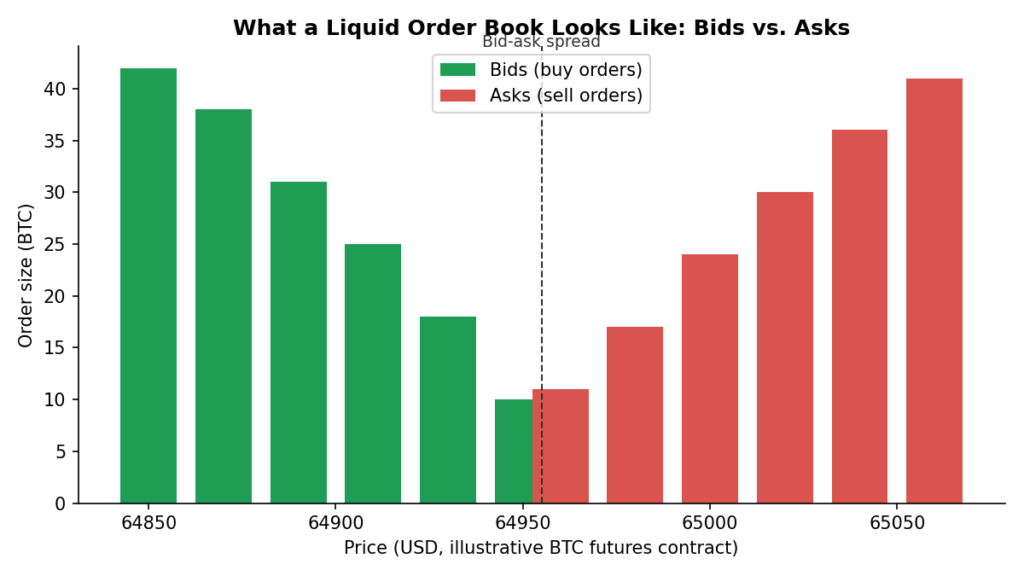
The order book shows liquidity in real time. It lists every buy and sell order waiting near the current price.
A visual breakdown of a liquid order book. The green bars represent buy orders (bids), while the red bars represent sell orders (asks). The gap between the two sides represents the bid-ask spread, a key indicator of market liquidity.
What to look for: a liquid market shows thick, matching bars of bids and asks, with only a small gap between them. Thin, patchy bars close to the price mean your order could slip through several price levels before it fills.
Definition: Market Depth Market depth is the size of buy and sell orders sitting near the current price. Exchanges often show it as a depth chart.
Why Does Liquidity Matter in Crypto Futures Trading?
Liquidity controls your execution quality: how close your fill price lands to the price you wanted, and how much extra cost you pay by accident. Low liquidity means worse prices, slower fills, and choppier charts.
Slippage risk. A thin book fills your market order across several prices instead of one.
Execution speed. Deep liquidity fills you almost right away. Thin liquidity can leave part of your order unfilled.
Price stability. Liquid markets absorb large orders without big price swings. Thin markets spike or crash on much smaller trades.
Funding rate swings. In perpetual futures, thin liquidity can push the contract price away from spot. That throws off the funding rate.
How Do You Measure Liquidity in Crypto Futures?
You measure liquidity by combining a few numbers, not just one.
Metric
What It Tells You
Sign of Healthy Liquidity
Bid-ask spread
Cost of entering and exiting right away
Stays tight, even during volatility
Order book depth
How much size sits near the current price
Thick, layered orders within 0.1 to 0.5% of price
24-hour trading volume
General market interest and activity
High and steady, not a one-off spike
Open interest
Total capital tied up in open positions
Steady or growing, not stacked on one side
Slippage on test orders
Real-world execution cost
Small gap between expected and filled price
VWAP deviation
Whether your fill beat or lagged the average price
Fills land close to VWAP over the session
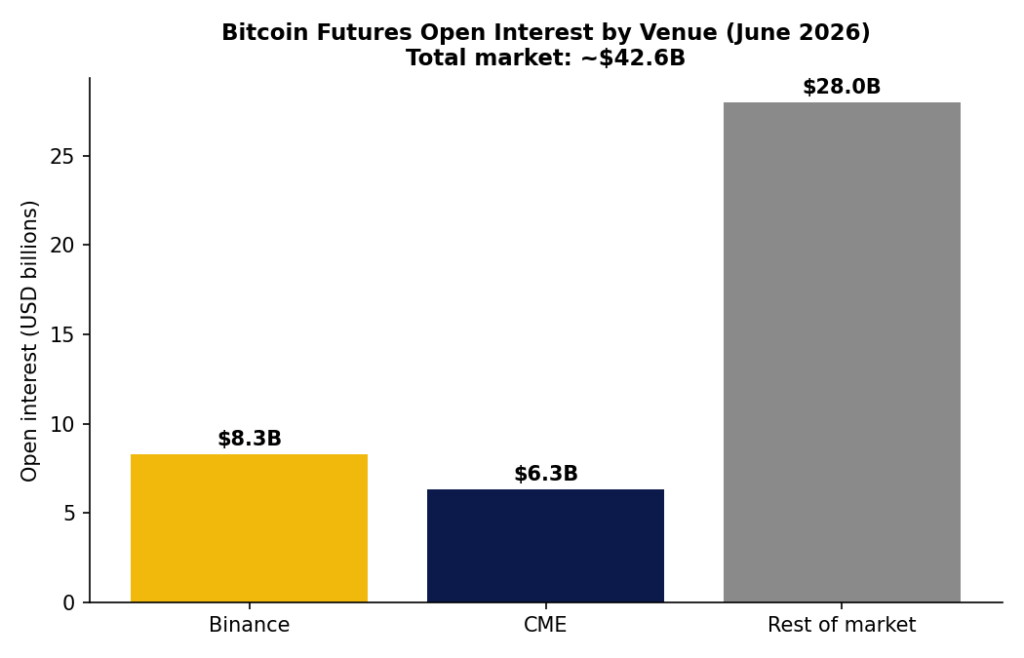
Bitcoin futures show this well. Open interest across major exchanges reached about $42.6 billion in June 2026. Binance and CME alone made up close to $14.6 billion of that total, based on CoinGlass and CoinDesk data. That much open interest is a key reason traders treat BTC futures as a liquidity benchmark.
What Is Liquidity in Crypto Futures Markets?
What to look for: open interest spread across several large exchanges, not stacked on one thin venue, signals a market that can absorb big trades without one order moving the price.
What Causes Low Liquidity in Crypto Futures Markets?
Low liquidity usually comes from four things, and they often feed each other.
Small market cap or new listing. Fewer traders means fewer orders sitting on the book.
Few exchange listings. A contract on one or two exchanges gets less order flow than one listed everywhere.
Off-peak trading hours. Even Bitcoin futures thin out during quiet hours, even though crypto trades 24/7.
Sudden volatility. Market makers often widen spreads or pull orders during sharp moves. This is when a liquidity crisis hits hardest.
High Liquidity vs Low Liquidity Crypto: What’s the Real Difference?
The clearest way to see the difference is to compare the same trade in each market.
Factor
High Liquidity Market
Low Liquidity Market
Bid-ask spread
Narrow (fractions of a percent)
Wide, can jump further in volatility
Order book depth
Thick, several layers of size
Thin, gaps between price levels
Slippage on a market order
Small
Large, especially on big size
Price impact of a large trade
Small
Large, can move price several percent
Typical examples
BTC and ETH futures on major exchanges
New or low-volume altcoin futures
Worked example: say you place a market order for 5 BTC futures contracts. The best ask sits at $65,000.
Scenario
Fill Price Range
Average Fill Price
Slippage
Deep liquidity
$65,000 to $65,010
$65,004
0.006%
Thin liquidity
$65,000 to $65,300
$65,140
0.22%
That $700 gap on a 5-contract order is the real cost of thin liquidity. It grows with bigger size and more leverage.
How Does Liquidity Work in Perpetual Futures?
In perpetual futures, liquidity also controls the funding rate. Perpetual contracts never expire, so exchanges use funding payments between long and short traders to keep the contract price close to spot.
Deep liquidity lets arbitrage traders close any gap between the perpetual price and spot fast. That keeps funding rates small and steady. Thin liquidity lets that gap stay open longer, so funding rates swing higher or deeply negative. This adds a cost or gain that has nothing to do with your trade idea. If you trade perpetual futures often, check depth and spread before you enter. It matters as much as checking the funding rate.
How Can You Trade Safely When Liquidity Is Low?
You can’t force a thin market to turn liquid, but you can change how you trade in one.
Check the depth chart first. Make sure enough size sits near your entry price before you place a large order.
Use limit orders on thin pairs. A limit order caps your fill price. A market order does not.
Know your stop order type. A stop-market order always triggers and fills, but it can fill at a much worse price in a fast, thin market. A stop-limit order caps your fill price, but it can fail to fill at all if price jumps past your limit. Thin liquidity is one of the reasons a position can still get liquidated even with a stop-loss set. See why crypto futures get liquidated despite a stop-loss for the other causes, like price gaps and Mark Price mismatches.
Split large orders. Breaking a big position into smaller pieces cuts the price impact on thin books.
Favor high open-interest contracts. Trading crypto futures on BTC or ETH carries less execution risk than trading obscure altcoin futures.
The Bottom Line on Liquidity in Crypto Futures
Liquidity in crypto futures is not a background detail. It sets your entry price, your exit price, and how much of a leveraged trade survives contact with the real market. Before you size a position, check the order book, the spread, and the open interest, not just the chart.
The Mudrex app helps you track order books and open interest next to your trades. Download it on Android or Apple, and subscribe to the Mudrex YouTube channel for regular videos on crypto derivatives and market structure.
Frequently Asked Questions
What is liquidity in crypto?
Liquidity in crypto means how easily you can buy or sell an asset near its current price without moving that price much. Higher liquidity usually means tighter spreads and faster, fairer trades.
Why is liquidity important in futures trading?
It controls your slippage, your fill speed, and how stable prices stay when you enter or exit a leveraged trade. Low liquidity can turn a good trade idea into a costly one.
How do you measure liquidity?
Combine order book depth, the bid-ask spread, 24-hour trading volume, and open interest, rather than relying on one number. Testing a small order and checking the slippage also gives you a real-world read.
What causes low liquidity in crypto?
Small market cap, few exchange listings, off-peak hours, and sudden volatility are the main causes. These factors often feed each other during sharp market moves.
How does liquidity affect prices?
In liquid markets, prices move smoothly and reflect real supply and demand. In thin markets, even a medium-sized order can cause a big price swing, called price impact.
Which cryptocurrencies have the highest liquidity?
Bitcoin and Ethereum usually have the deepest order books and the highest futures open interest across major exchanges. Liquidity tends to drop as you move down the market cap list.
What happens when liquidity dries up in crypto?
Spreads widen, slippage rises, and price swings get sharper on smaller orders, a state often called a liquidity crisis. This is when the gap between the price you expect and the price you get is widest.
Disclaimer: Crypto futures trading carries a real risk of loss, and leverage makes both gains and losses bigger. The prices, spreads, and slippage numbers in this article are examples only, not live market data or a promise of your results, and nothing here is financial advice. Talk to a qualified financial advisor before you trade futures or use leverage.
Siri is a writer venturing into the exciting realms of blockchain technology, cryptocurrency, and decentralized finance (DeFi), eager to explore the transformative potential of these innovations. She brings a unique perspective that bridges traditional industries and cutting-edge technology, often infused with a touch of humor through memes. She has a rich background in real estate and interior design, having previously contributed to NoBroker, where she crafted blogs and assets on these topics.