If you have searched “what is Nexus Protocol” after seeing the NEXUS token on an exchange, here is the direct answer: it is a small, deflationary token on Solana, and it trades with very thin liquidity. That means price swings can be sharp, and you could lose a large part of your money fast. Before you buy or sell NEXUS token in India, you need to know exactly what backs it, who runs it, and what the real risks are. This guide breaks down Nexus Protocol’s tokenomics, its safety profile, and the exact steps to buy and sell NEXUS, so you can make an informed call, not a rushed one.
Key Takeaways
What is Nexus Protocol: A Solana-based, deflationary utility token (ticker: NEXUS) with a fixed 21 million supply, reduced to 16 million after a genesis burn.
Tokenomics: 57.2% is reserved for public emission, 19% for marketing and ecosystem growth, and 23.8% (5 million NEXUS) was burned at launch.
Safety flags to check: the project’s lead is credited under a pseudonym, its “transparency score” is self-assigned rather than independently audited, and its total on-chain liquidity is thin (roughly $4,500 to $14,000 at last check).
Positives on record: mint and freeze authorities are reported revoked on-chain, and its liquidity pool is reported as locked, both of which reduce (but don’t eliminate) certain manipulation risks.
How to buy/sell: You can buy or sell NEXUS token in India directly with INR and UPI on a compliant platform like Mudrex, without needing a separate Solana wallet.
Is NEXUS a good investment: Treat it as a high-risk, small-position, “only what you can afford to lose” asset, not a core holding. This is not financial advice.
What Is Nexus Protocol, and What Role Does the NEXUS Token Play?
Nexus Protocol is a decentralized token project built on the Solana blockchain. Its native asset, the NEXUS token, is designed as a deflationary utility token, meaning its total supply is meant to shrink over time rather than grow. The project positions NEXUS as a store-of-value style asset within its own small ecosystem, supported by a public treasury, a “transparency center,” and community campaigns.
Unlike large, well-established coins, Nexus Protocol is a young, small-cap project. There is no independent, third-party audit confirming its claims. Everything you read about it, including on its own website, should be treated as a starting point for your own research (DYOR), not as a settled fact.
Definition: SPL token An SPL token is any digital token built using Solana’s own token standard, the same framework Solana uses for most of its native and third-party assets. NEXUS is issued as an SPL token.
Definition: Deflationary token A deflationary token is designed so its total circulating supply decreases over time, usually through scheduled or one-time “burns” that permanently remove tokens from circulation.
How Does NEXUS Work as an SPL and Deflationary Token?
NEXUS launched with a fixed maximum supply of 21 million tokens. On its own, a fixed cap does not make a token valuable or safe. What matters more is who controls the remaining supply and how it gets released.
Nexus Protocol’s own site reports:
Supply Bucket
Amount
Share
Public Emission
12,000,000 NEXUS
57.2%
Marketing & Ecosystem Reserve
4,000,000 NEXUS
19.0%
Genesis Burn (removed permanently)
5,000,000 NEXUS
23.8%
Current Supply (post-burn)
16,000,000 NEXUS
100%
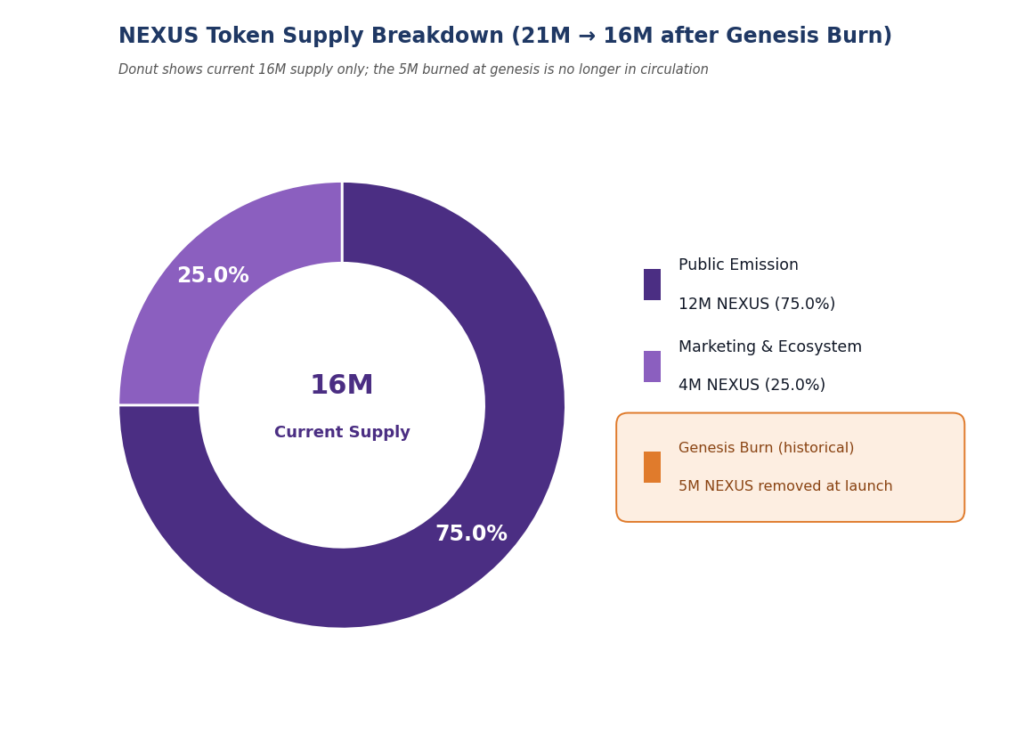
Donut chart titled ‘NEXUS Token Supply Breakdown (21M → 16M after Genesis Burn),’ subtitled ‘Donut shows current 16M supply only; the 5M burned at genesis is no longer in circulation.’ Center label reads ’16M / Current Supply.’ Two wedges: Public Emission, 12M NEXUS (75.0%), and Marketing & Ecosystem, 4M NEXUS (25.0%). A separate orange callout box below the legend reads ‘Genesis Burn (historical) — 5M NEXUS removed at launch,’ shown apart from the donut to indicate it is no longer part of current supply.
What Was the NEXUS Genesis Burn, and How Can Future Burns Affect Supply?
The project reports that on launch day, it permanently destroyed 5 million NEXUS tokens, cutting supply from 21 million to 16 million. A burn like this is designed to make each remaining token scarcer, in theory supporting price if demand holds steady or grows.
But a burn only affects supply, not demand. If very few people are buying and selling NEXUS, a smaller supply does not protect you from a price crash. Burns are also easy to announce and hard for an average buyer to verify without checking the blockchain directly, which is why we’re linking the contract’s public burn record on Solscan so you can look at the raw on-chain data yourself, rather than taking any project’s word for it.
How Are NEXUS Emissions Distributed, and Where Can You Check Treasury Transparency?
Nexus Protocol says it does not release its remaining 12 million NEXUS on a fixed schedule. Instead, releases are tied to factors like liquidity health, community growth, and “strategic milestones,” decided by the project team rather than an automated, code-enforced schedule.
This matters for one key reason: a team that controls when new tokens enter the market also controls a lever that can move the price. The project publishes a treasury wallet address for public viewing, but publishing a wallet address is not the same as an independent audit of how that wallet is used.
What Does It Mean That NEXUS’s Mint and Freeze Authorities Are Revoked?
Definition: Mint authority Mint authority is the on-chain permission to create new tokens beyond the original supply. If it’s revoked, no one, including the original team, can print more tokens later.
Definition: Freeze authority Freeze authority is the on-chain permission to freeze a specific wallet’s tokens, blocking that holder from trading. If it’s revoked, no one can lock your NEXUS in your own wallet.
On-chain data for the NEXUS contract shows both of these authorities revoked. This is a genuinely positive, checkable signal: it rules out two specific ways a team could dilute holders or trap their funds later. It does not rule out other risks, like the team abandoning the project, or existing large holders selling in size.
Is Nexus Protocol Safe? What Risks Should You Check Before Buying?
Is Nexus Protocol safe? Based on what’s checkable today, there is no evidence of the fastest, most obvious rug-pull pattern (liquidity being suddenly drained), and mint/freeze authorities are reported revoked. But “not an obvious rug pull” is different from “safe.” Several factors point to real, ongoing risk:
What Is Nexus Protocol (NEXUS)? How to Buy and Sell in India
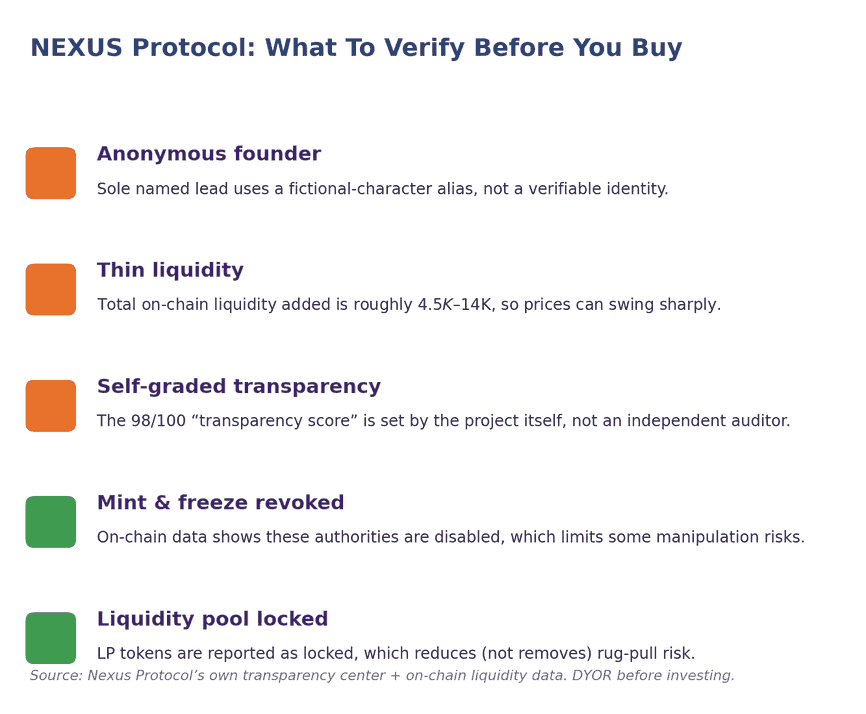
Anonymous leadership. The project credits a single named lead using what appears to be a fictional-character pseudonym, not a verifiable real-world identity. Our own guide on how to spot common crypto scams flags anonymous founders as one of the clearest early warning signs.
Self-graded transparency. The site displays a “98/100 transparency score.” This score is assigned by the project itself, not calculated by an independent auditor, exchange, or blockchain security firm.
Thin liquidity. Reported liquidity additions total roughly $4,500 to $14,000. At this depth, even a moderately sized buy or sell order can move the price sharply, and a small number of large holders exiting could crash it.
Aspirational roadmap. Several roadmap items, like additional exchange listings and “institutional adoption,” are future goals, not completed milestones. Treat roadmap language as intent, not achievement.
No independent audit. “Contract audited (immutable)” appears in the project’s own materials, but no named third-party auditor or public audit report is linked for outside verification.
Paste the verified NEXUS contract address yourself (never from a random link or message), set a sensible slippage tolerance, and confirm the swap.
Definition: Slippage
Slippage is the difference between the price you expect for a trade and the price you actually get, which grows larger in thin, low-liquidity pools like this one.
Given NEXUS’s thin liquidity, DEX swaps can suffer from higher price impact and failed transactions during volatile moments. A direct INR purchase on an exchange that already lists the pair, like Mudrex, sidesteps most of that friction.
How Can You Sell NEXUS Token in India and Withdraw INR?
Selling follows the buying process in reverse:
Log in to your exchange account and go to the sell or off-ramp section.
Enter the amount of NEXUS you want to sell, confirm the live rate, and execute the sale.
Withdraw the resulting INR directly to your linked bank account.
If you sold NEXUS at a profit, remember that crypto gains are taxable in India. A crypto tax calculator can help you estimate what you owe before you file.
If you’re selling on a Solana DEX instead, watch your slippage setting closely. In a thin pool, a large sell order can execute far below the price you saw before you clicked confirm.
Is NEXUS a Good Investment? How Should You Evaluate It?
Is NEXUS a good investment? There is no confident yes or no answer for a token this small and this new, and treat anyone who gives you one with suspicion. What you can do is weigh it using the same checklist you’d use for any small-cap token:
Liquidity depth: Thin liquidity means both upside and downside can be extreme. Position size accordingly.
Team transparency: An anonymous or pseudonymous team means you’re trusting code and public statements, not a track record you can verify.
Emissions control: Because future NEXUS releases are decided by the team rather than a fixed contract schedule, price can be affected by decisions you can’t predict in advance.
Track record over time: The project is young. A longer, unbroken history of locked liquidity and on-time roadmap delivery would be a stronger signal than anything on the site today.
Your own risk tolerance: Only invest an amount you could fully lose without it affecting your finances.
None of this is financial advice. If you decide to hold NEXUS, treat it as a small, speculative position, not a core part of your portfolio.
Conclusion
Nexus Protocol is a small, Solana-based deflationary token with some genuinely checkable positives, like revoked mint and freeze authorities and a locked liquidity pool, alongside real red flags, like an anonymous founder, a self-graded transparency score, and thin trading liquidity. If you still want exposure after weighing these risks, you can buy or sell NEXUS in India directly with INR, starting from ₹100, on the Mudrex app (available on Android and Apple). For more independent breakdowns like this one, check out the Mudrex YouTube channel.
FAQs
What is Nexus Protocol, and what role does the NEXUS token play in its ecosystem?
Nexus Protocol is a small Solana-based project, and NEXUS is its deflationary utility token, with a fixed 21 million supply reduced to 16 million after a launch-day burn.
Is Nexus Protocol safe?
It shows some positive on-chain signals, like revoked mint and freeze authorities, but also real risk flags, including an anonymous founder and thin liquidity. Treat it as high-risk.
Is NEXUS token a good investment?
There’s no reliable yes or no for a token this new and this illiquid. Evaluate it using standard small-cap checks, and only risk money you can afford to lose.
How can I buy NEXUS token in India?
You can buy NEXUS directly with INR and UPI on a KYC-compliant platform like Mudrex, or swap for it on a Solana DEX using a funded wallet.
How can I sell NEXUS token and withdraw INR?
Sell your NEXUS on the same platform you bought it from and withdraw the INR to your linked bank account. Remember that crypto profits are taxable in India.
What does it mean that NEXUS’s mint and freeze authorities are revoked?
It means no one, including the original team, can create new NEXUS tokens or freeze your wallet’s tokens after the fact.
Disclaimer
Cryptocurrency investments carry a high risk of loss. Small-cap and thinly traded tokens can experience extreme price volatility, and liquidity can be significantly lower than that of established coins. The examples and figures in this article are illustrative and sourced from the project’s own public materials and on-chain data at the time of writing. Nothing in this article is financial advice. Please do your own research before investing.
Siri is a writer venturing into the exciting realms of blockchain technology, cryptocurrency, and decentralized finance (DeFi), eager to explore the transformative potential of these innovations. She brings a unique perspective that bridges traditional industries and cutting-edge technology, often infused with a touch of humor through memes. She has a rich background in real estate and interior design, having previously contributed to NoBroker, where she crafted blogs and assets on these topics.