

Most traders lose money on crypto futures for one simple reason. They copy a strategy without copying the risk rules that go with it.
Advanced crypto futures trading strategies are not just fancier indicators. They are complete systems: an entry signal, a risk plan, and a leverage rule, all built for the same setup. Skip any one piece and the “advanced” part stops mattering.

This guide covers seven advanced crypto futures trading strategies experienced traders actually use: trend following, RSI confluence, breakout trading, funding rate arbitrage, hedging, event-driven trading, and scalping. You’ll also learn the risk controls that keep each one from wiping out your account.
These are not automatically the best crypto futures trading strategies for every trader. Each setup works under specific market conditions and requires its own position-sizing and exit rules.
An advanced crypto futures trading strategy combines a specific market condition, a confirmation signal, and a pre-set risk rule, instead of relying on one indicator alone. Beginner strategies usually stop at “buy when RSI is oversold.” Advanced strategies add a second and third filter before that signal is allowed to trigger a trade.
This matters because crypto futures trade with leverage, and a single unfiltered signal can put you in a losing trade sized far larger than you intended. Pro crypto futures trading strategies treat the entry signal, the market regime, and the exit plan as one linked decision, not three separate ones.
The seven advanced crypto futures trading strategies below follow that same pattern. Each one names the condition it needs, the signal that confirms it, and the rule that caps your downside if it fails.
Multi-timeframe analysis uses a higher timeframe, such as the daily chart, to set the trading bias and a lower timeframe, such as the 4-hour chart, to time an entry in the same direction. This helps filter some of the false signals that appear when a trader relies on only one timeframe.
The core toolkit for this trend-following setup includes:
Worked example: Suppose the daily chart shows Bitcoin above a rising 200 EMA, so your bias is long only. On the 4-hour chart, price pulls back to the 50 EMA with ADX still above 25. That pullback is your entry, with a stop just below the recent swing low and a trailing stop that follows price up from there.
| Signal | What It Confirms | Timeframe Used |
|---|---|---|
| 200 EMA slope | Overall trend direction | Daily |
| 50 EMA pullback | Entry timing | 4-hour |
| ADX > 25 | Trend strength, not chop | 4-hour |
| Trailing stop | Exit without guessing the top | Ongoing |
The biggest mistake with any trend following strategy crypto traders attempt is exiting a winning trade too early out of fear. Our full breakdown of trend following in crypto futures covers the pullback entries and risk rules in more depth.
RSI and moving average confluence works by only taking an RSI signal when it agrees with the direction of a longer moving average, which cuts out many of the false signals RSI gives on its own. This is one of the more reliable crypto futures strategies for traders moving past single-indicator setups.
Definition: Confluence Confluence means two or more independent signals point to the same conclusion at the same time, which raises the odds that a signal is real rather than noise.
The rule is simple to apply:
This setup is designed for trend continuation. Mean reversion requires a different market condition—typically a defined range where traders expect price to move back toward its average instead of continuing in one direction.
No breakout method works in every market. A more disciplined approach is to wait for a candle to close beyond a clear level on increased volume, then consider the retest instead of chasing the breakout candle.
A reliable breakout checklist looks like this:
| Setup | What You Watch | Risk Level |
|---|---|---|
| Resistance breakout + retest | Horizontal level | Low |
| Consolidation range breakout | Tight sideways box | Low to medium |
| Trendline breakout | Sloping trendline | Medium |
| False breakout fade | A failed break | High |
Treat the candle close, volume expansion and successful retest as breakout confirmation. Also review funding and open interest: a sudden move may be driven by a short squeeze rather than broad spot demand.
For the full walkthrough of all five setups, including the false breakout fade that advanced traders use to profit from fakeouts, see our guide on crypto breakout trading strategy mechanics.
Funding-rate arbitrage can work when the funding rate is positive. A trader buys the asset on the spot market and simultaneously shorts an equal notional amount through a perpetual futures contract. When both legs are properly matched, it functions as a market-neutral strategy designed to reduce directional exposure; not eliminate risk.
Definition: Funding Rate
A funding rate is a periodic payment exchanged between long and short positions in a perpetual futures contract to help keep its price close to the underlying spot price. The interval varies by asset and platform.
Worked example: Suppose the funding rate is positive at 0.03% for the next eight-hour interval. You buy $10,000 of Bitcoin on the spot market and open an equal $10,000 short perpetual position. If longs pay shorts and the rate remains unchanged, the short leg would receive approximately $3 for that interval. That equals about $9 across three intervals before trading fees, slippage and any change in the funding rate.
| Position | Direction | Role in the Trade |
|---|---|---|
| Spot Bitcoin | Long | Owns the underlying asset |
| Perpetual futures | Short | Collects funding, offsets spot price moves |
This hedged funding setup is not risk-free. Funding rates change, exchange fees eat into thin margins, and your short futures leg still needs margin maintenance to stay open. Our guides on how crypto funding rates work and crypto arbitrage trading cover the mechanics and the common mistakes in full.
Advanced traders hedge a crypto portfolio by opening a short futures position sized against their spot holding, so a drop in spot value is offset by a gain on the short side, without having to sell the underlying coins. This futures hedge is more precise than simply reducing exposure by moving capital into stablecoins.
A full hedge and a partial hedge trade off differently:
| Hedge Type | Futures Position Size | Impact if Price Falls 20% | Impact if Price Rises 20% |
|---|---|---|---|
| No hedge | ₹0 | −20% | +20% |
| Partial hedge (50%) | Half of spot holding | −10% | +10% |
| Full hedge (100%) | Equal to spot holding | ~0% | ~0% |
A full hedge protects nearly all your downside, but it also caps nearly all your upside. Most advanced traders lean toward a partial hedge around major events (a regulatory decision, a large token unlock) rather than staying fully hedged all the time, because the funding cost and margin lock-up can become significant when a hedge stays open for an extended period.
Sizing the hedge, choosing isolated margin, and setting a Mark-Price-based stop-loss are the three steps that matter most. Our complete guide on crypto hedging strategies walks through spot hedging versus futures hedging, sizing, and the costs involved.
Event-driven trading in crypto futures means placing trades around a scheduled event, like a CPI print, a regulatory ruling, or a major token unlock, rather than reacting to price action alone. It’s one of the higher-risk advanced crypto futures trading strategies, since it depends on timing a specific catalyst correctly.
One common event-driven crypto futures trading strategy is the news straddle:
This works because major crypto moves often happen in a short window right after news breaks, and a straddle lets you catch that move without guessing which way it goes. The risk is real: both orders can fill in a whipsaw move, or slippage during the volatility spike can turn a planned small loss into a larger one.
Execution can become even more difficult during a liquidation cascade, when forced position closures accelerate the move and reduce the available liquidity near the intended exit price.
Pro traders scalp crypto futures by combining one momentum signal (like an EMA crossover), one confirmation tool (like volume or RSI), and a fixed, small risk per trade, usually around 1% of their account. This type of scalping is designed for short timeframes such as the 1-minute and 5-minute charts, not daily charts.
Three scalping setups that combine well:
The image below shows how these seven strategies stack up against each other by relative risk, from funding rate arbitrage and hedging on the lower end, to scalping and event-driven trading on the higher end.
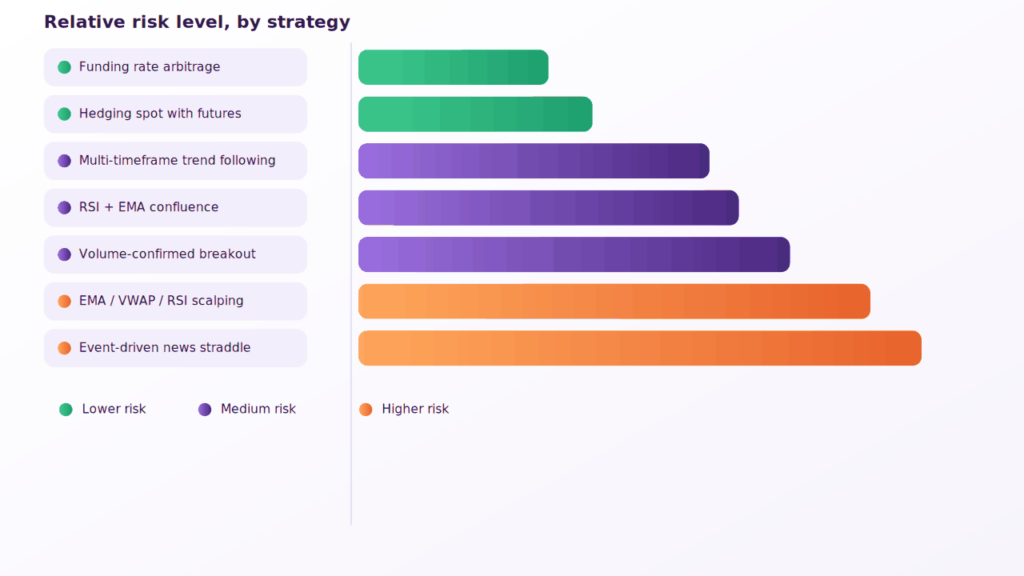
Look at where your preferred strategy sits on this ladder before you size a position. A scalping-sized stop-loss on a trend-following trade, or the reverse, is a common way advanced traders quietly overexpose themselves. For the exact indicator settings and risk rules, see our guide on crypto futures scalping strategies.
You manage liquidation risk by determining position size and stop-loss distance before selecting leverage. Keep a sufficient margin buffer between the stop trigger and the estimated liquidation price so that ordinary volatility and slippage do not immediately expose the position to forced closure.
Two order types behave very differently in a fast market, and mixing them up is a common, costly mistake:
| Execution factor | Stop-market order | Stop-limit order |
|---|---|---|
| What happens after trigger | Converts into a market order | Submits a limit order |
| Execution certainty | Higher probability, but not guaranteed in extreme conditions | Can remain completely unfilled |
| Fill price | Final price is not guaranteed and may include slippage | Fills only at the limit price or better |
| Main risk | Poor execution price during low liquidity | No execution if price moves past the limit |
| Typical use | When prioritising exit over exact price | When price control matters more than immediate execution |
A stop-market order becomes a market order after its trigger is reached. It prioritises execution, but its final price is not guaranteed and extreme liquidity conditions can still affect the fill. A stop-limit order provides more price control, but it may remain unfilled if the market moves beyond the specified limit.
Practical rules that advanced crypto futures trading strategies all share:
Do not treat a high-conviction trade as permission to ignore the predetermined risk limit or increase leverage beyond the original plan.
Our guide on how much leverage to use in crypto and our breakdown of why positions get liquidated despite a stop-loss cover both mechanics in full, with worked examples for each failure mode.
Advanced crypto futures trading strategies work when the strategy, the market condition, and the risk rule are all matched to each other. Trend following needs a real trend. Funding rate arbitrage needs a stretched funding rate. Scalping needs discipline more than cleverness.
Pick one strategy from this list that fits your schedule and risk tolerance, and practice it on a small position before scaling up. You can trade crypto futures on Mudrex with real-time INR margin and built-in stop-loss tools, or head to the Mudrex YouTube channel for walkthroughs on setting up each of these strategies step by step.
Advanced crypto futures trading strategies combine a specific market condition, a confirmation signal, and a pre-set risk rule, unlike beginner setups that rely on a single indicator alone.
There is no single best strategy. Experienced traders usually run several: trend following in trending markets, funding rate arbitrage in stretched markets, and scalping when volatility is high and liquidity is deep.
A crypto futures scalping strategy takes many small, fast trades on the 1-minute or 5-minute chart, usually using EMA crossovers, VWAP, or RSI, with a small fixed risk per trade.
Event-driven trading means placing trades around a scheduled catalyst, like a CPI release or regulatory ruling, often using a news straddle with both a long and a short stop order in place.
Basis trading, also called funding rate arbitrage, means buying an asset on spot and shorting its perpetual futures contract at the same time to collect funding payments with minimal directional risk.
Yes. A short futures position sized against a spot holding offsets losses if the price falls, without requiring you to sell the underlying coins.
Most advanced traders keep leverage modest and choose the amount only after setting their stop-loss and risk per trade, not before. The right amount depends on your stop-loss distance and personal risk tolerance, not a fixed number.
Traders manage liquidation risk by using isolated margin, basing stop-losses on Mark Price, and keeping real distance between their stop-loss and their liquidation price.
Crypto futures trading involves substantial risk, including the potential loss of your entire margin. Leverage magnifies both gains and losses, and no strategy in this guide guarantees a profit or eliminates risk. All figures, percentages, and worked examples above are simplified and illustrative, meant to explain mechanics rather than reflect real market data. This article is not financial advice. Please assess your own risk tolerance and consult a qualified financial advisor before trading crypto futures with leverage.