

Crypto markets are no strangers to sharp price swings. While long-term investors often ride out volatility, watching the value of a portfolio decline during a market correction can be challenging. This raises an important question: is crypto futures hedging safer than holding spot during volatility?
The answer depends on your investment goals, risk tolerance, and understanding of how futures markets work.

Selling may not fit every investor’s objective. Many investors want to maintain their spot holdings because they remain confident in the long-term outlook of assets like Bitcoin. However, they may also want temporary protection against short-term price declines without disrupting their investment strategy.
This is where crypto futures hedging comes in.
Rather than selling your spot portfolio, you can open a futures position in the opposite direction to reduce your overall market exposure. The objective isn’t to outperform the market or maximise profits. It’s to preserve capital, reduce portfolio drawdowns, and navigate periods of heightened volatility with greater confidence.
That said, hedging isn’t risk-free. Futures introduce additional considerations such as margin requirements, funding rates, liquidation risk, and active position management. Understanding these trade-offs is essential before deciding whether a futures hedge is the right approach for your portfolio.
Crypto futures hedging is a risk management strategy that uses futures contracts, including perpetual futures, to reduce the downside risk of an existing cryptocurrency portfolio.
Suppose you own 1 BTC purchased as a long-term investment. Ahead of a major macroeconomic event, you expect increased market volatility but still believe Bitcoin will appreciate over the coming years. Instead of selling your Bitcoin, you open a short perpetual futures position to temporarily reduce your downside exposure.
If Bitcoin’s price falls, the decline in your spot holdings and the resulting unrealised PnL may be partially offset by gains from the short futures position. While the hedge may not eliminate losses entirely, it can help reduce the overall impact of a market correction on your portfolio.
This is an important distinction because many beginners confuse hedging with speculation.
A speculative futures trade aims to profit from predicting market direction. A hedge, on the other hand, is designed to reduce portfolio exposure and manage risk while allowing you to continue holding your long-term investments.
Trader’s Note: A successful hedge isn’t measured by how much profit it generates. Its purpose is to reduce portfolio drawdowns, protect capital, and help you avoid emotional decisions during periods of market uncertainty.
There are several reasons investors choose to hedge rather than sell their crypto assets.
Some want to maintain long-term exposure to Bitcoin while protecting their portfolio during temporary market corrections. Others may want to avoid disrupting a long-term investment strategy or repeatedly buying and selling during uncertain market conditions.
Hedging also offers flexibility. Instead of making an all-or-nothing decision, investors can temporarily reduce risk while continuing to participate in the market if prices recover sooner than expected.
Market Observation: During periods of elevated volatility, many professional traders reduce their net market exposure instead of exiting their long-term investments entirely. Hedging allows them to manage short-term uncertainty while staying aligned with their broader investment thesis.
Pro Insight: Hedging isn’t about predicting every market move correctly. It’s about recognising that uncertainty is inevitable and managing risk before volatility affects your portfolio.
Understanding these mechanics is essential because an effective hedge can reduce risk, while a poorly managed one can increase it. In the next section, we’ll explore full vs partial hedges, how funding rates, margin requirements, and hedge ratios influence portfolio protection, and why liquidation risk remains one of the most important factors when hedging with crypto futures.
Knowing what crypto futures hedging is doesn’t automatically tell you how to hedge crypto with futures effectively. A successful hedge isn’t just about opening a short position. It’s about deciding how much of your portfolio to protect, how long to keep the hedge open, and how much risk you’re willing to manage.
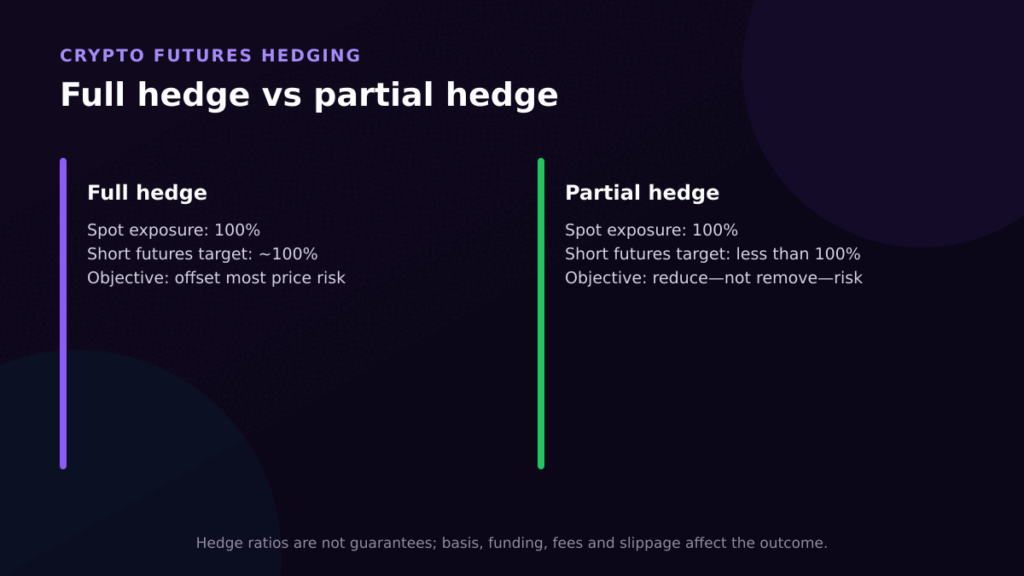
The size of your futures position is known as the hedge ratio, and it determines how much of your spot portfolio is protected.
A full hedge aims to offset most or all of your downside risk.
For example, imagine you’ve been holding 1 BTC for the long term. After a strong rally, Bitcoin approaches a major resistance level, and an important macroeconomic announcement is due later in the week. You still believe in Bitcoin’s long-term growth, but you’re concerned about a short-term pullback.
Instead of selling your Bitcoin, you open a short BTC perpetual futures position with similar notional exposure. If Bitcoin falls, gains on the futures position may offset part of the unrealised loss on the spot holding. The offset may not be exact because of basis, funding, fees, slippage and contract specifications.
The trade-off is that if Bitcoin continues rising, your spot portfolio gains value while your short futures position loses value. The hedge protects against downside risk, but it also limits part of your upside.
This is why many investors prefer a partial hedge.
Rather than hedging the entire portfolio, they protect only a portion of it. For example, if you hold 2 BTC, you might hedge only 1 BTC during a period of heightened uncertainty. This approach reduces portfolio drawdown while allowing the unhedged portion of your investment to continue benefiting if the market moves higher.
Pro Insight: Hedging isn’t about predicting the perfect market top. It’s about adjusting your portfolio exposure to match changing market conditions without abandoning your long-term investment strategy.
Opening a short futures position is only the beginning. Several factors determine whether your hedge actually provides the protection you’re looking for.
Most crypto futures exchanges offer perpetual futures, where traders exchange periodic Funding Rate payments.
If your hedge stays open for several days or weeks, funding payments can change the cost of maintaining it. Futures hedges are often used for defined risk windows, but the appropriate duration depends on funding, fees, basis and the investor’s objective.
Before opening a hedge, experienced traders often review the Funding Rate, Open Interest, and the Long-Short Ratio to understand current market positioning and estimate the potential cost of holding the trade.
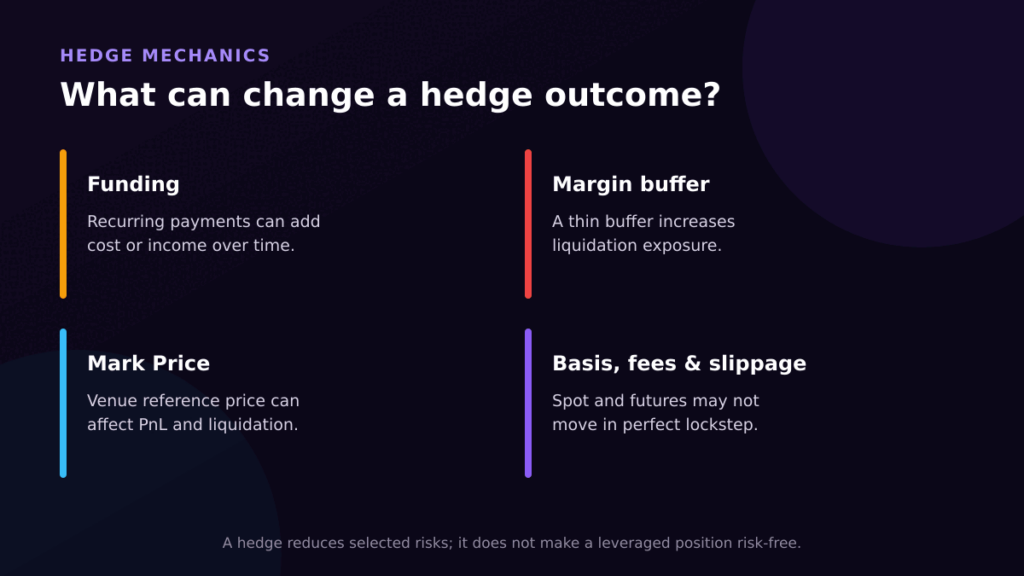
Every futures position requires Initial Margin to open the trade and Maintenance Margin to keep it active.
One common misconception is that a hedge eliminates risk. In reality, it changes the type of risk you’re managing.
Imagine Bitcoin unexpectedly rallies by 12% after you’ve opened a short futures hedge. While your spot portfolio gains value, your futures position begins losing money. If your available margin falls below the required level, the exchange may liquidate your hedge based on the Mark Price, even if your overall portfolio remains profitable.
Maintaining a healthy margin buffer and regularly monitoring your Margin Ratio helps reduce the likelihood of unexpected liquidation during periods of elevated volatility.
Some exchanges also support Hedge Mode, allowing traders to manage long and short futures positions simultaneously. Depending on your strategy, this can provide greater flexibility when managing portfolio risk.
Market Observation: During major macroeconomic events, experienced traders often reduce leverage, increase their margin buffer, and hedge selectively rather than reacting after volatility has already entered the market.
Trader’s Note: Hedging is a risk management strategy, not a profit strategy. Before opening any hedge, decide how much downside you’re trying to protect against instead of how much money you hope to make.
A well-managed hedge can reduce the impact of short-term volatility, but it isn’t always the right solution. In the next section, we’ll compare crypto futures hedging vs holding spot during volatility, explore when hedging makes sense, and discuss situations where simply holding your spot portfolio may be the better choice.
So, is crypto futures hedging safer than holding spot during volatility?
There isn’t a one-size-fits-all answer.
Holding spot assets avoids futures-specific risks such as margin requirements, Funding Rates, and liquidation, making it a simpler approach for long-term investors. However, it also leaves your portfolio fully exposed to market declines.
A well-managed futures hedge can reduce downside risk and help with capital preservation, but it also introduces additional complexity. Its effectiveness depends on factors such as your hedge ratio, position size, margin management, and how actively you monitor the position.
Like any risk management strategy, a hedge is only as effective as the person managing it.
Hedging isn’t something investors need to do every time the market becomes volatile. Instead, it’s typically used during periods when there’s a clear reason to expect increased uncertainty.
For example, hedging may make sense when:
However, there are also situations where not hedging may be the better decision.
If you’re investing with a long-term horizon, regularly accumulating crypto through SIPs or periodic investments, or aren’t comfortable managing futures positions, simply holding your spot portfolio may be the more appropriate strategy.
Sometimes, accepting short-term volatility is less risky than introducing the additional complexity of futures.
Market Observation: During periods of heightened uncertainty, experienced traders often reduce risk selectively rather than exiting the market completely. Their objective isn’t to avoid every correction, but to preserve capital until market conditions become clearer.
For most beginners, probably not.
Although hedging is designed to reduce downside risk, it still requires a solid understanding of futures markets. You’ll need to understand concepts such as Initial Margin, Maintenance Margin, Funding Rates, Mark Price, and liquidation risk, while actively monitoring your position.
Without that knowledge, a poorly managed hedge can introduce more risk than simply holding spot assets.
For most new investors, building experience through spot investing, learning how markets behave, and developing a disciplined risk management approach is usually a better first step before exploring futures.
Trader’s Note: Sometimes the simplest strategy is also the most effective. If you don’t fully understand how futures work, continuing to hold your spot portfolio may be less risky than opening a hedge.
Crypto futures hedging isn’t inherently safer than holding spot assets. It’s simply a different way of managing market risk.
Holding spot keeps your investment strategy simple but leaves your portfolio fully exposed to market volatility. Hedging can provide valuable downside protection, but it requires active management, an understanding of futures mechanics, and the discipline to monitor margin, funding costs, and position size.
The right choice depends on your investment goals, experience, and willingness to manage the additional risks that come with futures trading.
Most importantly, remember that not every market correction requires a hedge. If short-term volatility doesn’t change your long-term investment thesis, simply holding your spot portfolio may be the better decision.
Disciplined investors define their risk before volatility arrives and avoid allowing a short-term move to dictate an unplanned decision.
Continue learning: explore Mudrex Learn, watch the official Mudrex YouTube channel, or download the app and start trading.
Yes. Many investors use a short Bitcoin futures position to temporarily reduce the downside risk of their BTC holdings without selling their spot portfolio. This allows them to remain invested while seeking protection during periods of increased market volatility.
A partial hedge protects only a portion of your portfolio rather than the entire position. This approach reduces downside exposure while allowing part of your portfolio to continue benefiting if prices move higher.
Yes. If your futures position doesn’t have sufficient margin, it can be liquidated even while your spot holdings are gaining value. Once the hedge is liquidated, your portfolio becomes fully exposed to future price movements, making proper margin management essential.
Yes. Funding Rates influence the cost of maintaining a perpetual futures position. If a hedge remains open for an extended period, funding payments can accumulate and reduce the overall effectiveness of the strategy. This is why futures hedges are generally better suited for managing short-term periods of uncertainty.
Disclaimer: This content is for educational purposes only and is not financial advice. Crypto futures trading involves significant risk, including the loss of your entire margin. Do your own research and never trade more than you can afford to lose.