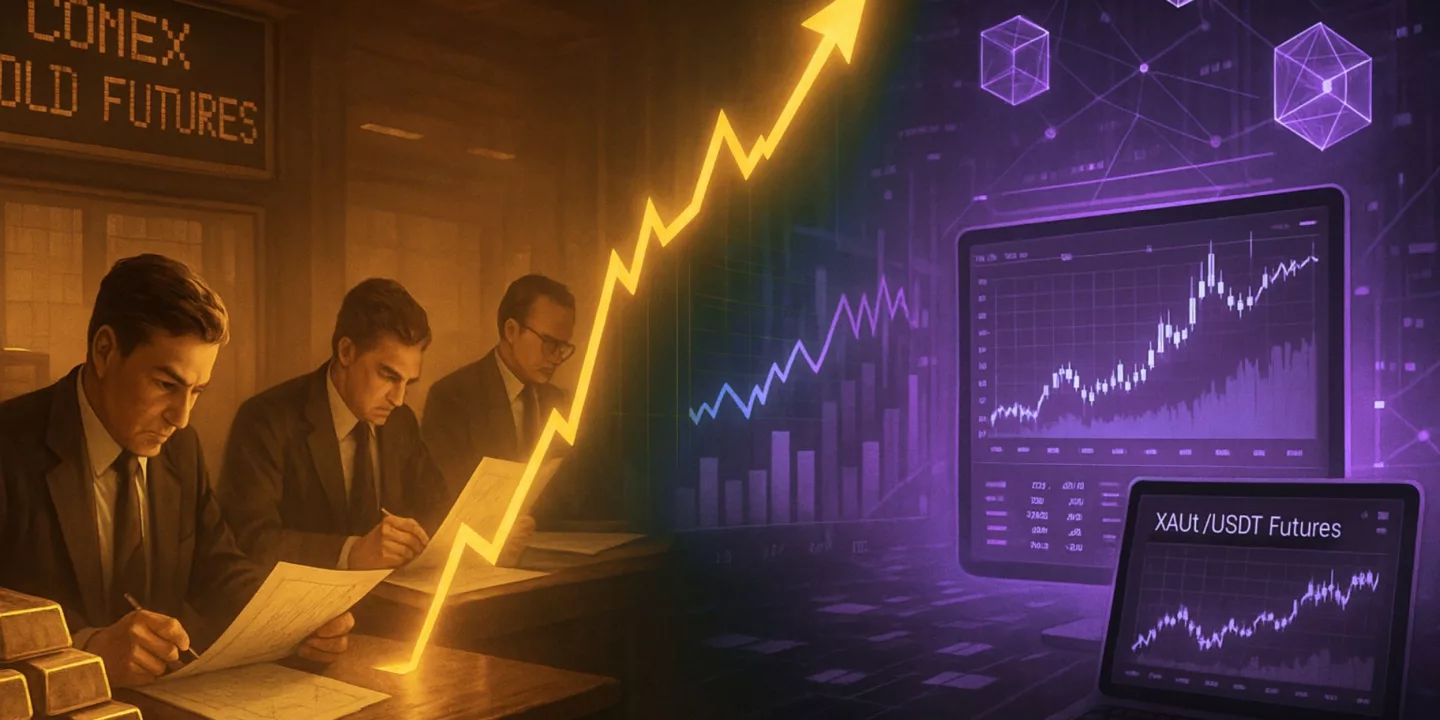
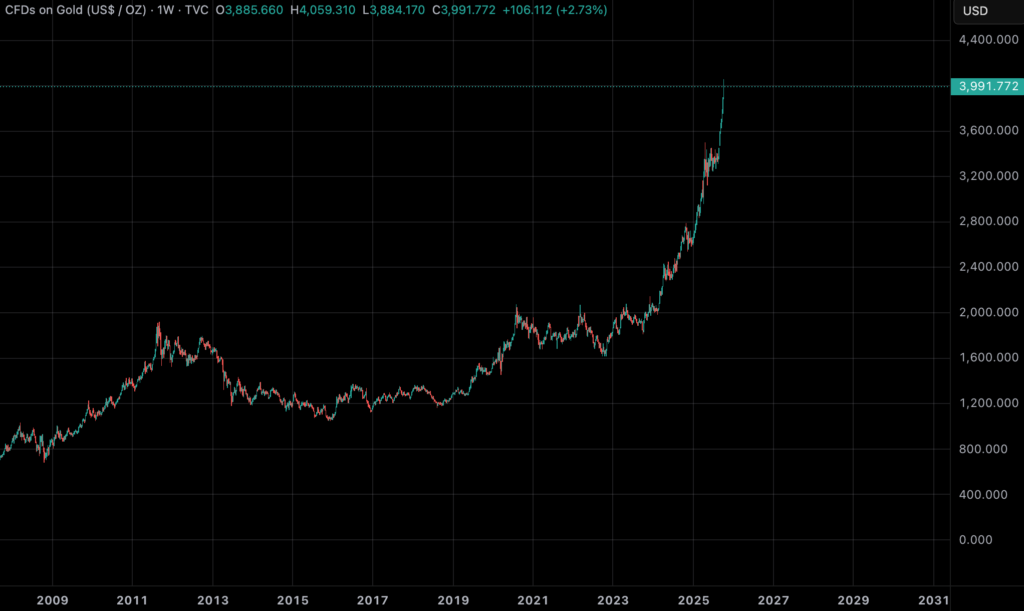
Gold’s Record-Breaking Rally: Gold prices have been on a tear, recently surging to all-time highs. In October 2025, the spot price of gold breached the $4,000 per ounce milestone for the first time, climbing as high as $4,031/oz. This marks a rally of over 50% gain in gold’s price just within 2025, following strong increases of about 27% in 2024 and 13% in 2023. Such a rapid ascent – the biggest rally for gold since the 1970s – underscores gold’s status as the ultimate safe-haven asset amid economic and geopolitical uncertainty. Investors worldwide have flocked to gold during recent bouts of inflation, war, and political turmoil, viewing it as a reliable store of value when currencies or stocks look risky.
Gold Futures Historical Analysis and the Rise of Tokenized Gold (XAUt)
Why Gold Matters for Traders: Gold’s rise to record levels has reignited interest from both traditional commodity traders and the crypto community. For gold bugs and futures traders, these new highs mean increased volatility and opportunities to profit from price swings. Meanwhile, crypto traders – who are no strangers to volatile assets – see gold’s breakout as a chance to diversify into a historically stable asset that’s showing bullish momentum. Both groups are looking for efficient ways to trade and backtest strategies on gold’s price movements. In this context, understanding gold futures historical data and how to backtest gold trading strategies is crucial. Even more exciting is the emergence of tokenized gold like XAUt, which offers a novel way to trade gold with the flexibility of crypto. Before diving into the merits of XAUt, let’s first review how traditional gold futures work and how one can obtain historical data for backtesting.
Traditional Gold Futures: How They Work and Why They’re Popular
What Are Gold Futures?
Gold futures are contracts that let you lock in today’s gold price for a future date. These contracts are traded on commodity exchanges. Each standard contract represents 100 troy ounces of gold — a pretty big position size — though smaller versions like mini (50 oz) and micro (10 oz) contracts exist for retail traders.
In simple terms, buying a gold futures contract means you’re agreeing to purchase gold at a fixed price later, while selling one means you agree to deliver it. Most traders, however, never take delivery of the actual gold — they close or “roll over” their positions before expiry.
Gold futures are among the most actively traded instruments in the world, reflecting gold’s importance as a global store of value and hedge against uncertainty.
How Gold Futures Trading Works
Trading gold futures is straightforward once you understand the basics:
You go long if you think gold prices will rise.
You go short if you expect them to fall.
Each trade uses leverage, meaning you only need to deposit a margin (usually 5–10% of the contract’s value) instead of paying the full amount. For instance, controlling $400,000 worth of gold might only require a $20,000 margin. This leverage magnifies both profits and losses, so careful risk management is essential.
Contracts typically have monthly or quarterly expiries. If you want to keep your position open after expiry, you’ll need to roll it over to the next contract month.
In reality, very few traders ever take physical delivery of gold — the futures market is mainly used for speculation, hedging, and price discovery. Key players include:
Gold producers who hedge their future output.
Institutional investors who use it for diversification.
Speculators and day traders who profit from price swings.
Why Traders Choose Gold Futures
Gold futures remain a favorite tool for professionals and active traders for a few key reasons:
1. Deep Liquidity & Low Costs The gold futures market is highly liquid, with billions in daily volume and tight spreads. This ensures easy entry and exit, even with large positions, and minimal price slippage.
2. Nearly 24/5 Market Access Gold futures trade electronically almost 24 hours a day, five days a week — from Sunday evening to Friday afternoon. That means you can react quickly to global news, though the market still closes on weekends.
3. Efficient Use of Capital (Leverage) Since futures are leveraged, traders can gain significant exposure to gold with relatively little upfront capital. This capital efficiency allows traders to diversify into other markets or hedge other assets simultaneously.
4. Hedging & Diversification Tool Gold often moves differently than stocks or currencies. During inflationary periods or geopolitical stress, gold tends to hold its value. This makes gold futures useful for hedging risk or adding diversification to a portfolio.
5. Speculation & Arbitrage Opportunities Short-term traders are attracted to gold futures because of their volatility and liquidity. Arbitrageurs also take advantage of price differences between gold futures, spot gold, and ETFs to earn low-risk profits, keeping markets efficient.
Gold Futures Historical Data: Where to Find It and How to Backtest Strategies
Accessing Historical Gold Data: Whether you aim to trade gold futures or any gold-related instrument, analyzing historical price data is essential. Fortunately, gold’s long trading history means there’s plenty of data available. Here are a few common sources and methods to get historical gold price data for analysis and backtesting:
Financial Portals: Websites like Yahoo Finance and Investing.com provide free historical price data for gold futures. For instance, you can find the continuous front-month gold futures under tickers like GC=F on Yahoo Finance and download daily price series (dates, open/high/low/close) into a CSV file. Investing.com offers a similar service for Gold Futures, where you can select a date range and export the price history. These sources usually give you settlement prices and maybe volume for each day.
Commodity Data Providers: The CME Group (exchange) website itself publishes contract specifications and sometimes historical settlement prices or volume data. For more comprehensive data (including intraday prices or many years of history), specialized data providers or subscription services (like Quandl, Reuters, Bloomberg, etc.) can be used. Some data providers or Kaggle datasets compile decades of gold futures prices. If you’re interested in spot gold (XAU/USD) instead of futures, the World Gold Council provides long-term price series and downloadable charts, and sites like Macrotrends have 100-year gold price charts.
Trading Platforms: Many trading/charting platforms (e.g. TradingView, MetaTrader, or Python libraries) allow you to fetch historical gold price data. For example, on TradingView you can pull up continuous gold futures or XAU/USD and scroll back decades.
Backtesting Your Gold Trading Strategy: Once you have historical data, backtesting is the process of applying your trading strategy rules to that past data to see how the strategy would have performed. Here’s a simple step-by-step approach to backtest a gold trading strategy:
Define Your Strategy Clearly: Determine the rules of your trading strategy. For example, Buy gold when the 50-day moving average crosses above the 200-day moving average (golden cross), and sell when the opposite occurs.The rules can be based on technical indicators, price patterns, or fundamental signals (or a combination). Be specific – define entry, exit, stop-loss, and take-profit conditions as needed.
Gather Sufficient Historical Data: Obtain enough data to cover various market conditions. For gold, you might want at least 5-10 years of daily data (or intraday if you’re a short-term trader) to include bull, bear, and sideways markets. Ensure the data’s quality – no gaps or errors – because bad data can skew results. If you’re focusing on gold futures, decide whether to use the continuous adjusted price series (to avoid jumps at contract rollover), or focus on a specific contract expiry each time and manually handle rolls. For simplicity, many backtesters use continuous futures data for strategy simulation.
Choose a Backtesting Platform/Tool: You can backtest manually in a spreadsheet, use programming (e.g. Python with pandas for a custom backtester, or specialized tools like Backtrader), or utilize trading platforms that support strategy backtesting (e.g. MetaTrader for XAU/USD, TradingView’s Pine Script for gold charts.
Execute the Backtest: Run your strategy on the historical data. The backtesting engine will simulate each trade as if you had taken it in real time, logging entries and exits based on your rules. Ensure you account for realistic conditions – for example, include a small transaction cost (spread or commission) and do not assume perfect execution at past prices if there were big gaps. For gold futures, also consider the effect of leverage (the backtester should mark-to-market the P/L and margin requirements) and contract rolls (if applicable).
Analyze Performance Metrics: Evaluate the results. Key metrics include total return, annualized return, maximum drawdown (worst peak-to-valley loss – crucial for understanding risk), win rate, profit factor, and Sharpe ratio among others. Look at the equity curve (cumulative P/L over time) – does the strategy perform consistently in different years or does it depend on a few big wins? For instance, a strategy might do great in trending periods (like gold’s strong uptrend in 2020-2021, or 2023-2025), but falter in choppy markets. By analyzing the backtest, you can identify such weaknesses and refine your approach.
Perform Walk-Forward Testing (Optional): To avoid overfitting your strategy to past data, consider walk-forward or out-of-sample tests. This means you might backtest on an older period, then see how the strategy would have done on more recent unseen data. Alternatively, split data into a training period (to optimize or develop the strategy) and a testing period (to evaluate true performance). For example, use 2010-2018 for development and 2019-2025 for a forward test.
By following these steps, you can derive insights from historical gold price movements and gain confidence (or realize limitations) in your trading strategy before putting real money at risk. Backtesting isn’t foolproof, markets can change, but it’s a valuable part of a trader’s toolkit.
Gold Futures Historical Analysis and the Rise of Tokenized Gold (XAUt)
What is XAUt (Tether Gold)? XAUt is a gold-backed crypto token issued by Tether (the same company behind the USDT stablecoin). Each XAUt token represents ownership of one troy ounce of physical gold that is stored in a professional vault in Switzerland. In essence, Tether has tokenized gold bars: for every XAUt in circulation, there is an ounce of real gold kept in reserve. XAUt is an ERC-20 token (on Ethereum) and also available as a TRC-20 token (on Tron), which means it can be transferred like any cryptocurrency, 24/7, globally.
By holding XAUt, investors effectively hold gold – but in a digital form that comes with the speed and flexibility of crypto. The token’s value tracks the market price of gold almost perfectly, since it’s redeemable for physical gold. In fact, XAUt can be redeemed for actual gold bars if a holder accumulates enough tokens (minimum redemption is usually 1 full bar, about 430 XAUt tokens, delivered in Switzerland). For most traders, though, the interest lies in trading XAUt on exchanges to speculate on gold’s price without ever touching physical metal.
Why Tokenized Gold? The concept of tokenized gold marries the stability of a time-tested asset (gold) with the technological advantages of blockchain. For years, investors who wanted exposure to gold without holding physical bars have used alternatives like gold ETFs (exchange-traded funds) or futures. XAUt and other gold tokens now offer a new alternative. They fulfill the economic purpose of owning gold while overcoming many traditional challenges like storage and transport.
As gold hits new highs and crypto adoption grows, tokenized assets are gaining traction. The total market for gold-backed crypto tokens recently surpassed $3 billion, with trading volumes surging (led by XAUt and competitor PAX Gold) when gold’s price hit records.
Now that we know what XAUt is, let’s examine why a trader might prefer XAUt over traditional gold futures. Both have their pros and cons, and the best choice can depend on your needs (are you looking for leverage? do you want to hold long-term? etc.). To make the comparison clear, we’ll look at various factors side by side:
Merits of Trading XAUt vs. Traditional Gold Futures
Tokenized Gold (XAUt) vs Gold Futures – Key Differences: The table below highlights the main differences between trading gold via traditional futures contracts and trading gold via the XAUt crypto token. This comparison will underscore the merits of XAUt in accessibility, convenience, and more:
Factor
Traditional Gold Futures
Tokenized Gold (XAUt)
Standard Unit
Standard contract = 100 troy ouncesgold (approx. 3.11 kg). Micro contracts (10 oz) exist for smaller traders.
Each token represents 1 troy ounce of gold (London Good Delivery bar). Fractional ownership down to 0.000001 oz (six decimal places) is possible.
Trading Hours
Trades almost 24h/5 days on CME Globex (closed on weekends). Limited trading outside weekday hours.
Trades 24/7, 365 days a year on crypto exchanges. You can enter or exit positions on weekends and holidays, anytime.
Accessibility
Requires a commodities/futures brokerage account and permission to trade futures. Margin and regulatory compliance (KYC, eligibility) needed. Not available to all retail investors in some countries.
Accessible to anyone with a crypto exchange account or wallet. Standard KYC on major exchanges, but generally easier onboarding than futures brokers. No special approvals – if you can trade crypto, you can trade XAUt.
Leverage
Traditional Gold FuturesModerate leverage (10–20x) — only ~5–10% of contract value is posted as margin, giving amplified exposure but also higher liquidation risk if prices move sharply.
XAUt on Mudrex High leverage (up to 50x) — Mudrex’s crypto futures allow traders to take larger positions with smaller capital, far exceeding traditional market leverage limits. This boosts potential returns but demands careful risk control.
Contract Expiry
Expires on a set future date (e.g., monthly contracts). If you want to hold longer, you must roll over to next contract, incurring spread and possible price differences (contango/backwardation effects).
No expiry – XAUt tokens do not expire. You can hold them as long as you wish, just like holding a gold coin. No need to roll any position; the concept of continuous exposure is built-in.
Liquidity & Volume
Extremely high liquidity on regulated exchanges – gold futures trade hundreds of billions in notional value per day, with deep order books. Slippage is minimal for reasonable trade sizes. However, retail traders must trade during exchange hours (no weekend liquidity).
Global liquidity across crypto exchanges. XAUt’s trading volume has grown (often hundreds of millions of USD per day across platforms), and you can usually buy/sell at tight spreads. Plus, liquidity is 24/7.
Trading Tools & Integration
A wide array of professional trading platforms support futures (e.g. CME’s trading systems, broker platforms like Thinkorswim, etc.). Backtesting futures may require specific futures-capable software or continuous data handling. Also, using futures in algorithmic strategies might need handling margin and roll logic.
XAUt, being a crypto token, can be traded on modern crypto platforms and integrated into DeFi. You can easily store it in a wallet, or use platforms like Mudrex for trading.
As the table illustrates, XAUt offers significant merits for traders, especially retail traders or crypto enthusiasts, when compared to traditional gold futures.
24/7 Trading: Perhaps the biggest practical advantage is the ability to trade gold 24 hours a day, 7 days a week on crypto markets. Gold futures traders can’t do anything if a major news event happens on a Saturday – they must wait until Sunday evening when futures reopen. XAUt traders, on the other hand, can respond immediately, providing greater flexibility and potentially better risk management. For crypto traders used to round-the-clock markets, having gold accessible in the same way is a huge plus.
Fractional Ownership & Accessibility: XAUt lowers the barrier to entry for gold trading. You don’t need to commit to ~100 ounces of gold exposure at a time. You can buy even 0.01 XAUt (1/100th of an ounce) or less, making gold accessible to those with small portfolios. There’s no need for a specialized broker or high account minimums – even a person with a $100 investment can get exposure to gold via XAUt. This democratization of gold investing is akin to how crypto made investing more accessible in general.
No Expiry: XAUt tokens don’t expire. You can hold your gold exposure as long as you want without worrying about rolling contracts. This makes XAUt ideal for long-term investors who simply want to buy-and-hold gold. With futures, a long-term holder would have to roll over every few months, which can incur costs and risks (if you forget to roll, you might get an unwanted delivery notice or position close-out). XAUt simplifies this greatly
Ease of Use and Integration: Trading XAUt is as easy as trading any crypto asset. If you already trade Bitcoin, adding XAUt to your portfolio is seamless – no new accounts or learning curve for a different marketplace.
Lower Holding Costs & No Storage Worries: For anyone who’s considered buying physical gold, the issues of secure storage and insurance are real obstacles. Gold futures avoid that but introduce other costs (rolls, broker fees, etc.). XAUt provides the economic exposure of physical gold without any storage or insurance fees passed to the user. Tether handles the custody. As a trader or investor, you can hold XAUt for months or years without any deductions (unlike some gold ETFs which have annual expense ratios, or vault storage fees if you hold gold in a custodian). You also don’t need to worry about the safety of storing gold in your house or a bank – your gold is in a high-security Swiss vault by default. This peace of mind and cost savings are compelling.
Direct Ownership of Gold: When you own XAUt, you own a slice of a physical gold bar. It’s your gold in a literal sense, just abstracted by the token. In contrast, a gold futures contract is just a paper (or electronic) bet on price – until you take delivery, you don’t “own” any gold. Even gold ETFs typically give you exposure but not the option to redeem for metal (except maybe large institutional holders). With XAUt, if you ever wanted, you could convert your digital holdings to actual gold bars (meeting the minimum requirement). This feature appeals to long-term gold bugs who like the security of knowing the token is tied to something tangible. It bridges the gap between the digital and physical.
Transparency and Trust via Blockchain: XAUt transactions are recorded on a public blockchain, which adds a layer of transparency to gold trading that traditional markets don’t offer. You can track transactions, and Tether provides verification tools to ensure each token is backed by a specific gold bar. This is quite innovative – imagine being able to identify the serial number of the gold bar you indirectly own! Such transparency is a merit that can increase trust (though it does hinge on trusting Tether’s auditing). Traditional futures markets operate in a black box by comparison; you trust the clearinghouse but you can’t trace a specific ounce of gold behind your futures exposure.
Conclusion: Embracing the Future of Gold Trading
Gold’s ascent to record highs has once again proven why the precious metal holds a special place in the financial world. Traditional gold futures have long been a go-to avenue for traders to capitalize on gold’s moves or hedge their risks, and understanding how to access and analyze historical data remains a fundamental skill.
However, innovation in the form of tokenized gold is revolutionizing how we can interact with this age-old asset. XAUt (Tether Gold) exemplifies this revolution – blending the timeless value of gold with the cutting-edge flexibility of crypto. For crypto traders, XAUt offers a familiar way to gain exposure to gold without leaving the digital asset ecosystem. For gold traders, XAUt provides new freedom: trade gold on weekends, trade in tiny sizes, or use DeFi – all while still effectively holding real, tangible gold.
The merits of trading XAUt compared to traditional gold futures are clear: around-the-clock access, fractional trading, no expiries, easy custody, and more. It lowers barriers and invites a broader range of participants to engage with gold.
You can start trading gold futures on Mudrex with as little as ₹500 via UPI deposits. Plus, Mudrex offers high leverage up to 50x on XAUt futures, giving you the power to amplify trades and capitalize on even small price swings — all within a FIU-compliant, beginner-friendly app built for Indian traders.
So, if you’re ready to explore crypto-enhanced gold trading, now’s the time. Download the Mudrex app today to unlock seamless futures trading on 350+ pairs, with low fees and intuitive tools.
What are Gold Futures?
Gold Futures are exchange-traded contracts that let traders buy or sell gold at a fixed price on a future date.
Where can I access Gold Futures historical data?
You can download it from sources like CME Group, Yahoo Finance (GC=F), or Investing.com for free historical pricing.
What is XAUt?
XAUt (Tether Gold) is a tokenized version of gold. Each token represents one troy ounce of physical gold stored in a Swiss vault.
How is trading XAUt different from traditional Gold Futures?
XAUt trades 24/7, requires no contract rollover, and can be traded fractionally on crypto platforms like Mudrex.
Can I trade XAUt on Mudrex?
Yes. Mudrex lets you trade XAUt spot and futures with up to 50x leverage, UPI deposits, and low fees in a fully compliant platform.
Anush is a crypto researcher dedicated to making blockchain insights clear and accessible. A proud Solana maxi who still appreciates a good Layer 2 debate, he dives deep into market trends so others don’t have to (but really should). Passionate about simplifying crypto, he strives to make the space less intimidating and a lot more relatable, one report at a time.