
A single large order can move a crypto futures price by a fraction of a percent on a calm day. During market stress, large orders in crypto futures can move price several percent, and trigger a chain of forced liquidations behind it. The difference is not the order. It is how much liquidity is left to absorb it.
If you trade crypto futures, or watch whale wallets for clues on where price is headed, this gap matters. A large order does not just reflect sentiment, it actively reshapes price by consuming the orders sitting on the book. In calm markets, that impact is small and fades fast. Under stress, thin books turn one large trade into a cascade that outruns stop-losses and liquidates leveraged positions across the board.
Market impact and slippage are related but not the same thing, and mixing them up leads to bad assumptions about risk. Market impact is the price move an order itself causes by consuming resting orders on the book. Slippage is the gap between the price you expected and the price you actually got, which includes market impact plus any additional cost from a fast-moving market.
Definition: Market Impact Market impact is the price move an order itself causes by consuming resting orders on the book, separate from any external news or sentiment shift.
A small retail order rarely has measurable market impact, since it fills within the existing spread. A large order works differently: it can consume every resting order at the best price, then keep filling at worse prices until it’s done, a process traders call “walking the book.” In calm markets, market makers refill the book fast, so impact fades quickly. Under stress, that refill slows or stops, so the impact lingers and compounds.
| Term | What It Means |
|---|---|
| Market impact | The price move an order causes by consuming resting liquidity on the book |
| Order book | The live list of buy (bid) and sell (ask) orders waiting to be matched |
| Market depth | The size of orders resting near the current price on both sides |
| Order book imbalance | The ratio of buy orders to sell orders near the top of the book |
| Slippage | The gap between the expected fill price and the actual fill price |
| Bid-ask spread | The gap between the best buy price and the best sell price |
| Matching engine | The exchange system that pairs incoming orders with resting orders |
| Execution algorithm | Software that splits a large order into smaller pieces to reduce impact (e.g. TWAP, VWAP) |
| Whale order | An unusually large order relative to a market’s typical size, placed by an individual or institution |
| Cumulative Volume Delta (CVD) | A running total of buy volume minus sell volume, used to gauge real buying or selling pressure |
| Open interest | The total number of futures contracts still open in a market |
Large orders move crypto futures prices by consuming resting orders on the book faster than new orders can replace them, forcing each new slice to fill at a worse price. This is the core mechanism behind every large-order price move, calm or stressed market alike.
Picture the order book as a stack of shelves, each holding limited size at a specific price. A large market order doesn’t simply “buy at the market price”: it clears the first shelf, then the next, until the full order is filled, each shelf slightly worse than the last.
Here’s an example:
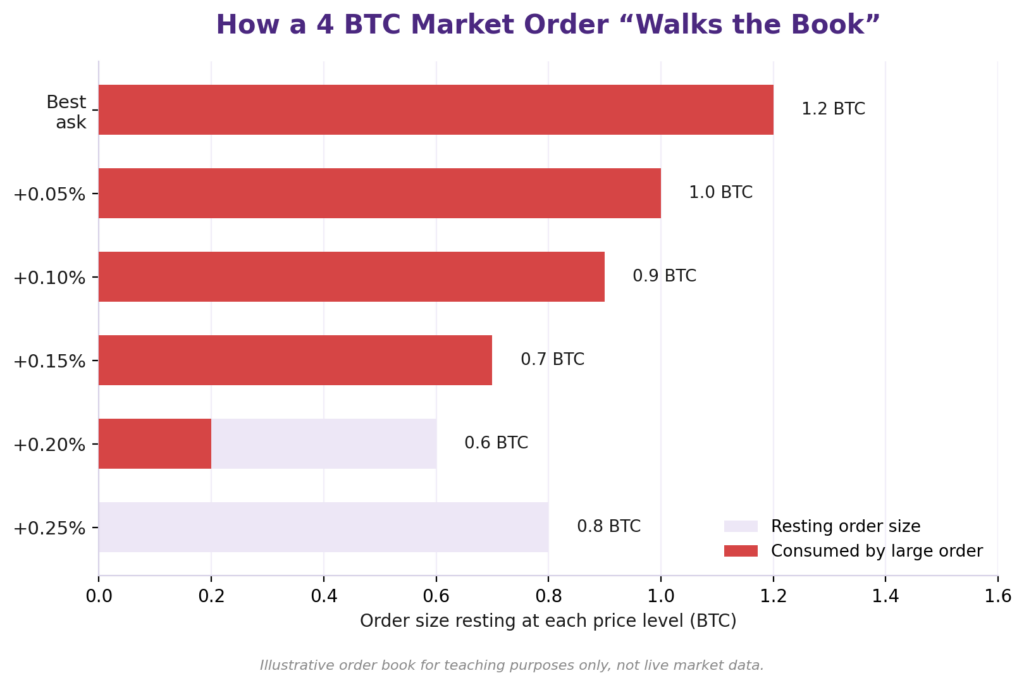
The order fully consumes the first three price levels, partly eats the fourth, and never touches the last two. That partial consumption at the fourth level is where the average fill price starts moving noticeably away from the best ask it started at.
| Order Size | Book Condition | Levels Consumed | Approx. Average Fill Price Move |
|---|---|---|---|
| 1 BTC | Normal depth | 1 level | Under 0.02% |
| 4 BTC | Normal depth | 3-4 levels | ~0.10% |
| 4 BTC | Thin book | 6+ levels | ~0.35% or more |
Illustrative figures for teaching purposes only, not live market data.
The same order, placed on a thinner book, consumes more levels and moves the average fill price further. This is why order size alone never tells you the full risk picture. Order size relative to market depth is what actually matters.
Large orders cause bigger price swings during market stress because the same event that creates the stress, whether a news shock or a cascade of liquidations, also pulls liquidity off the book right when large orders need it most. Less resting size means a large order walks through more price levels, faster.
Market makers aren’t required to keep quoting during volatile moves, and most pull back or widen spreads sharply when risk rises. That leaves a near-empty book, so an order that would barely register on a calm day can move price several percent in seconds.
The chart below shows how the same large order behaves as liquidity conditions go from calm to stressed.
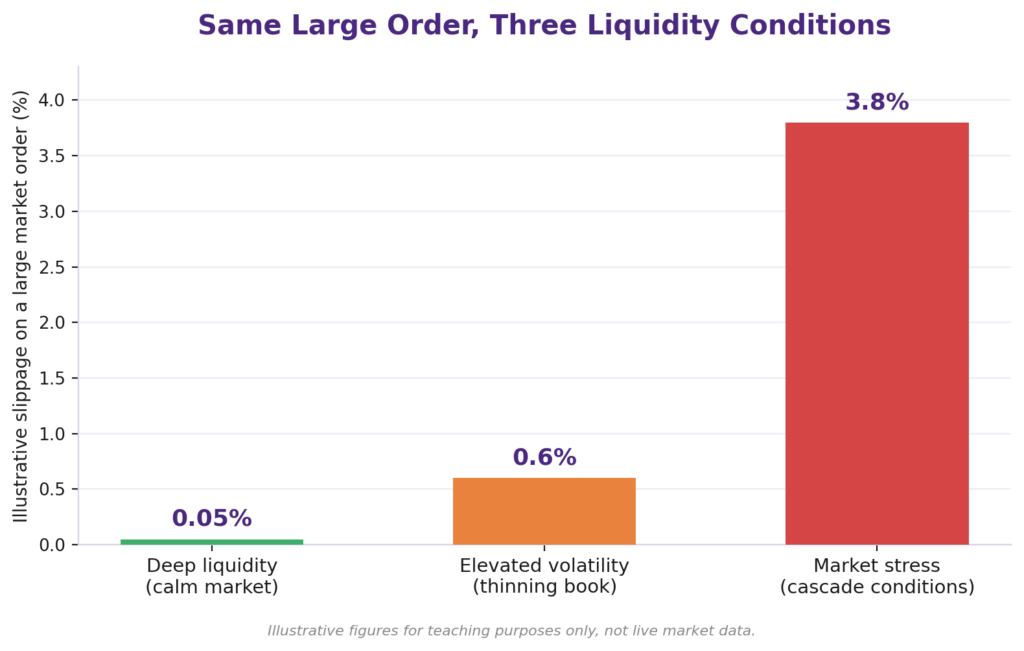
The jump from the middle bar to the right bar matters most. Slippage doesn’t rise in a straight line as liquidity thins, it accelerates, because a thinning book also triggers stop-losses and liquidations that add more forced orders into an already-thin market.
This is the feedback loop behind a liquidation cascade: one large move triggers the most leveraged positions to liquidate first, and their forced selling pushes price further, consuming what depth remains and dragging in the next tier of leveraged positions.
On October 10, 2025, a real liquidation cascade saw the market-wide liquidation rate jump from roughly $0.12 billion per hour to $10.39 billion per hour within a 40-minute window, with Bitcoin falling around 7% in under an hour as order book depth briefly fell by more than 98%. That scale of depth loss is why the same order size can look harmless one hour and dangerous the next.
Whale trades move crypto markets less through their own size and more through the reactions they trigger from other traders and the exchange’s liquidation engine. A single whale order rarely moves price on its own in a deep market; it moves price when it clears enough of the book to trip stop-losses, liquidations, or other algorithmic orders nearby.
This is why the same whale-sized order can look completely different depending on timing. Placed into a deep, calm book, it might move price by a fraction of a percent and get quietly absorbed. Placed during crowded, one-sided leverage, it can be the spark that sets off a much larger, self-feeding move, since order book imbalance leaves little standing between the whale’s order and the next cluster of liquidation prices.
None of these three effects need to be large individually. Together, they explain why a single trade is sometimes blamed for moves far bigger than the trade itself.
Institutions execute large crypto orders without moving the market by splitting one large order into many smaller ones and spreading the fills over time or across venues, rather than sending the full size as a single market order. The goal is to blend into normal order flow instead of standing out as one large, price-moving event.
| Execution Method | How It Reduces Impact | Best Suited For |
|---|---|---|
| Iceberg order | Hides total order size from the visible book | Large single-venue orders in liquid pairs |
| TWAP | Spreads fills evenly over a fixed time window | Predictable, low-urgency execution |
| VWAP | Matches execution pace to real trading volume | Blending into natural market activity |
These execution algorithms don’t eliminate market impact, they spread it thin enough that no single fill stands out, which is exactly what a large market order fails to do.
Retail traders protect themselves from large-order price swings mainly by avoiding market orders on thin books and checking depth before placing size, rather than trying to predict when a whale might trade.
For a full walkthrough of leverage trading crypto safely around volatile swings, size your position to your stop-loss distance rather than your available margin.
ALSO READ: What is cross margin in crypto futures trading?
Large orders move crypto futures prices by consuming the liquidity sitting on the order book, and the damage they do depends far more on how deep that book is than on the order itself.
Calm markets absorb even sizable trades with minimal impact. Stressed markets turn the same order into an outsized move, and can set off a liquidation cascade that runs well past the original trade. Whether you’re sizing your own trade or reading a whale wallet’s move, order book depth at that moment tells you more than order size alone ever will.
Ready to put this into practice? Download the Mudrex app to check live order book depth before you size your next trade, or visit the Mudrex YouTube channel for walkthroughs on reading market depth and managing execution risk.
Large orders affect crypto prices by consuming the resting buy or sell orders on the book, pushing the average fill price away from the best available price as they work through it.
Market impact is the price move directly caused by placing and filling an order, separate from any impact of news or shifting sentiment.
Whale trades move the market mainly by triggering nearby stop-losses and liquidations, not just through their own size, especially when the book is already thin.
Institutions typically use iceberg orders, TWAP, or VWAP execution to split a large order into smaller pieces and blend into normal trading activity.
When liquidity is low, the same order consumes more price levels on the book, so slippage and price impact both increase.
Market stress pulls liquidity providers off the book right when large orders need depth most, which is why price impact accelerates instead of staying steady during volatile periods.
Crypto futures trading carries a high risk of loss, and leverage magnifies both gains and losses. The figures, charts, and worked examples in this article are simplified and illustrative only, meant to explain mechanics, not live market data, financial advice, or a guarantee of any outcome. Always assess your own risk tolerance and consult a qualified financial advisor before trading crypto futures.