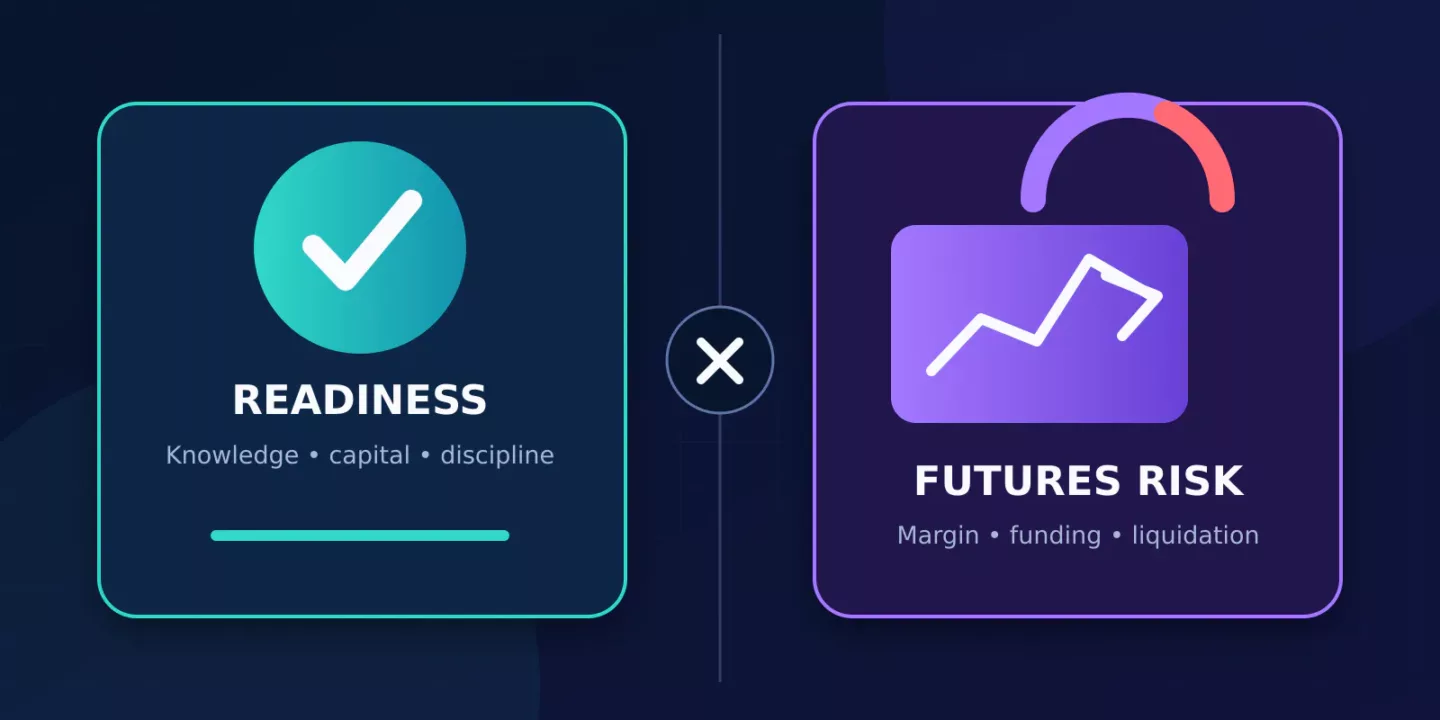

Is crypto futures trading right for you? The answer depends less on predicting the next Bitcoin move and more on whether you understand leverage, margin, liquidation and the amount you could lose.
Crypto futures can support long positions, short positions and portfolio hedges without requiring direct ownership of the referenced cryptocurrency. However, they also introduce risks that standard, unleveraged spot trading does not have. Leverage magnifies losses, funding can change holding costs, and a position may be liquidated when its margin no longer meets the venue’s requirements.
This guide explains how the product works, who should avoid it and how to assess your financial and emotional readiness before placing a trade.
Crypto futures are derivative contracts linked to the price of a cryptocurrency or a reference index. Holding a futures position does not ordinarily mean that you own the referenced cryptocurrency.
A long position gains value when the contract moves favourably upward, while a short position gains value when it moves favourably downward. Both can lose money when the market moves against them. Trading fees, funding, slippage and settlement rules also affect the final result.
Most retail crypto futures products are perpetual contracts with no fixed expiry date. A funding mechanism helps keep their market price close to the underlying spot index. When funding is positive, long holders generally pay short holders. When it is negative, short holders generally pay long holders. The interval and formula vary by venue.
Open interest shows the total outstanding derivatives positions, but it does not reveal whether every position is bullish or bearish. Rising open interest combined with an extreme funding rate can indicate crowded positioning. It is a risk signal, not a reliable prediction of the next price move.
Leverage allows a smaller amount of margin to control a larger notional position. For example, ₹10,000 of margin at 10× leverage creates ₹1,00,000 of exposure.
If the contract price moves 2% in the trader’s favour, the position changes by approximately ₹2,000 before fees and funding. That equals about 20% of the ₹10,000 margin. A 2% adverse move produces an approximately equal loss.
The calculation illustrates exposure, not liquidation. The actual liquidation threshold depends on initial margin, maintenance margin, fees, funding, mark price, margin mode and the venue’s risk engine.
Leverage does not improve a strategy or increase the probability of being correct. It only increases the effect of the resulting price movement on the trader’s capital.
Initial margin is the collateral needed to open a leveraged position. Maintenance margin is the minimum equity needed to keep it open.
If losses and costs push the account below the applicable maintenance requirement, the venue may reduce or close the position. Many platforms use a mark price rather than the most recent trade to calculate unrealised profit and loss and test liquidation thresholds.
The selected margin mode changes the exposure:
| Margin mode | Typical collateral structure | Main risk |
|---|---|---|
| Isolated margin | Collateral assigned to one position | The assigned margin may be lost if the position is liquidated |
| Cross margin | Eligible balance shared across positions | A losing position may draw on more of the futures account |
These are common structures, not universal guarantees. Traders must check the rules displayed for the specific platform and contract.
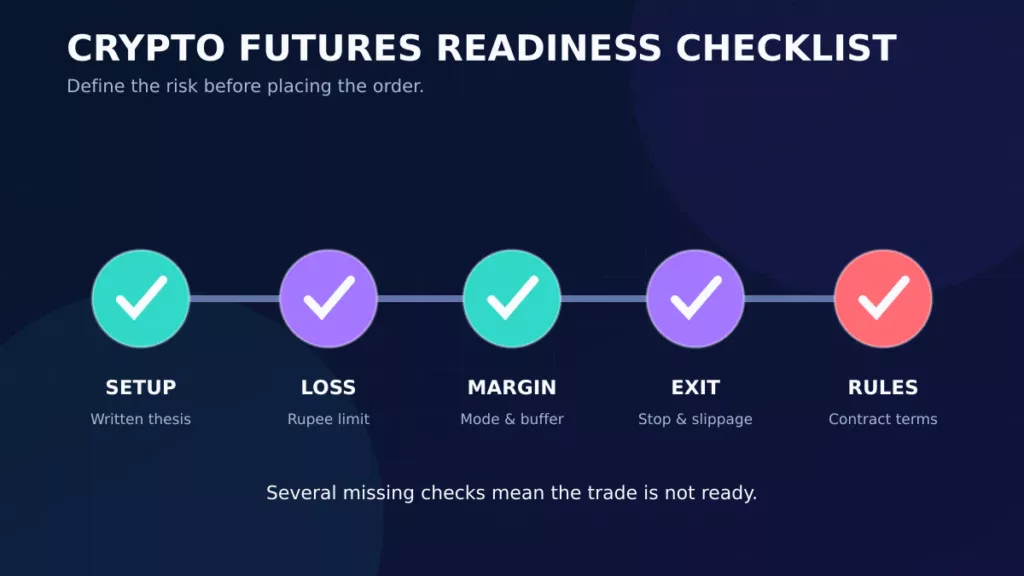
Futures may be unsuitable for a beginner who cannot yet explain leverage, margin, liquidation price, funding and order execution in their own words. Learning the terminology alone is not enough; the trader must also calculate the loss at the planned exit.
Standard, unleveraged spot trading removes funding and margin-based liquidation from the learning process. It can help a beginner practise order placement, position sizing and market observation without leveraged contract mechanics.
Spot trading is not automatically safe. The asset can lose most or all of its value, and custody, liquidity and platform risks remain. The point is that its basic risk structure is generally easier to understand.
Paper trading can help test a routine before risking real capital. Treat simulation as practice rather than proof of profitability because it cannot reproduce every live fill, fee, gap or emotional response.
Also Read : Is Crypto Futures Riskier than Spot Trading
Some situations create a particularly poor fit for leveraged trading.
Do not use credit-card funds, personal loans, rent money, emergency savings or money needed for household expenses. A trading loss should not threaten essential financial obligations.
Financial pressure also makes disciplined decisions harder. A trader may move a stop, add to a losing position or increase leverage because they feel that the money must be recovered quickly.
A market opinion is not a risk plan. Before entering, the trader should know the position size, planned stop, estimated loss at that stop, liquidation price and total costs.
If you do not know those values, you cannot evaluate the trade properly. The platform’s maximum permitted leverage should never decide the amount placed at risk.
Crypto markets operate continuously. Funding, margin ratio and liquidation distance can change while the trader is away.
A person who cannot monitor an actively managed leveraged position should consider whether a less complex product or no trade better fits their schedule.
Also Read: How to avoid Liquidation
Fear of missing out can produce entries after a sharp move, when volatility and crowding may already be elevated. Revenge trading often follows a loss and replaces the original plan with an attempt to recover money quickly.
A common cycle is:
Loss → frustration → larger position → rule-breaking → deeper drawdown
The practical response is to pause, document the trade and resume only when a valid setup meets the written rules.
Financial readiness means more than having enough margin to open a position.
Before trading, confirm that:
The minimum margin accepted by a platform does not represent an appropriate trade size. Position size should follow the maximum planned loss and stop distance.
Crypto futures can move quickly, and leveraged profit-and-loss changes can feel larger than expected. A trader needs rules for both favourable and adverse moves.
Emotional readiness includes the ability to:
A profitable rule-breaking trade can still reflect poor execution. A losing trade can still represent disciplined execution when it follows the predefined process.
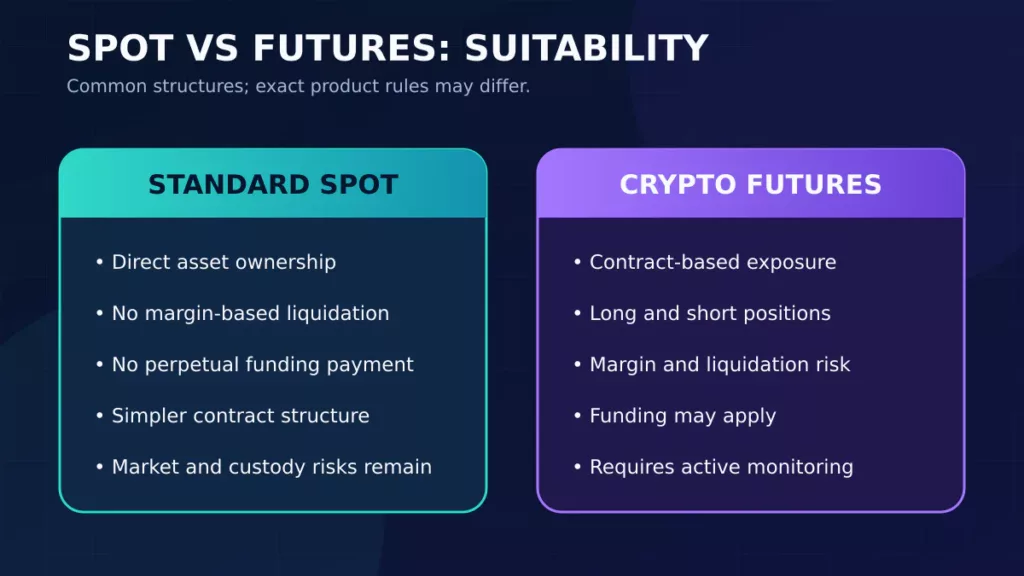
| Consideration | Standard unleveraged spot | Crypto futures |
|---|---|---|
| Exposure | Direct ownership of cryptocurrency | Contract linked to a crypto price |
| Leverage | Not used in a standard purchase | Often available |
| Margin-based liquidation | No | Possible |
| Direction | Usually benefits from appreciation | Long and short exposure available |
| Recurring funding | No perpetual-futures funding | May apply to perpetual contracts |
| Main use | Ownership or longer-term exposure | Active trading or hedging |
| Management requirement | Lower contract complexity | Active margin and risk monitoring |
Spot may fit someone seeking direct ownership and a simpler structure. Futures may fit an informed trader who needs short exposure, a hedge or actively managed leveraged exposure.
Neither product is universally better. The appropriate choice depends on the objective, product knowledge and maximum acceptable loss.
Also Read : Spot vs futures shorting
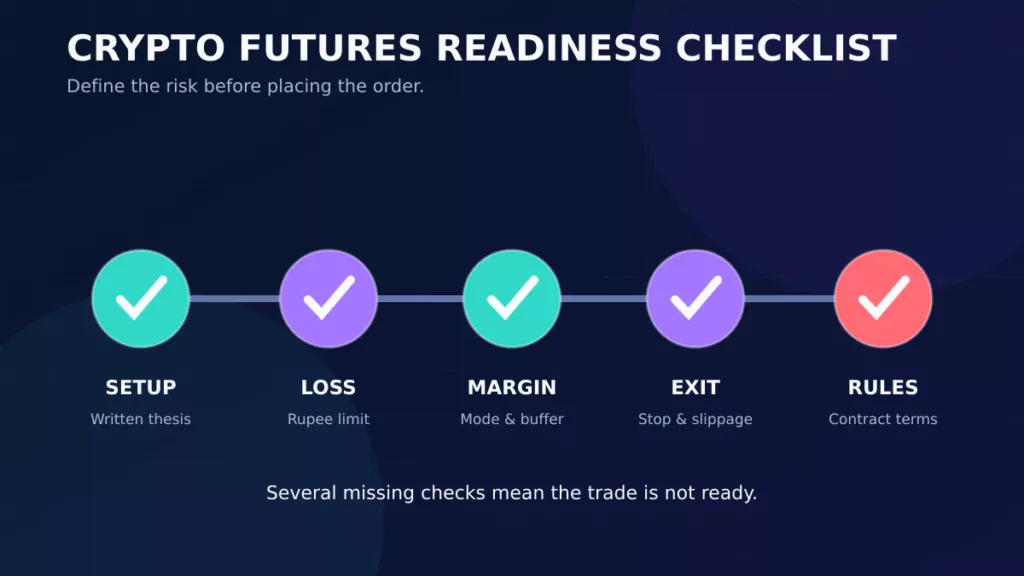
Before placing a futures order, answer each question honestly:
Several “no” answers indicate that education, paper trading or standard spot exposure may be a more appropriate next step.
Is crypto futures trading right for you? It depends on whether the product’s mechanics match your knowledge, financial position and ability to manage loss.
Futures can provide flexible long, short and hedging exposure. They also add leverage, margin, funding, liquidation and execution risks. Before opening a position, review the contract specification, calculate the loss at the planned exit and confirm that the plan does not expose essential funds.
Explore Mudrex Learn, visit the Mudrex YouTube channel or download the Mudrex app to continue learning about crypto futures and risk management.
It may be appropriate only if you understand the contract, can calculate the potential loss, use non-essential risk capital and can follow a written plan during volatility. It is not suitable for everyone.
Beginners should first understand leverage, margin, liquidation, funding and order execution. Standard unleveraged spot trading or paper trading may provide a simpler learning environment.
People using borrowed or essential money, traders without a loss limit, anyone unable to monitor the position and people prone to FOMO or revenge trading should avoid leveraged futures.
A stop can help close a position before liquidation, but it does not guarantee the fill price. Gaps, rapid moves, low liquidity or incorrect trigger settings can create slippage or failed execution.
Isolated margin commonly limits the collateral assigned to one position, which can make per-trade risk easier to understand. However, exact loss treatment and liquidation rules vary by venue
Yes. A short futures position can offset some downside in a spot holding. The hedge can still face basis, funding, execution, sizing and liquidation risks.