
Bitcoin falls sharply overnight. A spot holder sees the market value of their Bitcoin decline, while a futures trader may try to benefit from the same move by opening a short position. The difference is not a prediction advantage. It comes from the structure of the instrument being used.
Understanding crypto spot vs futures shorting helps traders distinguish asset ownership from contract-based exposure. In standard spot trading, you buy and sell cryptocurrency that you own. Crypto futures allow eligible traders to take long or short contract positions without owning the underlying coin.

That flexibility comes with additional risks. Margin, leverage, funding, mark price and liquidation can affect a futures position before the trader chooses to close it. This guide explains how shorting works, how a short can hedge a spot holding and what to check before risking capital.
The first fact in any crypto spot vs futures shorting comparison is that the instruments create different forms of exposure.
In a standard spot trade, the buyer pays the current market price and receives the cryptocurrency. The buyer can hold it, transfer it to a compatible wallet or sell it later. If the asset price rises, the holding gains market value. If the price falls, its market value declines.
In a crypto futures trade, the trader opens a contract position linked to the price of an underlying asset such as Bitcoin or Ethereum. Many crypto futures are cash-settled, so the trader does not receive the underlying cryptocurrency. Contract specifications and settlement rules vary by venue and must be reviewed before trading.
Futures positions can be directional:
Futures also introduce margin, leverage, maintenance requirements and liquidation risk. For a broader product comparison, see Mudrex’s guide to spot, futures and options.
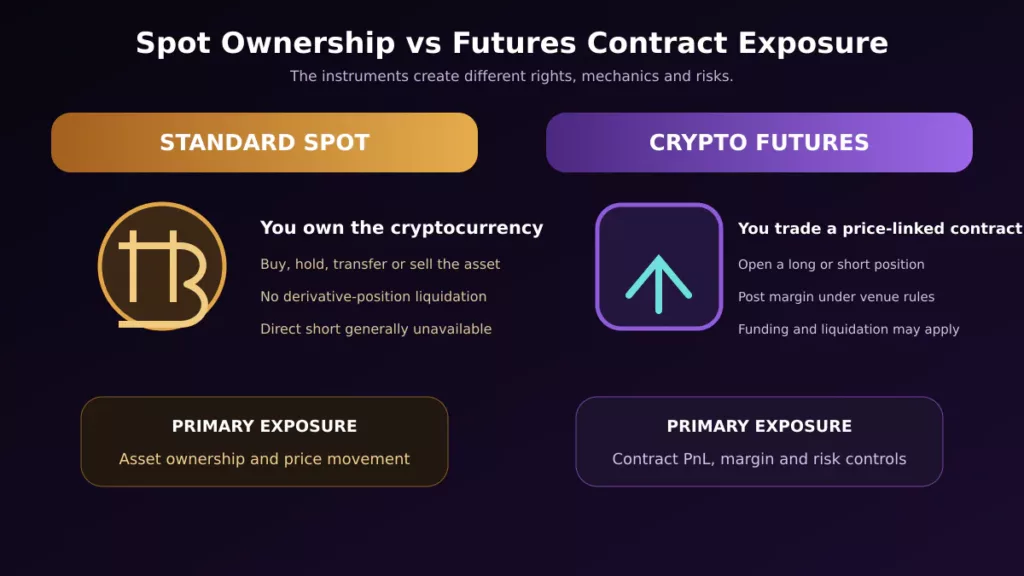
In a standard, fully funded spot market, a trader can sell only cryptocurrency already held in the account. Selling an existing Bitcoin holding before a decline may preserve cash value, but it does not create a position that gains as Bitcoin continues to fall.
A conventional short sale involves selling an asset that the trader does not own, often after borrowing it, and later buying it back.
Therefore, the statement “spot trading cannot be shorted” needs an important qualification. Standard unleveraged spot trading does not provide a direct short position. However, some venues offer a separate spot-margin or lending product that allows eligible users to borrow cryptocurrency and sell it short. Availability, eligibility, borrowing costs and liquidation rules vary.
Crypto futures offer another way to take negative price exposure. Instead of borrowing the coin, the trader opens a short contract position. This distinction is central to understanding crypto spot vs futures shorting.
A futures short expresses the view that the contract price will fall. On a trading platform, the trader selects the contract, chooses the position size and margin mode, and places a sell order to open the short. A buy order—often marked “reduce only”—can later reduce or close it.
The trader does not normally borrow the underlying Bitcoin or Ethereum to create this futures position. Profit and loss come from the difference between the entry and exit prices, multiplied by the contract or position size, subject to the venue’s specifications.
For a linear short position, a simplified gross PnL calculation is:
Gross short PnL = (Entry price − Exit price) × Position quantity
Actual realised PnL can differ after trading fees, funding payments, slippage and contract-specific adjustments.
While a position remains open, its unrealised PnL changes with the platform’s applicable reference or mark price. Unrealised losses can reduce account equity and move the position closer to liquidation even though the trader has not manually closed it. Review the crypto futures beginner checklist before placing a first leveraged trade.
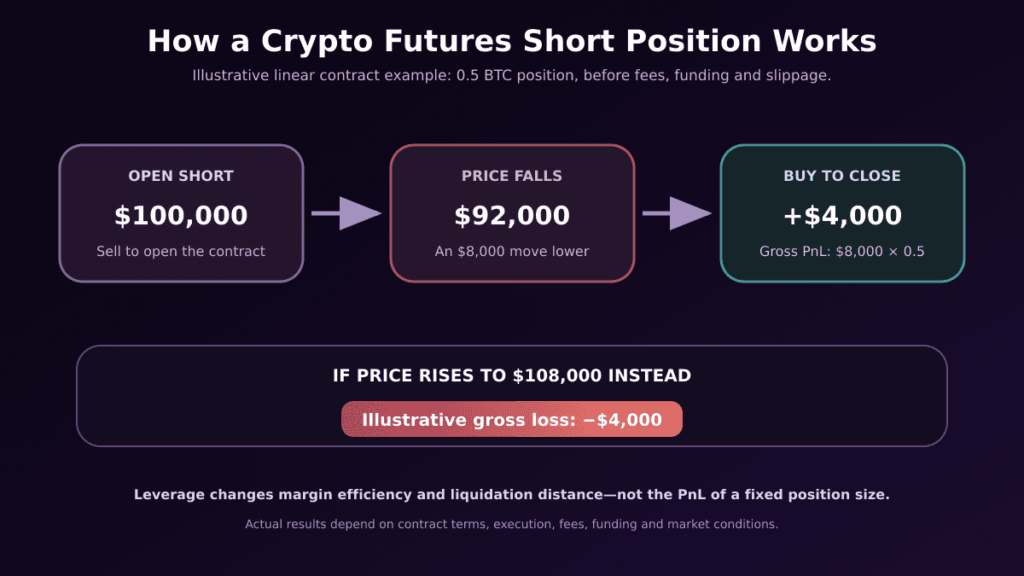
Suppose Bitcoin futures are trading at $100,000 and a trader opens a linear short position representing 0.5 BTC.
The example excludes leverage effects on margin, trading fees, funding, slippage and liquidation. Leverage does not change the gross PnL of a fixed position size. It changes how much margin is required and how large the PnL is relative to that margin. If leverage encourages the trader to take a larger position, the absolute gain or loss also increases.
The leverage amplifies the effect of underlying price movements and treats speculative futures trading as high risk.
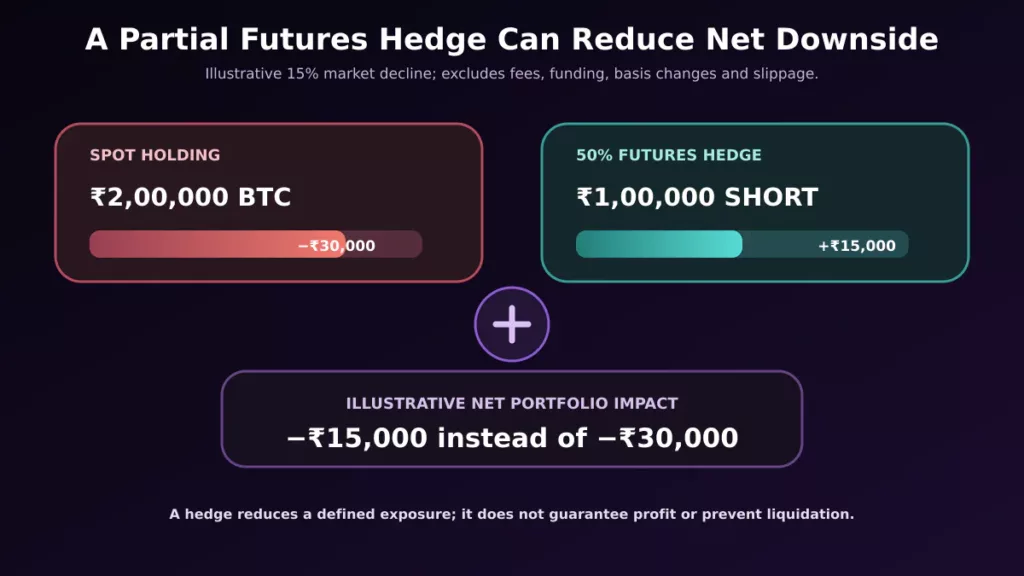
A trader may remain positive about Bitcoin over a long horizon while wanting to reduce exposure during a defined short-term risk period. Selling the spot holding is one option. Another is opening a futures short as a hedge.
Assume a trader holds 1 BTC and opens a smaller Bitcoin futures short. If Bitcoin falls, a gain on the futures short may offset part of the decline in the spot holding. If Bitcoin rises, the spot holding gains value, while the short position loses.
The hedge is not automatically perfect. Its result depends on:
The objective of a hedge is to reduce a defined risk, not to guarantee profit. A short that is too large can turn a hedged portfolio into a net bearish position. A highly leveraged hedge may also be liquidated during a rally, leaving the spot holding exposed later.
Read Mudrex’s practical guide to hedging with crypto futures before sizing a hedge.
Futures margin lets a trader control a position whose notional value exceeds the capital posted. This can make a modest adverse move consume a large share of the available margin.
If account equity no longer satisfies the platform’s maintenance requirement, some or all of the position may be liquidated according to the platform’s rules. Higher leverage usually leaves less distance between the entry and estimated liquidation price.
Read how crypto futures liquidation works before opening a position.
Many derivatives platforms use a mark or reference price to calculate unrealised PnL and evaluate liquidation risk. It may differ from the last traded price shown on a chart.
The exact formula is venue-specific. Mudrex explains the relationship between mark price and liquidation.
Perpetual futures have no scheduled expiry and use funding payments to help keep contract prices aligned with spot. When funding is positive, longs generally pay shorts. When it is negative, shorts generally pay longs.
Intervals and calculations vary by platform. Check the current rate and countdown instead of assuming every venue uses an eight-hour schedule. See Mudrex’s guide to funding rates and funding rates during market stress.
A rapid price rise can force short traders to close positions or trigger liquidations. Their buy orders can add demand and intensify the move, creating a short squeeze.
Stop-loss orders may limit loss, but they cannot guarantee execution at the trigger price. Gaps, slippage, insufficient liquidity or an unfilled stop-limit order can produce a worse exit or allow liquidation to occur first.
Before opening a short position, answer these questions:
Use conservative position sizing and capital you can afford to lose. Paper trading can help a beginner practise order entry, position sizing and exit rules, but simulated results do not guarantee live performance. Mudrex also explains several common crypto futures misconceptions.
| Feature | Standard spot trading | Crypto futures short |
| Instrument | Cryptocurrency | Derivatives contract |
| Underlying ownership | Buyer owns the asset | Usually no ownership of the underlying asset |
| Direct negative exposure | Generally unavailable without a separate margin or borrowing product | Available by opening a short contract position |
| Margin and leverage | Not used in a standard fully funded spot trade | Common; rules vary by contract and venue |
| Liquidation risk | No derivative-position liquidation in standard spot | Yes, when margin requirements are breached |
| Ongoing funding | None in standard spot | May apply to perpetual futures |
| Common uses | Holding, transferring or selling cryptocurrency | Directional trading or hedging |
| Main risk | The asset can lose substantial or all market value | Loss, liquidation, funding and execution risk |
The central lesson in crypto spot vs futures shorting is that spot ownership and futures exposure solve different problems. Standard spot trading allows a trader to buy, hold, transfer or sell cryptocurrency. Futures add the ability to open a short contract position without normally borrowing the underlying coin.
That flexibility comes with leverage, margin, funding, mark-price and liquidation risks. A short position can hedge a spot holding or express a bearish view, but neither outcome is guaranteed. Position size, contract rules and execution conditions matter as much as price direction.
Before trading, review the contract specification, calculate the planned loss and understand what could trigger liquidation. Explore more educational resources on Mudrex Learn, visit the Mudrex YouTube channel or download the app.
Disclaimer: This content is for educational purposes only and does not constitute financial, investment, legal or tax advice. Crypto futures involve significant risk, including the loss of the entire margin. Product availability and rules vary by jurisdiction and platform. Conduct independent research and never trade more than you can afford to lose.
Standard, fully funded spot trading does not normally provide a direct short position. Some platforms offer separate spot-margin products that permit eligible traders to borrow and short assets, subject to borrowing costs and liquidation rules.
The trader opens a short contract position and later closes it with an offsetting buy order. A price decline can create a profit; a price increase creates a loss. Fees, funding, slippage and contract rules affect the final result.
Normally, no. A futures short is a derivatives position linked to Bitcoin’s price. The trader must still post eligible collateral and comply with margin requirements.
It can reduce some downside exposure when sized appropriately. The hedge may be incomplete because of basis changes, contract sizing, funding, fees, slippage and liquidation risk.
Liquidation is the platform-driven reduction or closure of a position when the account no longer meets applicable margin requirements. The trigger and process depend on the contract, margin mode and venue.
Funding rates are periodic payments between long and short position holders in perpetual futures. They help keep the perpetual contract price aligned with the spot market. The direction and interval vary by venue.
A short squeeze is a rapid upward move in which short traders close positions or are liquidated. The resulting buy orders can add further upward pressure.
Minimum margin depends on the venue, contract, position size and selected leverage. The safer question is how much capital the trader can afford to lose under a predefined risk plan.
Not always. A stop-loss can reduce risk, but gaps, slippage, liquidity conditions or an unfilled stop-limit order can result in a different execution price or allow liquidation to occur first.