
Pick the wrong leverage tool and it can cost you more than a bad trade. Margin trading quietly charges interest every hour you hold a position. Crypto futures skip the interest, but a funding fee can flip against you every few hours instead.
Both let you trade with more money than you have. Both can wipe out your deposit if you get the mechanics wrong. This guide breaks down crypto futures vs margin trading across 7 real differences, so you know exactly which one fits your next trade before you open it.
The core difference is ownership. Margin trading uses borrowed money to buy the real asset, so you own it and pay interest on the loan. Crypto futures use a contract tied to the asset’s price, so you never own anything and pay a funding fee instead of interest.
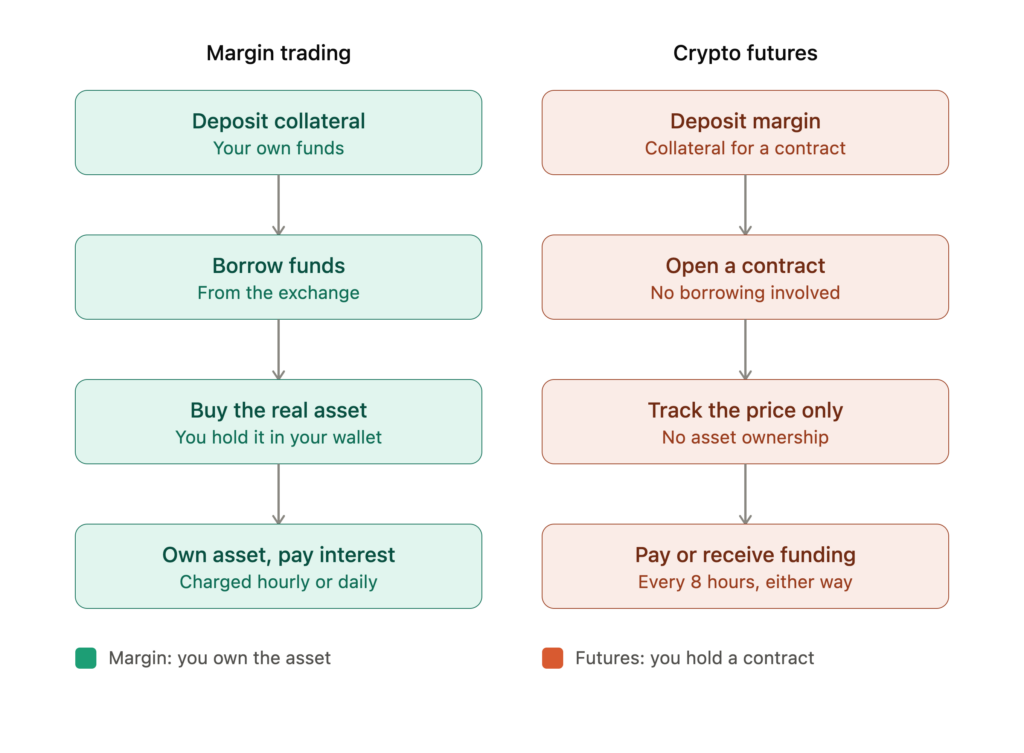
Both are leveraged trades. Both can lose more than your original deposit if the market swings hard against you. The mechanics underneath, however, are built differently, and that difference decides your costs, your risk, and how a bad trade actually plays out.
| Term | What it means |
|---|---|
| Leverage | The ratio of position size to your own capital |
| Initial margin | The deposit needed to open a leveraged position |
| Maintenance margin | The minimum equity needed to keep a position open |
| Margin call | A demand to add funds before a margin position is force-closed |
| Liquidation | The exchange closing your position automatically when margin runs out |
| Funding rate | A recurring fee paid between long and short traders in perpetual futures |
| Open interest | The total value of contracts still open in a futures market |
| Long-short ratio | The balance of bullish vs bearish positioning in the market |
You own the real asset in margin trading, but not in crypto futures. This single difference shapes almost everything else about the two instruments.
In margin trading, your exchange lends you funds so you can buy more of the actual coin than your capital allows. The coin sits in your account, the same as if you had bought it outright. Our full guide on how margin trading works in crypto covers this step by step, including how collateral, leverage, and shorting fit together.
In futures, you never touch the coin. You are trading a contract that mirrors the coin’s price without owning any of the underlying asset. That is why futures traders talk about “positions” and margin traders talk about “holdings.” Different words, different legal claim on the coin.
Crypto futures usually offer noticeably higher leverage than margin trading. Exact leverage caps vary by platform, by asset, and sometimes by your account tier, so always check the specific limit on your exchange before opening a position.
Higher leverage is not automatically better. More leverage means your liquidation price sits closer to your entry price, so a small market move can end your trade. Beginners are usually better off starting with a lower leverage multiple on either instrument, then raising it only once they can consistently predict their own liquidation price. Our beginner checklist for crypto futures walks through leverage, margin, and position sizing in more detail.
Margin trading charges interest that only ever goes one way: you pay it, and it grows the longer you hold. Futures charge a funding rate instead, which can occasionally pay you rather than cost you.
Definition: Funding Rate A recurring fee, usually charged every 8 hours, exchanged directly between long and short traders in a perpetual futures contract to keep its price close to the spot price.
Here is what that looks like on a ₹1,00,000 position held for a week.
| Day | Margin interest (cumulative, ₹) | Futures funding (cumulative, ₹) |
|---|---|---|
| 1 | 27 | 30 |
| 3 | 82 | 65 |
| 5 | 137 | 125 |
| 7 | 192 | 145 |

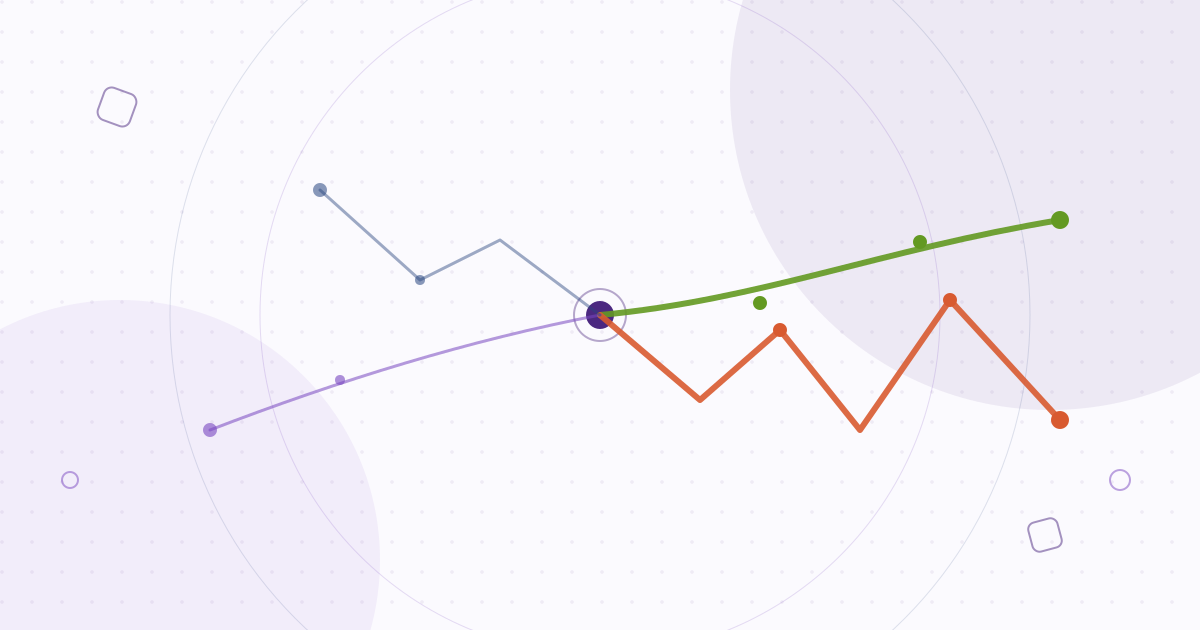
The margin trading line rises steadily because interest always accrues in the same direction. The futures line moves up and down because funding can flip when market sentiment shifts, sometimes working in your favor. These figures are illustrative only, since actual rates change by exchange, asset, and market conditions.
Margin trading usually gives you a margin call first. Futures trading often liquidates you directly, with no warning step in between.
Definition: Liquidation The point at which an exchange automatically closes your leveraged position because your remaining margin can no longer cover further losses.
In margin trading, if your collateral ratio drops too low, the exchange typically issues a margin call asking you to add funds. Ignore it, and the position gets closed. In futures, once your margin ratio breaches the maintenance level, the position is usually closed immediately, without a call or grace period.
One important nuance applies to both: a stop-loss order is not the same as liquidation. A stop-market order will always trigger once the price hits your level, but it can fill at a worse price during a fast move, a problem known as slippage. A stop-limit order can be more precise, but it can also fail to fill at all if the market races past your limit price, leaving your position exposed right when you needed protection most. Our guide on why crypto futures positions can be liquidated even with stop losses in place breaks this gap down in full.
Shorting is more direct in crypto futures. You simply open a short contract. In margin trading, you first have to borrow the asset itself before you can sell it short.
Both approaches let you profit when prices fall, but the mechanics differ:
For active traders who want to flip between long and short quickly, futures usually feels faster because there is no separate borrowing step to manage.
Traditional futures contracts have a fixed expiry date. Most crypto futures today are perpetual contracts, which never expire. Margin trading positions have no expiry at all; you decide when to close them.
This is one area where crypto futures and traditional futures diverge in an important way. If you want a full breakdown of that comparison, our guide on how crypto futures differ from traditional futures covers contract structure, trading hours, and regulation side by side.
Margin trading tends to suit traders who want direct ownership of an asset with some added leverage, and who are comfortable with a steady daily interest cost. Futures tend to suit traders who want higher leverage, easier shorting, and flexibility around funding costs that can occasionally work in their favor.
Neither instrument is safer than the other in absolute terms. Both can lose more than your initial deposit. The right choice depends on your holding period, how closely you plan to monitor the trade, and whether owning the underlying coin matters to your strategy.
A few habits cut your liquidation risk on both margin trading and futures.
Crypto futures vs margin trading comes down to one question: do you want to own the coin, or just trade its price? Once you know that answer, the rest, leverage, cost, and liquidation risk, follows naturally from it.
Download the Mudrex app to start trading, or subscribe to the Mudrex YouTube channel for more beginner-friendly breakdowns of leverage and risk management.
Margin trading uses borrowed funds to buy the real asset, so you own it and pay interest. Crypto futures use a contract that tracks the asset’s price, so you never own it and pay a funding rate instead.
No. You hold a contract that tracks the asset’s price, without ever owning or holding the underlying coin.
Futures typically offer noticeably more leverage than margin trading, though exact caps vary by platform, so check your exchange’s specific limits before trading.
No. Futures use a funding rate exchanged between long and short traders instead of a fixed interest charge on borrowed funds.
Neither is automatically safer. Beginners who want direct asset ownership and a simpler cost structure often start with margin trading at low leverage. Those comfortable with contracts and shorting sometimes prefer futures, again at low leverage.
Crypto futures and margin trading both involve substantial risk of loss, including the potential loss of your entire deposit. Leverage magnifies both gains and losses, and a small adverse price move can trigger a margin call or liquidation. All figures, worked examples, and scenarios in this article are illustrative only and not financial advice. Please assess your own risk tolerance and consult a qualified financial advisor before trading with leverage.