Searching for the best Web3 crypto coins in 2026? Start with what each project actually does. Web3 includes blockchains that host applications, networks that supply external data, and protocols that provide storage or access to blockchain information. Their tokens serve different purposes and carry different risks.
This guide covers seven established Web3-related crypto assets worth researching: Ethereum (ETH), Solana (SOL), Chainlink (LINK), Filecoin (FIL), The Graph (GRT), Polkadot (DOT) and Arweave (AR). They are examples selected for distinct use cases, not a ranking by expected returns. There is no guarantee that any will outperform the market.
Web3 crypto coins and tokens are digital assets associated with blockchain ecosystems and decentralised applications. Depending on the project, a token may be used for transaction fees, network security, storage, data services, governance or incentives.
Some Web3 assets are native coins, such as ETH and SOL. Others are tokens issued on existing blockchains, such as LINK and GRT. The distinction matters for understanding their utility and technical risks.
For a plain-language introduction to coins, tokens and blockchain applications, see what Web3 crypto coins are and how they work.
Also Read in Detail : What is Web3?
| Web3 asset | Symbol | Main use case | Research question |
| Ethereum | ETH | Smart contracts and blockchain settlement | How much network activity translates into ETH demand? |
| Solana | SOL | High-throughput applications and transactions | Can the ecosystem sustain usage and network reliability? |
| Chainlink | LINK | Oracle data and blockchain interoperability services | How does service adoption affect token demand? |
| Filecoin | FIL | Decentralised data-storage marketplace | Are customers paying for useful storage services? |
| The Graph | GRT | Indexing and querying blockchain data | Is query activity driving a sustainable service economy? |
| Polkadot | DOT | Blockchain interoperability, security and governance | Does ecosystem activity justify token economics? |
| Arweave | AR | Long-term and permanent-data storage | Is demand for durable data storage growing? |
This table compares infrastructure functions, not real-time prices, market capitalisation or predicted returns. For live market figures and current asset availability, compare Web3 crypto coins on Mudrex; those figures can change quickly.
Ethereum supports smart contracts and decentralised applications, including DeFi protocols, marketplaces and tokenised assets. ETH is its native asset and is used for transaction fees and network security under Ethereum’s proof-of-stake model.
Why it matters: Ethereum is a widely used foundation for on-chain applications and an important settlement environment for parts of the Web3 economy.
Key risks: Network fees can rise, applications face smart-contract risks, and competing blockchains or scaling networks can affect where activity occurs. Growth in the ecosystem does not guarantee ETH price appreciation.
Look at developer activity, network transaction demand, fees, layer-2 adoption and whether ecosystem growth creates lasting value for ETH. Ethereum hosts a broad range of applications, but successful apps do not always translate directly into higher token prices. Compare staking participation, protocol changes and competitive pressures. Check primary network dashboards instead of inferring adoption from headlines alone. The main risks include smart-contract exploits, congestion in specific applications, competition from other networks and macroeconomic market moves.
Solana is a smart-contract blockchain designed for relatively high transaction throughput and low transaction costs. Its ecosystem includes payments, decentralised exchanges, consumer applications and games. SOL is used for network fees and staking.
Why it matters: Application teams may choose Solana where speed and cost are particularly important.
Key risks: Operational reliability, validator concentration, competition, speculative activity and changing user demand. Review sustained active usage rather than headline transaction counts alone.
For Solana, assess real application usage, developer tools, transaction demand and how network upgrades affect reliability. A low average transaction fee is useful, but it is not sufficient proof that the economic value of the native token will rise. Look for sustained users rather than one-off incentive campaigns. Consider the concentration of application categories, validator economics, supply issuance and the risk that an application moves to a different chain. Market interest can change much faster than infrastructure adoption.
Smart contracts cannot independently verify all information outside their blockchain. Chainlink provides oracle and interoperability infrastructure that can connect blockchain applications with external data and systems. LINK supports aspects of the network’s economics, including staking and service-related functions.
Why it matters: Oracles are important for financial applications that depend on accurate information, such as asset prices.
Key risks: Competing oracle providers, adoption that may not translate directly into token demand, and the complexity of token-value capture. Learn more on the Chainlink price and project page.
Chainlink is best analysed as infrastructure rather than a consumer blockchain. Understand which oracle, automation and cross-chain services a project uses and whether those services generate fees or other demand related to LINK. Read current token documentation instead of assuming every integration creates immediate token buying. Watch for competition, reliance on particular partners, contract security and changes to service economics. Partnerships can validate a technology without guaranteeing investment returns.
Filecoin is a network for buying and providing digital storage capacity. Storage providers participate in a marketplace, and the FIL token helps support payments, collateral and network incentives.
Why it matters: Web3 apps may need data availability without relying on a single storage provider.
Key risks: Commercial demand, storage-provider economics, technical complexity, token supply and competition from both conventional clouds and other decentralised storage services. Explore Filecoin on Mudrex.
Examine whether clients are paying for persistent data storage, what service levels providers offer and how the protocol incentives storage operators. Data volume by itself may overstate economic use if much of it is subsidised or free. Compare the decentralised storage proposition with traditional cloud providers on availability, retrieval speed and operational complexity. Study FIL issuance, collateral requirements and provider economics before treating growth in stored data as token-price demand.
Blockchain records can be difficult for apps to search efficiently. The Graph enables structured indexing and querying of on-chain data. Network participants use GRT within the protocol’s staking and incentive mechanisms.
Why it matters: Easier data access helps developers build usable applications without operating every indexing component themselves.
Key risks: Competition, changing protocol economics and the need for real query demand. See The Graph (GRT) project page.
The Graph provides data indexing and query services used by blockchain applications. Its token economics are linked to network participants who stake or use GRT for protocol roles, while query-fee activity and upgrades influence incentives. Compare decentralised queries with hosted alternatives, observe whether developers keep using the protocol, and read current documentation because reward and allocation rules can evolve. The risks include demand concentration, protocol complexity, supply changes and competing indexing products.
Polkadot is an ecosystem designed around shared security, interoperability and governance across connected blockchain applications and networks. DOT is associated with network participation, staking and governance.
Why it matters: The ability to coordinate distinct networks is an important challenge for a fragmented blockchain ecosystem.
Key risks: Competing interoperability approaches, ecosystem adoption, network complexity and changing tokenomics. Review the current protocol design rather than relying on older parachain-auction descriptions. Learn more on the Polkadot (DOT) page.
Polkadot’s DOT supports network economics, staking, governance and access to computational resources such as coretime. For this project, track whether applications require these resources, how upgrades affect the ecosystem and whether governance decisions change supply or token utility. Long-run developer adoption matters more than a marketing claim about interoperability. Investors should review official supply documentation carefully because token-economic assumptions from older Polkadot articles may no longer reflect current network rules.
Arweave is designed for durable, long-term data storage. Its model uses cryptographic and economic incentives to support a network that preserves information over time. AR is the native token used within its storage economy.
Why it matters: Some applications need records, content or archives to remain accessible long after they were first published.
Key risks: The difficulty of sustaining permanent storage promises, competing products, network economics and token volatility. Read more about Arweave (AR).
Arweave focuses on long-term data persistence and uses its own economic design for supporting storage. Investors should ask which workloads truly benefit from long-term retention, what service and gateway dependencies remain, and whether actual demand supports the network’s token economics. Assess operational access to stored information, competition from other storage systems and the practical difference between permanent storage claims and guaranteed availability. Do not assume that every Web3 application needs this type of storage.
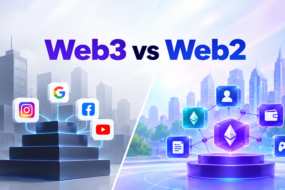
These projects were chosen because they represent identifiable Web3 functions: application platforms, oracle infrastructure, decentralised storage, blockchain data and interoperability. Our Web2 vs Web3 comparison provides additional context on how these services differ from conventional internet platforms. This is not a ranking by investment quality, market capitalisation, trading volume or future gains.
Before investing, update and compare these six metrics:
A low token price does not mean a coin is cheap: supply and market capitalisation matter. Likewise, a well-designed protocol can still have an overvalued token.
Tokenomics describes how an asset is supplied and used. Start with circulating supply, total or maximum supply when applicable, emission schedules, team and investor allocations, staking incentives and planned unlocks. Market capitalisation is broadly the current price multiplied by circulating supply; fully diluted valuation uses a larger assumed supply. A token with a low per-unit price can still be expensive relative to its total valuation.
Ask who receives newly issued tokens and why. High staking rewards can look attractive while being partly offset by issuance and price decline. Unlocks may put selling pressure on markets, although outcomes depend on demand and holder behaviour. Governance proposals can also change economics. Always identify the official token and contract/network; names and tickers can be imitated.
Use the same questions for every candidate rather than switching criteria to favour the latest trending asset. Utility: what real service does the network provide, and does the token have a defined role? Adoption: are there sustainable users, developers, transactions or fee-paying customers? Economics: how do issuance, fees and supply unlocks work? Security: what are the main protocol, bridge and custody vulnerabilities?
Liquidity: is meaningful trading volume distributed across reputable markets, and how large are the spreads? Governance: who can change the rules? Valuation: what assumptions would have to be true for the current price to make sense? Write down findings and uncertainties. An asset may pass the technology test but fail the valuation or liquidity test. No scorecard can reliably predict returns.
Market capitalisation is a useful rough size measure but not a guarantee that holders can sell large positions at the quoted price. Trading volume measures activity over a period; it can be inflated by short-term incentives or poor-quality venues. Liquidity is the depth available near the current price. Thin markets can suffer substantial slippage even when headline volume looks healthy.
Fully diluted valuation (FDV) applies the current price to the fully diluted token count; it can highlight future supply risk but does not prove every token will enter circulation immediately. Compare several metrics together with token unlock schedules and verified exchange or on-chain data. Avoid ranking Web3 tokens by unit price alone.
Application-platform coins such as ETH and SOL relate to network execution and fees. Oracle tokens such as LINK belong to the infrastructure used to make external information usable by contracts. Storage assets such as FIL and AR are linked to storing or preserving data. GRT is associated with blockchain data indexing, while DOT has roles in Polkadot governance, staking and computing resources.
These categories face different competitive markets. A blockchain competes for developers and application demand; a storage protocol competes with other decentralised tools and conventional cloud services; an oracle network must demonstrate trustworthy service delivery. Comparing all tokens only by past returns conceals those differences.
Product adoption and token returns are not the same variable. An application may grow while its token experiences dilution, limited economic value capture or a valuation that already anticipates rapid expansion. A crypto market downturn can lower prices even when a team delivers technical milestones. Conversely, speculative rallies can lift tokens with limited usage.
Consider two separate theses: “This infrastructure could matter” and “This token offers attractive risk-adjusted exposure at this price.” They require different evidence. The first depends on demand and technical execution; the second also depends on supply, valuation, liquidity and portfolio risk. Investors should avoid mistaking a plausible technology story for a reliable price forecast.
There is no universally best Web3 coin for beginners. Established projects may offer more research resources and market liquidity than obscure tokens, but they can still suffer significant losses. New investors should understand the project’s purpose, decide how much loss they can tolerate and avoid leverage when learning the basics.
Choosing a coin is only the research stage. Our guide to investing in Web3 crypto coins in India covers INR funding, platform checks, custody choices, fees and tax considerations if you decide to make a purchase.
Also Read : How to invest in Web3 Crypto Coins in 2026?
Keep a short watchlist with a reason for tracking each coin, links to official updates and the metrics that would strengthen or weaken the case. Review token unlock announcements, governance votes, protocol outages, security incidents, developer releases and market liquidity. Check whether a claimed partnership or user milestone has a credible source and whether it materially affects demand for the token.
Do not treat a rising chart as independent validation of fundamentals. Revisit the original assumptions rather than looking only for evidence that supports a purchase. If you decide to buy, separate the research decision from timing, sizing, custody and tax considerations. Our guide to investing in Web3 coins in India explains the buying process rather than ranking the projects.
Watch for guaranteed return claims, undisclosed sponsored placements, vague statements about “100x potential”, and comparisons that omit token supply. Be sceptical of projects that cannot explain who controls the contracts, publish inconsistent circulating-supply figures or encourage users to connect wallets to unfamiliar websites. Anonymous teams are not automatically fraudulent, but verification becomes more difficult.
Other warning signs include concentrated trading activity, a large near-term unlock, an unaudited bridge that holds substantial assets, or aggressive incentives that disappear when subsidies end. A third-party audit reduces certain risks but cannot prove a project safe. Independent verification matters more than social-media follower counts.
Crypto prices can move sharply even when a project’s technology is progressing. Risks include market crashes, hacks, protocol failures, token unlocks, thin liquidity, misleading promotional claims and changes to regulation or tax treatment. There is no guaranteed return, and many Web3 ventures may not achieve widespread use.
For readers in India, profits from transfers of virtual digital assets are generally subject to a special tax regime; this can substantially affect net returns. Check current rules and seek professional tax advice where necessary.
Examples of infrastructure-focused assets include ETH and SOL for blockchain execution, LINK for oracle services, FIL and AR for storage-related systems, GRT for indexing and DOT for network governance and resources. Each project’s real-world use must be assessed independently, and token demand may differ from product demand.
Themes overlap. A project may use blockchain infrastructure for AI workloads, gaming or virtual worlds, but that does not mean every AI or metaverse token should be classified as core Web3 infrastructure. Classify assets by what the token actually enables rather than promotional labels.
Market capitalisation helps show approximate size, but it says little by itself about valuation, security, adoption or sell-side liquidity. Compare market cap with fully diluted valuation, supply unlocks, activity and the economic function of the asset.
There is no objective best pick. ETH, SOL, LINK, FIL, GRT, DOT and AR are established examples across different Web3 use cases. The right research shortlist depends on risk tolerance, project fundamentals, liquidity and valuation.
Five examples with distinct roles are ETH (smart contracts), LINK (oracles), FIL (storage), GRT (blockchain data) and DOT (interoperability). This is an illustrative list, not a performance ranking.
Yes. ETH is Ethereum’s native cryptocurrency and helps pay for transactions on a major blockchain platform used by Web3 applications.
People use the terms interchangeably, but native blockchain assets are technically coins, whereas assets issued on an existing blockchain are generally called tokens.
No. Returns are uncertain and losses can be substantial, regardless of how widely a project is discussed or how useful its technology appears.
No. A token priced at ₹1 can be expensive relative to its supply and underlying adoption. Compare market capitalisation, fully diluted valuation, token unlocks and liquidity rather than unit price alone.
Look for a clear problem, demonstrable product usage, transparent tokenomics, credible security practices, active development and reliable market liquidity. Be cautious about guaranteed-profit promises.
Supported Web3 tokens can be purchased through platforms like Mudrex that offer INR funding and crypto spot trading. Before ordering, verify the token and network, check whether it is available on your chosen platform, and review pricing and fees.
Check the official project website and token identifier, circulating supply, upcoming unlocks, practical use case, market liquidity, custody options and known security issues. Understand that even a legitimate and useful project can fall sharply in price.
Disclaimer: This article is for information and education only. The assets listed are examples for research, not personalised recommendations or predictions. Cryptocurrency investing involv