

Ethereum staking or stake Ethereum allows ETH holders to help secure the network through Proof of Stake while potentially earning variable rewards. You can run your own validator, use a staking service, join a pool or use a liquid staking protocol. Each route has a different capital requirement, custody model, liquidity profile and level of technical responsibility.
You need at least 32 ETH to activate an individual Ethereum validator. However, 32 ETH is not a universal minimum for participating in Ethereum staking. Pooled and liquid staking products can accept smaller deposits, while some service-based arrangements may also lower the operational barrier.

This guide explains how Ethereum staking works, how to stake ETH in five steps, what changed after Pectra, how withdrawals work and which risks and Indian tax considerations to review before staking.
Also Read: Best crypto to stake
Ethereum staking is the process of placing ETH at stake so validators can participate in the network’s Proof of Stake consensus. Validators attest to blocks, may be selected to propose blocks and help the network agree on its canonical state.
Correct participation can earn ETH rewards. Validators that go offline can miss rewards and incur smaller penalties, while specific slashable actions—such as signing conflicting blocks—can result in a larger loss and validator ejection.
Also read: What Is Ethereum?
To activate your own validator, you must deposit at least 32 ETH and operate validator software reliably. Your validator’s rewards depend on factors such as its effective balance, performance, proposal opportunities, the number of active validators and overall network activity.
Not every user must operate a validator. A staking service can run infrastructure on a user’s behalf, while pooled and liquid staking arrangements combine deposits or use protocol mechanisms to make participation possible with less than 32 ETH. Those conveniences introduce additional dependencies, including providers, custodians and smart contracts.
Visit Ethereum detail Page to see live chart and Market data
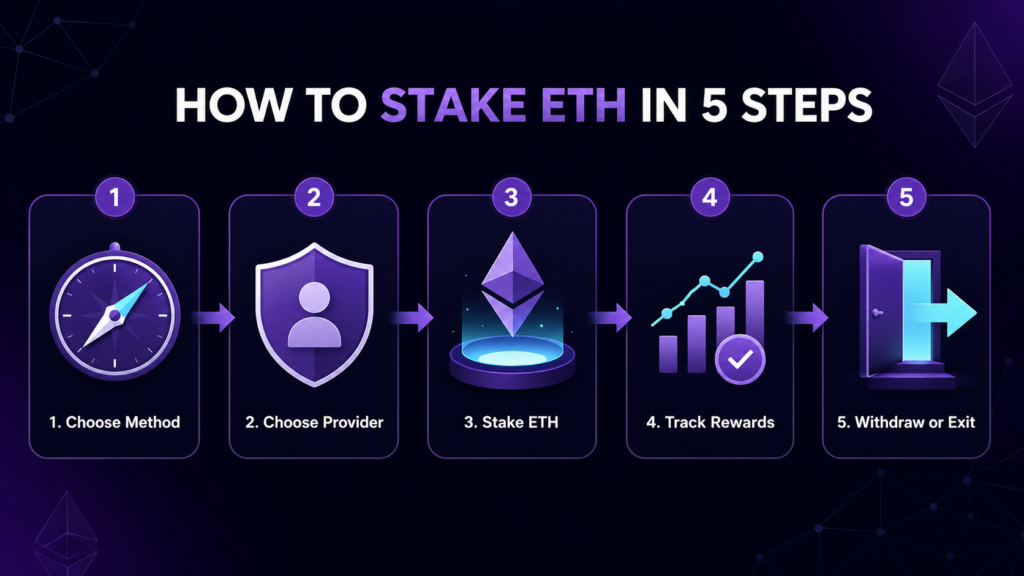
The exact process differs by method, but most staking journeys follow these five steps.
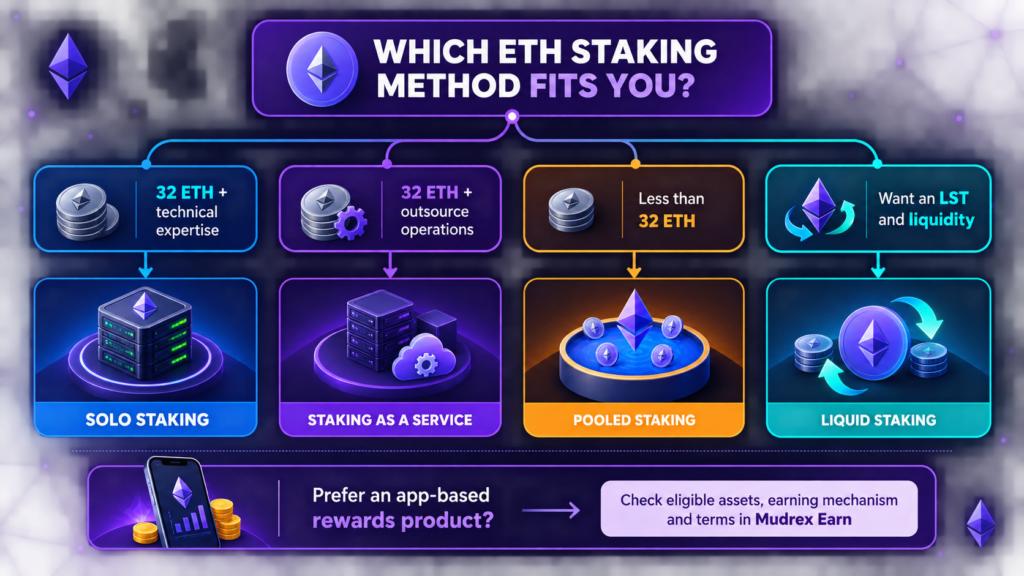
Choose among four main approaches:
Compare custody, fees, validator operations, reward distribution, smart-contract exposure, withdrawal terms and liquidity. Lido, Rocket Pool, Coinbase, Kiln and Figment are examples from the broader Ethereum staking ecosystem, but their products and operating models differ.
Verify that you are using an official website or app before connecting a wallet or transferring ETH.
Solo staking requires the Ethereum validator deposit process and at least 32 ETH. Other methods may accept smaller deposits through a provider, pool or smart contract. Before confirming a transaction, verify the destination address, network, fees and withdrawal or redemption conditions.
Monitor validator or provider performance, reward history, fees and any change to withdrawal conditions. Returns can be affected by consensus-layer rewards, execution-layer rewards, MEV, uptime, network participation and provider charges.
Native Ethereum staking uses validator exit and withdrawal processes. Pooled and liquid staking products can have separate redemption methods. An LST may provide market liquidity without directly exiting the underlying validator, but its market price can diverge from the ETH value it is intended to represent.
Choose a method, select a provider, stake ETH, track rewards and understand the withdrawal or exit process.
Also Read: Ethereum Price Prediction
At least 32 ETH is required to activate an individual validator. A solo operator also needs:
Users who have less than 32 ETH—or do not want to operate validator infrastructure—can consider pooled staking, liquid staking or another provider-based arrangement.
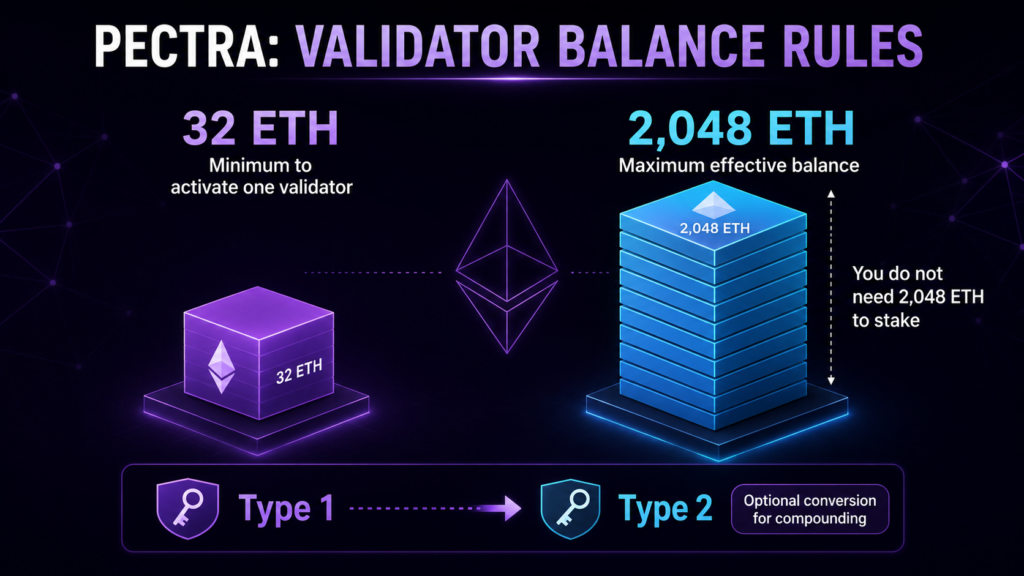
Ethereum’s Pectra upgrade changed the effective-balance rules. An eligible compounding validator can now have an effective balance of up to 2,048 ETH, while the 32 ETH activation minimum remains in place.
| Method | Typical ETH requirement | Who operates the validator? | Main benefit | Main trade-off |
|---|---|---|---|---|
| Solo staking | At least 32 ETH | You | Maximum control and direct protocol participation | Infrastructure, uptime, key-security and slashing risk |
| Staking as a service | Usually 32 ETH for a dedicated validator | Provider | Outsourced technical operations | Provider fees and operational trust |
| Pooled staking | Can be below 32 ETH | Pool or provider | Lower capital and technical barrier | Provider, custody, fee and smart-contract risk |
| Liquid staking | Provider-specific; can be below 32 ETH | Protocol or provider | Potential liquidity through an LST | Smart-contract, liquidity, provider and depeg risk |
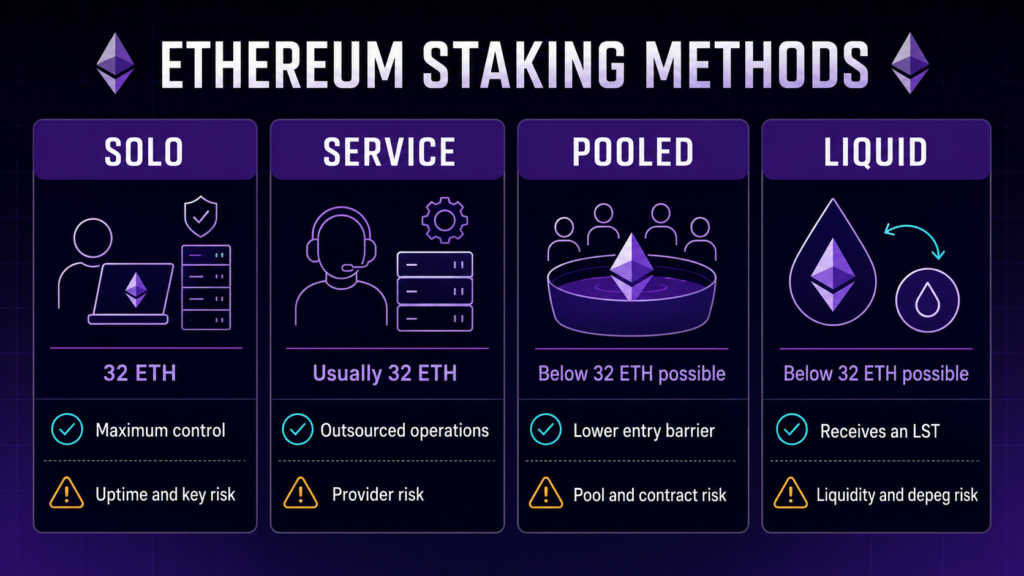
Solo staking gives you direct control over your validator and withdrawal credentials. It also supports network decentralisation by allowing validators to operate independently.
The trade-off is operational responsibility. You must maintain reliable infrastructure, protect keys and keep validator software current. Poor performance can reduce rewards, while serious slashable behaviour can cause a larger loss.
Staking as a service allows a user to fund a validator while a third party handles much of the technical infrastructure. It can suit someone who has the required ETH but does not want to operate a node.
The main trade-off is dependence on the provider’s infrastructure, security and operating practices. Review which keys you retain, the provider’s fees, withdrawal process and what happens if the provider experiences an outage.
Pooled staking combines deposits from multiple users, lowering the entry barrier for people who do not have 32 ETH. Pool designs vary: some are custodial, while others use smart contracts and distributed operators.
Review custody, fees, smart-contract audits, validator operations, withdrawal terms and centralisation risk rather than assuming every pool works the same way.
Liquid staking gives the user a token representing a staked position. For example, Lido issues stETH and Rocket Pool issues rETH.
An LST may be transferred, traded or used in supported applications without first completing a native validator exit. This flexibility adds another layer of risk: the token can trade away from its expected value, liquidity can deteriorate and the underlying protocol or smart contracts can fail.
Also read: Liquid Staking vs Native Staking
Ethereum does not pay every validator a fixed percentage. Validators can earn consensus-layer rewards for duties such as attestations and block proposals. A block proposer can also receive execution-layer rewards, including transaction priority fees and applicable MEV-related rewards.
The network-level return changes as the amount of staked ETH, validator participation and network activity change. Provider fees and operating performance can further affect a user’s net return.
As of 30 August 2026, Ethereum’s official staking page displayed approximately 34% of ETH staked and a current APR of about 2.5%. These are live figures, not guaranteed rates, and can change.
Rewards are denominated in ETH. If ETH’s market price falls, the INR value of the principal and rewards can decline even if the ETH balance increases.
The Pectra upgrade, activated in May 2025, introduced important staking changes.
Through EIP-7251, Ethereum raised the maximum effective balance for an eligible validator from 32 ETH to 2,048 ETH. This allows larger balances to earn consensus-layer rewards through fewer validator instances and lets eligible validators compound rewards above 32 ETH.
The key distinction is:
Pectra also introduced Type 2, or 0x02, compounding withdrawal credentials. Older Type 1, or 0x01, validators generally have balances above 32 ETH swept to their withdrawal address. Eligible Type 2 validators can allow rewards above 32 ETH to contribute to effective balance, up to the maximum.
Converting eligible credentials from Type 1 to Type 2 is opt-in and irreversible. Pectra also made it possible to trigger exits through the execution-layer withdrawal address, reducing some trust assumptions in delegated arrangements.
Yes. Ethereum supports validator exits and withdrawals, but exiting the active validator set and receiving ETH are separate stages.
Two native scenarios matter:
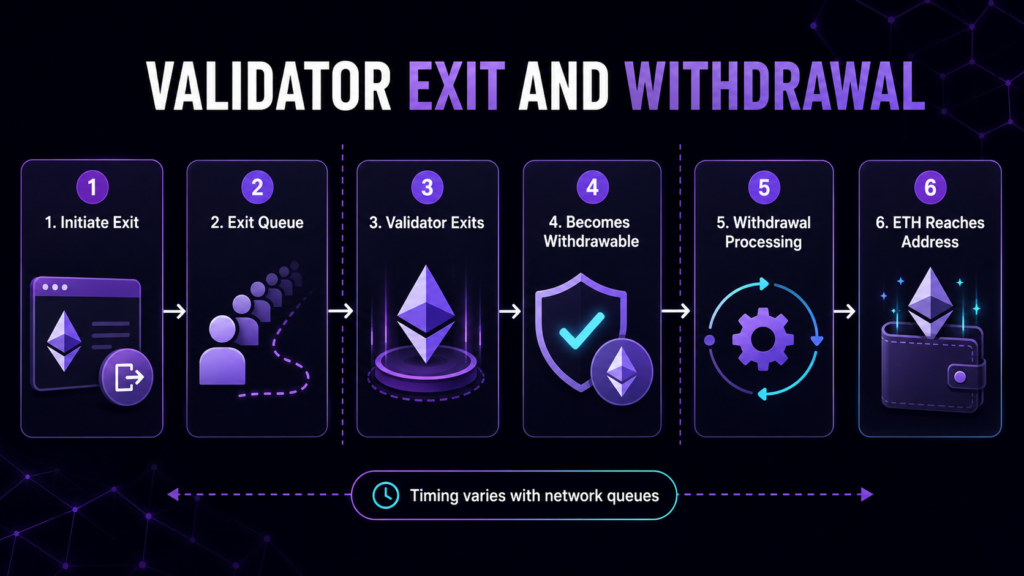
A full native withdrawal generally follows this sequence:
Initiate exit → Exit queue → Validator exits → Becomes withdrawable → Withdrawal processing → ETH reaches the withdrawal address
The exit queue rate-limits how quickly validators can leave. After a validator becomes withdrawable, the protocol processes the withdrawal. Timing varies with network conditions, so review Ethereum’s withdrawal documentation and current queue data before planning an exit.
Pooled services and liquid staking protocols can have separate redemption routes, fees and timelines. Their user-facing process may not match the native validator flow.
 request to receiving ETH" class="wp-image-88235"/>
Staking can generate rewards, but it is not risk-free.
Poor uptime can reduce rewards or lead to smaller penalties. Defined forms of serious validator misconduct, such as conflicting signatures, can result in slashing. Ordinary downtime and slashing are not the same event.
Solo operators must protect signing and withdrawal credentials, maintain hardware and keep client software secure and up to date.
Third-party staking services can introduce dependence on a provider’s custody model, infrastructure, financial health and withdrawal process.
Pooled and liquid staking protocols may rely on smart contracts. Bugs, exploits or governance failures can affect deposited assets or the tokens representing them.
An LST can trade above or below the value users expect it to represent. Market stress can reduce liquidity and widen the discount.
Staking does not protect against a fall in ETH’s market price. The fiat value of the stake can decline by more than the value of rewards earned.
Large pools and providers can concentrate validator operation. This can create network-level centralisation concerns even when participation becomes easier for individual users.
Two products with similar advertised APRs can deliver different net results after provider fees, validator performance and protocol mechanics. Compare net returns and underlying risks, not only the headline rate.
Mudrex Earn offers an app-based way to access rewards on eligible crypto assets. It should not be treated as identical to native Ethereum staking: depending on the asset and product, the earning mechanism may involve staking or lending.
To review an eligible opportunity:
Eligibility, rates and terms can change. Check the product details shown in the app before subscribing and compare custody, provider, smart-contract, liquidity and counterparty risks with those of native staking.
There is no universally best way to stake ETH.
Ethereum staking rewards can have tax implications in India. India’s VDA framework taxes income arising from the transfer of virtual digital assets at 30% plus applicable surcharge and cess. A 1% TDS can also apply to qualifying VDA transfers, subject to the statutory conditions and thresholds.
The treatment of staking rewards when they are received can depend on how the reward is characterised and the taxpayer’s circumstances. Published guidance commonly treats the fair market value of rewards on receipt as taxable income, while a later sale, swap or other transfer can create a separate VDA tax event. Because the applicable head and rate at receipt can require fact-specific interpretation, obtain advice from a qualified tax professional.
Keep records of:
For further reading, see Mudrex’s guide to staking taxation in India and the Income Tax Department’s Section 115BBH.
Before staking ETH:
Ethereum staking is not one product. Solo staking offers the greatest control, staking as a service outsources infrastructure, pooled staking lowers the entry barrier and liquid staking can provide potential liquidity through an LST.
Pectra changed validator economics by allowing eligible compounding validators to earn rewards on effective balances of up to 2,048 ETH, while 32 ETH remains the minimum required to activate an individual validator.
Before staking, compare the capital requirement, custody model, fees, validator operations, reward mechanics, withdrawal process and downside risks. Staking can potentially increase an ETH balance while helping secure the network, but it should be approached as a risk-managed activity—not as guaranteed passive income.
You need at least 32 ETH to activate an individual validator. You can participate with less through third-party pools or staking services that accept smaller deposits.
No. Pectra raised the maximum effective balance for eligible compounding validators to 2,048 ETH. The minimum effective balance to activate an individual validator remains 32 ETH.
There is no fixed or guaranteed reward rate. Rewards vary with validator performance, network participation, effective balance, proposal opportunities and provider fees.
Liquid staking generally gives users a token representing a staked ETH position. The token may remain transferable or usable elsewhere, but this adds smart-contract, provider, liquidity and depeg risks.
An LST, or liquid staking token, represents a position in a liquid staking system. Examples include stETH from Lido and rETH from Rocket Pool.
Slashing is a serious protocol penalty for defined validator misconduct such as conflicting signatures. Ordinary downtime is different and generally results in missed rewards or smaller penalties rather than automatic slashing.
Yes. Validators can exit and withdraw, subject to Ethereum’s exit and withdrawal processes. Pools and liquid staking providers can have separate redemption mechanics and timelines.
Not automatically. Staking and lending create different risks. Staking can involve validator, protocol, custody and smart-contract risk; lending can add borrower and counterparty exposure.
India’s VDA rules clearly tax income from VDA transfers and include TDS rules for qualifying transfers. The treatment of staking rewards on receipt can be fact-specific, so maintain records and obtain professional tax advice.
There is no single fixed period. Timing depends on the validator exit queue and subsequent withdrawal processing. Provider-based and liquid staking redemptions can follow different timelines.
Yes. ETH remains exposed to market-price risk. Liquid staking can also add smart-contract, provider, liquidity and depeg risks.