Crypto staking can reward long-term holders for supporting proof-of-stake networks, but the best crypto to stake is not simply the coin with the largest advertised APY. Reward rates change, exit rules differ by network, and a high nominal yield can be offset by token inflation, fees, price declines or long unbonding periods.
This guide compares ten widely used proof-of-stake assets by indicative annual reward rate, liquidity, staking mechanics and key risks. It is designed to help you shortlist the best cryptos for staking based on your own time horizon and liquidity needs, rather than chase a single headline number.

There is no universal winner because staking goals differ. This quick view maps common investor priorities to the networks in this guide; it is a starting point, not a recommendation to buy a token solely for its staking reward.
| Goal | Suggested fit | Why it stands out | Main caveat |
|---|---|---|---|
| Established staking ecosystem | Ethereum (ETH) | Mature validator ecosystem, broad tooling and pooled options | Lower nominal reward; 32 ETH needed for solo validation |
| Liquid delegated staking | Cardano (ADA) | Delegated ADA remains spendable at the protocol level | Reward varies with pool and network parameters |
| Relatively short native exit | Solana / NEAR / Sui | Epoch-based exits are generally shorter than multi-week unbonding | Validator/provider details and token volatility still matter |
| Higher nominal reward potential | Polkadot / Cosmos | Often higher headline rewards than large-cap peers | 28-day / 21-day unbonding and dilution or slashing risk |
| Known fixed staking term | Avalanche (AVAX) | Native staking uses a predefined term rather than open-ended unbonding | No early native exit before the selected end date |
| Ethereum-scaling exposure | Polygon (POL) | Direct delegation with a comparatively shorter exit process | Checkpoint timing and reward rates can vary |
Crypto staking is a way of participating in a proof-of-stake blockchain by committing or delegating eligible tokens to help secure the network. Validators use stake as an economic guarantee while they propose or attest to blocks. In return, the protocol may distribute staking rewards.
The exact mechanics vary. Some networks require tokens to be locked for a defined period; others let delegated tokens remain liquid. Some expose delegators to slashing, while others use different penalties or simply withhold rewards. If you are new to the concept, read our detailed crypto staking guide before comparing individual coins.
Staking and lending can both generate crypto rewards, but they create different risks. This distinction matters because some centralized “Earn” products may use more than one underlying mechanism. If you want to understand the second model in more detail, read how crypto lending works and how its risk profile differs from staking.
| Feature | Crypto staking | Crypto lending |
|---|---|---|
| What generates the reward | Participation in a proof-of-stake network | Borrower or strategy pays interest/yield |
| Main risks | Token-price risk; validator or slashing risk on some networks; lock-up/unbonding; smart-contract/provider risk if using third parties | Counterparty, borrower, platform and strategy risk; token-price risk |
| Liquidity | Network-specific: can be liquid, epoch-based, queue-based or fixed-term | Product-specific withdrawal terms |
| Eligible assets | Primarily proof-of-stake assets | Can include assets that do not support native staking |
Because “best” is subjective, this list is not ranked solely by APY. We evaluated seven practical factors: network maturity and security, indicative reward rate, token issuance and reward quality, liquidity and exit time, staking minimums and accessibility, validator or protocol penalties, and the additional risks introduced by pools, liquid-staking protocols or custodial platforms. We prioritized mechanics that can be checked against current protocol documentation.
This framework is designed to answer the real decision behind the query: not simply which coin pays the most, but which staking setup offers a sensible balance of reward quality, liquidity, network risk and operational complexity for a particular user.
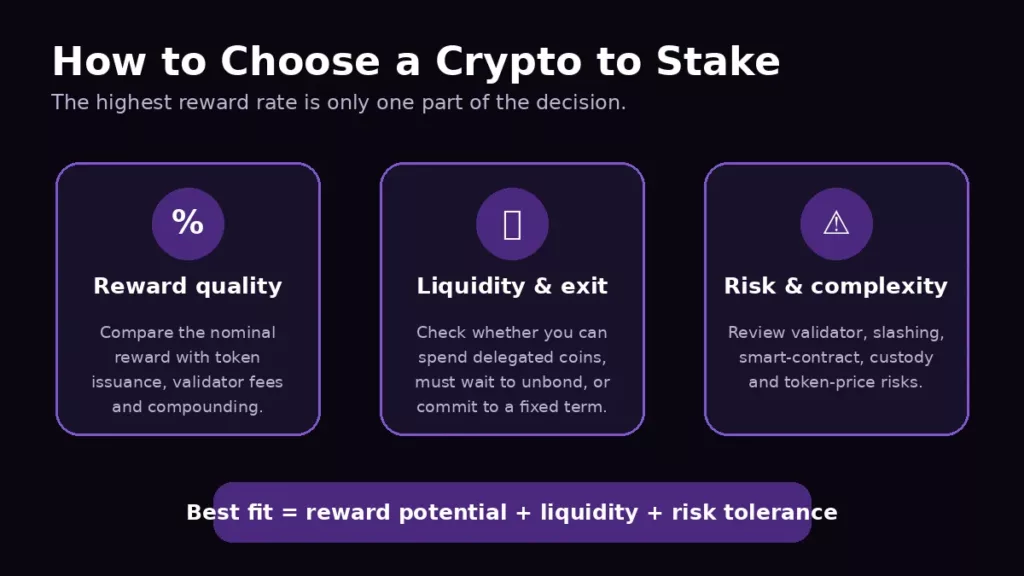
Headline APY is useful, but it is not the same as your economic return. Many proof-of-stake networks issue new tokens to pay validators and delegators. If the token supply expands quickly, part of the staking reward can simply offset dilution experienced by all holders. Because providers may quote rates differently, understanding APR vs APY in crypto can help you compare staking yields more accurately.
A rough screening estimate is: token-denominated real reward ≈ nominal staking reward rate minus net token issuance or dilution. This is not an exact portfolio-return formula: validator fees, compounding, fee burns, changing circulating supply and the token’s market price all matter. A coin can deliver a positive staking reward while your INR portfolio value still falls if the token price declines.
Example: if a network pays roughly 12% in staking rewards while its token supply expands by roughly 8%, the inflation-adjusted token reward is closer to 4% before fees and other effects. Use this as a comparison lens, not as a guaranteed return calculation.
The figures below are indicative annualized reward rates, not guaranteed Mudrex rates. Public sources may quote APR or APY differently, and rates can change with network participation, validator commission, protocol parameters and provider fees. Always check the live rate and withdrawal terms before staking.
| Coin | Indicative annual reward rate* | Native exit / liquidity | Best fit for | Main trade-off |
|---|---|---|---|---|
| Ethereum (ETH) | ~2.6% current protocol APR | Validator exits are queue-based; pooled/liquid routes vary | Established staking ecosystem and deep tooling | Solo staking needs 32 ETH; third-party pools add extra risk |
| Solana (SOL) | ~5–6% recent native staking benchmark range | Deactivation normally completes at an epoch boundary (~2 days), but can take longer | Higher nominal reward with relatively short native cooldown | Validator performance/commission and SOL volatility |
| Cardano (ADA) | Variable; no fixed protocol APY | No protocol lock-up for delegated ADA; it remains spendable | Simple, liquid wallet delegation | No fixed protocol APY; pool performance affects rewards |
| Polkadot (DOT) | Variable; pool/validator dependent | 28-day native unbonding | Users comfortable trading liquidity for higher nominal rewards | Long exit time; active validator/pool selection matters |
| Cosmos (ATOM) | Variable; protocol/provider dependent | 21-day native unbonding | Higher nominal reward and Cosmos ecosystem exposure | Long unbonding and delegator slashing risk |
| Coin | Indicative annual reward rate* | Native exit / liquidity | Best fit for | Main trade-off |
|---|---|---|---|---|
| Avalanche (AVAX) | ~6.4% current Core estimate | Fixed staking period; minimum 14 days and no early native exit | Users who can commit to a known staking term | Funds stay locked until the chosen end date |
| Polygon (POL) | Variable; validator/provider dependent | 80 checkpoints (~40 hours if checkpoints are ~30 min; delays possible) | Ethereum-scaling exposure with relatively short direct unbonding | Reward rate and checkpoint timing vary |
| NEAR Protocol (NEAR) | ~4.8% current benchmark | 4 epochs (~24–28 hours) | Shorter native unbonding with delegated staking | Validator/pool commission and smart-contract surface |
| Tezos (XTZ) | ~3.0% current estimate | Direct staking: up to 4 days; delegation remains liquid | Choice between liquid delegation and higher-risk direct staking | Staked tez can be slashed; delegation rewards differ |
| Sui (SUI) | ~1.5% current estimate | Changes take effect at the next epoch (~24 hours) | Epoch-based staking on a newer high-throughput network | Newer network and lower current nominal reward |
*Rates are approximate snapshots/ranges as of August 2026 from public network or provider data. They are not promised returns and may not match the live rate on any specific platform.
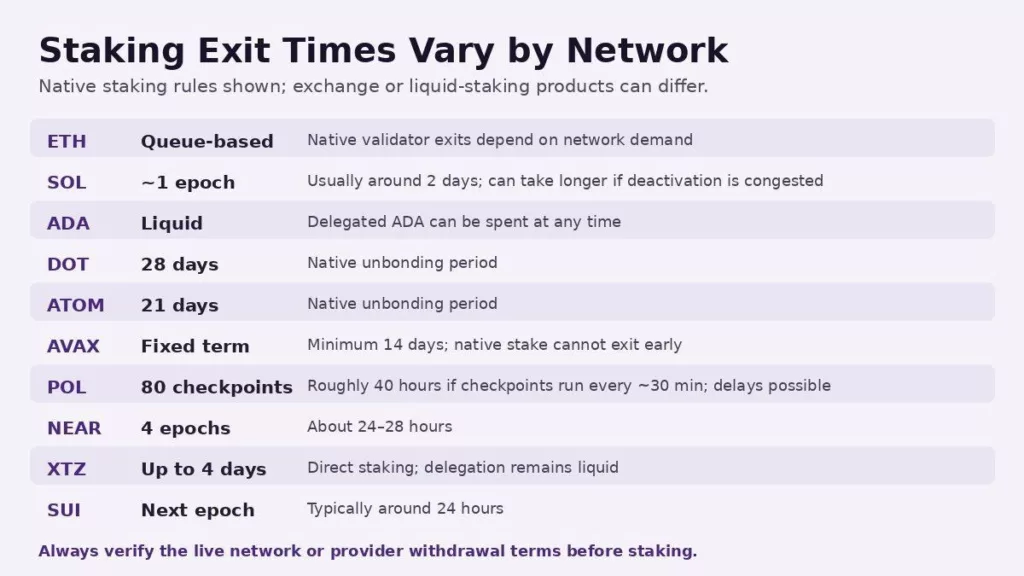
Ethereum is the most established proof-of-stake network in this list. Ethereum’s staking dashboard currently shows about 33% of ETH staked and a 2.6% protocol APR. Running your own validator requires 32 ETH, while pooled staking can lower the capital requirement but introduces provider or smart-contract risk. Native validator exits are queue-based, so there is no universal fixed withdrawal time.
ETH fits users who value a mature validator ecosystem and broad tooling more than the highest headline yield.
Also Read : Ethereum Price Prediction
Solana uses delegated staking and organizes stake activation and deactivation around epochs. Solana’s official staking guide says an epoch is approximately two days; deactivation normally completes at an epoch boundary, although network-wide limits can make the process take more than one epoch during heavy unstaking.
Nominal staking rewards are commonly in the mid-single digits, but validator commission and performance matter. SOL can suit users who want a relatively short native cooldown and are comfortable with its market volatility.
Read : Solana Price Prediction
Cardano’s delegation model is unusually liquid. The official Cardano delegation guide states that you can spend ADA at any time regardless of how it is delegated. Rewards are distributed by the protocol and vary with stake-pool performance and network parameters rather than a fixed APY.
That makes ADA one of the lower-friction staking options for users who do not want a protocol-level unbonding lock. The trade-off is that the nominal reward is generally more modest than higher-yielding networks.
Also Read : Is Cardano a good investment & Cardano Price Prediction
Polkadot offers nomination pools and direct nominating, but liquidity is the key constraint. The network’s official chain-state documentation lists a 28-day unbonding duration. That means DOT can remain unavailable for nearly a month after you start unbonding.
DOT may appeal to long-term holders who accept the wait in exchange for potentially higher nominal rewards. It is less suitable if you expect to need fast access to the position.
ATOM staking uses delegation to Cosmos Hub validators. The Cosmos Hub delegator FAQ confirms a three-week unbonding period and notes that delegators can share slashing risk if a validator double-signs. The long exit period is the main practical trade-off behind its comparatively high nominal reward rates.
ATOM is therefore more appropriate for holders who already understand the Cosmos ecosystem and do not need short-notice liquidity.
Avalanche staking works differently from a normal “unbond whenever you want” model. The current Avalanche staking FAQ lists a roughly 6.41% reward rate at the time of its update, a 25 AVAX minimum for native delegation, and a minimum staking period of two weeks. Native stake stays locked for the period you choose and cannot be stopped early.
AVAX can work for users who prefer a defined staking term and can leave the funds untouched until the end date. It should not be described as having a 14-day “unbonding period”; it is a minimum fixed staking term.
Polygon has migrated its staking token from MATIC to POL. According to the Polygon delegation documentation, direct delegated stake remains locked for 80 checkpoints after an unbond request. With checkpoints targeted around 30 minutes, that is roughly 40 hours in normal conditions, but congestion can extend it.
POL suits users who want exposure to an Ethereum-scaling ecosystem and can accept validator and checkpoint timing risk. Reward rates vary across validators and staking products.
NEAR staking uses delegation to validators or staking pools. The NEAR staking documentation specifies a four-epoch unbonding delay, roughly 24–28 hours under current epoch timing. A current CF Benchmarks NEAR staking index has placed the annualized network reward around the high-4% range, though the net reward to a delegator can differ by pool commission.
NEAR can suit users who want a relatively short native exit process without running a validator themselves.
Also Read : Is Near Protocol a good investment
Tezos now distinguishes between delegation and direct staking. The current Tezos staking documentation says delegated tez remains liquid and is not exposed to slashing, while directly staked tez is locked and can be slashed. Direct unstaking can take up to four days before funds are finalized.
That distinction makes old descriptions of Tezos as universally “no lock-up staking” outdated. Users can choose liquidity through delegation or stronger protocol participation through direct staking. A current Tezos staking reward estimate is around 3%, but the rate changes over time.
Sui uses delegated proof of stake with rewards distributed by epoch. The Sui Foundation’s staking explainer notes that staking and withdrawal changes take effect when the epoch changes; Sui epochs are approximately 24 hours. A current SUI staking reward estimate is around 1.5%, but the rate changes over time.
SUI may appeal to users who want exposure to a newer high-throughput Layer 1 and accept a shorter operating history than Ethereum, Cardano or Tezos.
Check Crypto Live Price in INR
You generally have three routes: operate a validator, delegate through a wallet or staking pool, or use a centralized platform product. Each route changes who controls the validator, how quickly you can exit and which additional risks you take on. If you prefer pooling your assets rather than running a validator, learn how staking pools work.
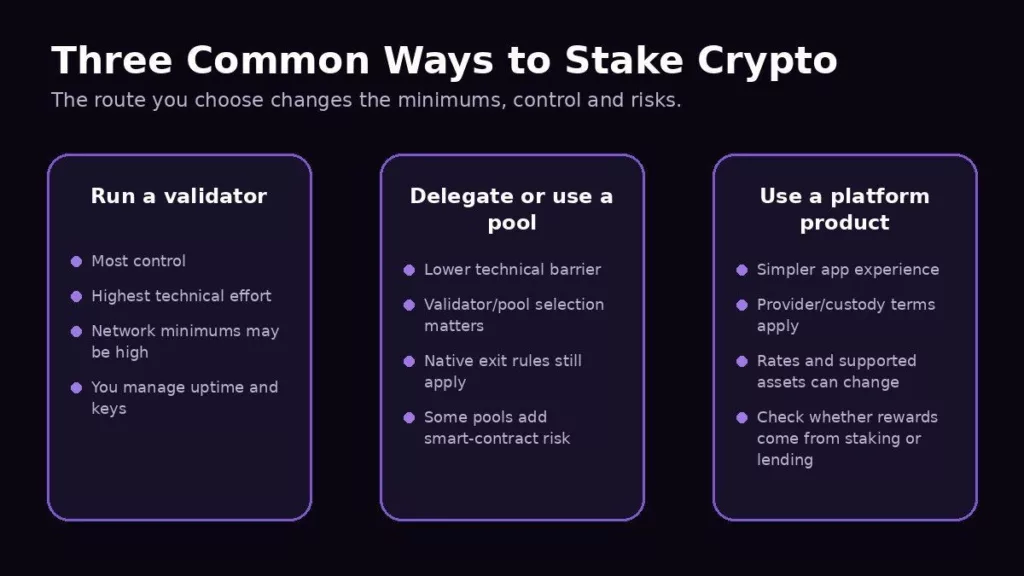
The coin you choose is only half of the staking decision. The route you use changes liquidity, custody and risk. Native staking interacts directly with the protocol; liquid staking typically gives users a transferable token representing their staked position. Depending on the design, it can add smart-contract, provider, protocol and liquid-staking-token risks; platform-based products simplify access but add provider and custody considerations.
| Route | How it works | Main trade-off |
|---|---|---|
| Native validation / delegation | Stake or delegate through the blockchain’s own staking mechanism | Network minimums, validator selection, technical work or native exit delays |
| Liquid staking | Stake through a protocol and receive a tradable token representing the staked position | Smart-contract risk where applicable, plus provider, protocol and liquid-staking-token price risk |
| Platform-based rewards | A centralized app or provider handles the operational process for supported assets | Custody/provider risk; the underlying earning mechanism may not always be native staking |
For a deeper comparison of liquidity, lock-ups and additional risks, read our guide to staking vs liquid staking.
Staking can make sense when you already want to hold a proof-of-stake asset for the medium or long term and can accept its exit rules and risks. It can add token-denominated rewards to an existing position, but it should not be the only reason to buy a weak or highly inflationary token.
Before deciding, compare the expected reward after fees and dilution with the token’s price risk, your liquidity needs and the staking route you plan to use. If you may need the funds quickly, a lower-yield but more liquid setup can be more suitable than a higher headline APY with a long lock-up.
Learn What IDO means in Crypto
For Indian users, staking rewards and later disposal of those rewards can have tax implications under the Virtual Digital Asset framework. Tax treatment can depend on how the reward is received and how the tokens are later transferred, so keep records of reward dates, fair market values and disposal transactions.
Tax treatment can depend on the nature of the reward and subsequent disposal, so keep accurate records and read our detailed guide to crypto staking taxation in India. Tax rules and interpretations can change, so consider qualified tax advice for your specific circumstances.
Choosing the best crypto to stake and choosing a platform for staking crypto are separate decisions. Compare supported assets, live reward rates, withdrawal terms, fees, custody and the underlying earning mechanism before using any platform.
For supported assets, Mudrex Earn lets users access crypto rewards from the Mudrex app. The current Mudrex flow is Coins → Earn → choose an eligible asset → Subscribe to Earn. Mudrex states that Earn has no platform lock-in and no subscription fee. However, Mudrex’s own product and tax guidance notes that Earn can involve staking or lending depending on the asset, so an Earn listing should not automatically be treated as native proof-of-stake delegation. Review the live rate, withdrawal terms and earning mechanism shown in the app before subscribing.
Choosing the best crypto to stake in 2026 means matching the network’s reward potential, liquidity and risks to your own goals. Ethereum offers the most established staking ecosystem in this comparison; Cardano prioritizes liquid delegation; Solana and NEAR offer shorter native cooldowns; Polkadot and Cosmos demand more patience; and Avalanche requires a fixed commitment period.
Treat every APY as a moving snapshot. Before staking, verify the live reward rate, token issuance, validator or provider terms, unbonding rules and tax implications. If you prefer an app-based platform for staking crypto, review which assets are currently eligible in Mudrex Earn and confirm whether the product uses staking, lending or another supported earning mechanism before subscribing.
Risk note: Crypto assets are volatile and staking rewards are variable. Staking does not protect you from a decline in the token’s market value. This article is educational and is not financial, investment or tax advice.
Native staking is available on proof-of-stake networks such as Ethereum, Solana, Cardano, Polkadot, Cosmos, Avalanche, Polygon, NEAR, Tezos and Sui. The exact staking route, minimum and withdrawal rules differ by network.
There is no single best crypto to stake for everyone. Ethereum is the most established option in this list, Cardano offers liquid delegation, Solana has a relatively short cooldown, while Polkadot and Cosmos can offer higher nominal rewards with much longer exit times.
Among the large networks compared here, Cosmos and Polkadot often show some of the higher nominal reward rates. A higher rate does not automatically mean a better return because token issuance, price volatility, fees, slashing risk and long unbonding periods can offset the headline number.
Crypto staking is not risk-free. Risks include token-price declines, validator or slashing risk on some networks, lock-up or unbonding delays, smart-contract risk in some liquid-staking implementations, and custody or counterparty risk when using centralized providers.
Bitcoin does not support native proof-of-stake staking because it uses proof of work. Products described as “Bitcoin staking” usually use a different mechanism, such as lending, restaking infrastructure or another yield strategy, and should be assessed under those specific risks. Read more about Bitcoin transactions
APR is an annualized rate without assuming compounding. APY includes an assumed compounding frequency. Staking providers may calculate and display these metrics differently, so compare the methodology as well as the headline rate.
It depends on the network and product. Cardano delegation is liquid, Solana and Sui are epoch-based, NEAR uses a four-epoch delay, Polkadot and Cosmos use multi-week unbonding, and Avalanche native staking stays locked until the selected term ends.
There is no universal minimum. Solo validation can require substantial capital, while delegation, nomination pools, liquid-staking protocols and platform products may allow much smaller amounts. Check the current minimum for the specific network and staking route you plan to use.
Liquid staking lets you stake through a protocol while receiving a tradable token that represents the staked position. It can improve liquidity, but depending on the design it can add smart-contract, provider, protocol and liquid-staking-token risks on top of the underlying staking risks.
For assets supported in Mudrex Earn, open the Mudrex app, go to Coins → Earn, select the eligible asset and review the live rate and terms before subscribing. Availability and rates can change, and the underlying mechanism may be staking or lending depending on the product.