
Many beginners enter crypto futures believing the product is simply spot trading with leverage. Others assume higher leverage guarantees larger profits or that an unrealised loss does not matter until the trade is closed.
These assumptions can become expensive. These contracts introduce margin, liquidation, funding, mark price and leverage. Each one changes how a position behaves and how quickly a trader can lose capital.

This guide examines five common crypto futures misconceptions, explains why they are misleading and shows what beginners should check before trading a perpetual contract.
Every market has a learning curve. In leveraged derivatives, however, a misunderstanding can affect the account before a trader has time to correct it.
A prediction may eventually prove correct, yet the position can still fail first. Excessive leverage may trigger liquidation, funding can reduce returns, or a stop order may not fill as expected during a fast market.
Understanding the mechanics can help traders:
Education does not make crypto futures safe. It helps reduce preventable errors while the underlying market and leverage risks remain. Start with the Mudrex crypto futures beginner checklist before considering a live position.
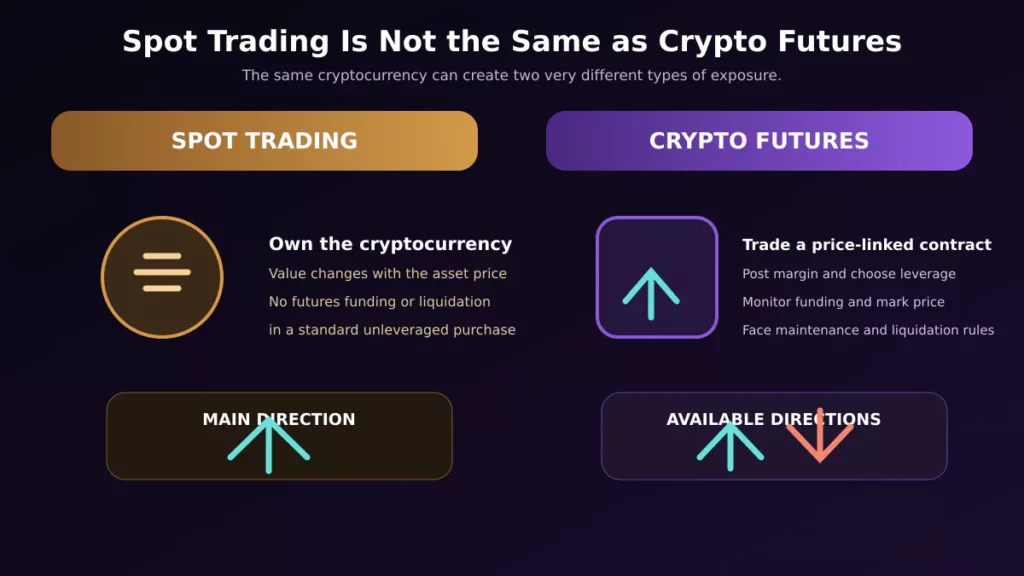
This is one of the most common crypto futures myths. Spot and futures markets can track the same cryptocurrency, but the trader holds a different type of exposure.
In a standard spot purchase, the buyer acquires the cryptocurrency. The position does not have a futures liquidation price, funding rate or maintenance-margin requirement. Its value can still fall sharply, but ordinary un leveraged spot ownership does not create the same forced-liquidation mechanism.
In a futures position, the trader holds a contract linked to the asset’s price rather than the cryptocurrency itself. A long position gains when the contract price rises and loses when it falls. A short position does the opposite.
Futures also introduce:
Therefore, futures are not simply a larger spot purchase. They form a separate derivatives market with different costs and failure points. Read the Mudrex comparison of spot, futures and options for more details.
Leverage lets a trader control a larger position with a smaller amount of margin. For example, ₹10,000 of margin at 10× leverage creates ₹1,00,000 of notional exposure.
The misunderstanding is that leverage improves the probability of a profitable trade. It does not. It magnifies the result of the price movement on the larger position.
| Leverage | Position controlled with ₹10,000 margin | Result of a 2% favourable move* | Result of a 2% adverse move* |
| 2× | ₹20,000 | +₹400 | −₹400 |
| 5× | ₹50,000 | +₹1,000 | −₹1,000 |
| 10× | ₹1,00,000 | +₹2,000 | −₹2,000 |
| 20× | ₹2,00,000 | +₹4,000 | −₹4,000 |
*Illustrative only; excludes fees, funding, slippage and maintenance-margin effects.
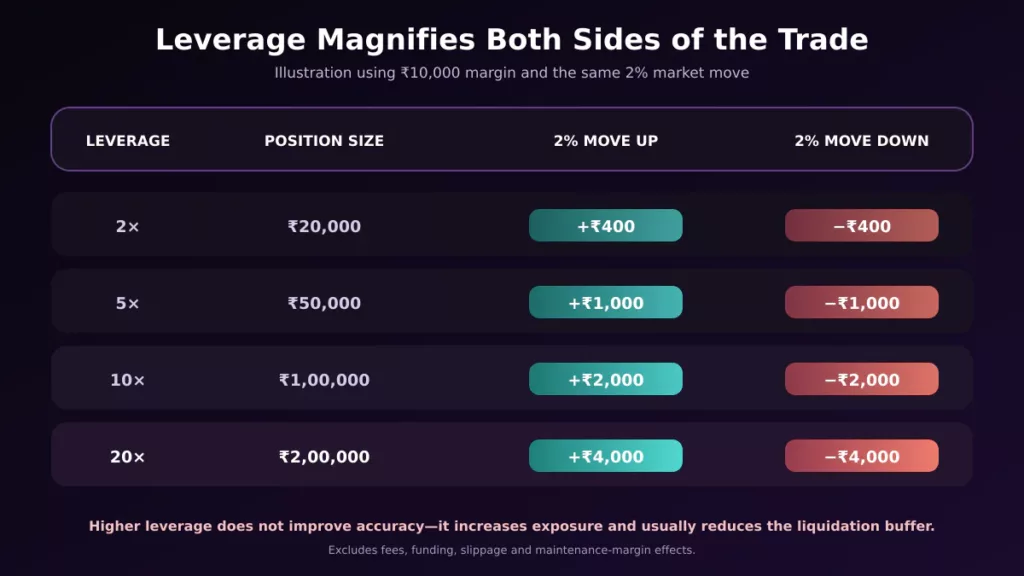
As leverage rises, the liquidation price generally moves closer to the entry price. A move that looks small on the chart can consume a large percentage of the trader’s margin.
The appropriate question is not “What is the highest leverage available?” It is “What position size and loss can my plan tolerate?” Review how much leverage may be too much before selecting a multiplier.
Funding is easy to ignore because a single payment may appear small. Repeated payments can still affect a leveraged perpetual position.
Perpetual futures have no scheduled expiry. A funding mechanism helps keep their price near the spot or index price. When funding is positive, long position holders generally pay short position holders. When it is negative, shorts generally pay longs.
The direction, interval and formula vary by venue. Traders should check the live rate and countdown rather than assume every platform uses the same schedule.
Funding becomes particularly relevant when:
Funding is not a guaranteed trading signal. A high positive or negative rate may indicate crowded positioning, but it does not predict when price will reverse.
The Mudrex guide to funding rates during market stress explains how funding relates to leverage, open interest and sentiment.
The first three crypto futures misconceptions share one problem: they focus only on whether price will rise or fall.
Before entering a trade, record:
A stop-loss can help control risk, but it is not a guarantee. Price gaps, slippage or an unfilled stop-limit order can still allow liquidation to occur. The article on liquidation despite a stop-loss explains this distinction.
Traditional short selling often involves borrowing an asset, selling it and later buying it back. A short crypto futures position works differently for the trader.
The trader enters a contract that gains value when the referenced futures price falls. They do not normally borrow and deliver the underlying cryptocurrency to open that position.
For example:
Shorting through futures removes the need for the trader to source and borrow the coin. It does not remove risk. A market can rise without a fixed limit, so an unprotected short can lose rapidly—especially with high leverage.
This distinction helps separate futures trading from spot ownership and traditional asset borrowing. It also explains why long and short positions can be opened within the same derivatives market.
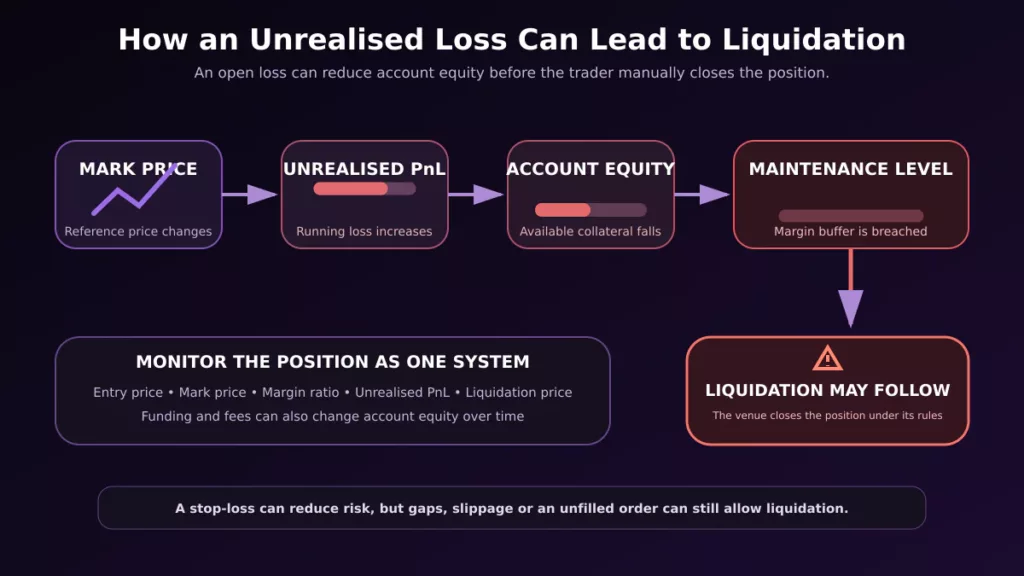
Beginners sometimes describe an open-position loss as “only on paper.” In leveraged crypto futures, unrealised PnL can directly affect account equity and available collateral.
Unrealised PnL is the running gain or loss while a position remains open. Venues commonly calculate it using a mark or reference price. As an adverse move increases the loss, the position’s margin buffer can shrink.
Realised PnL is locked in when all or part of the position closes or when the venue applies a settlement. Trading fees, funding and liquidation activity can also affect the final result.
If equity falls below the maintenance requirement, the venue may liquidate the position under its rules. The trader does not need to press the close button for the loss to become realised.
Monitor entry price, mark price, margin ratio, unrealised PnL and liquidation price together. The Mudrex guide to mark price and liquidation explains why the chart’s last traded price may differ from the price used for liquidation checks.
Understanding crypto futures misconceptions is only the first step. Use this checklist before placing a position:
Paper trading can help a beginner practise order entry, leverage and stop placement without financial loss. It cannot fully reproduce live-market slippage, emotional pressure or liquidity. Mudrex has a guide to crypto futures paper trading for structured practice.
| Myth | Reality |
| Futures are spot trading with leverage | Futures use contracts, margin and separate liquidation mechanics |
| More leverage guarantees more profit | Leverage magnifies both gains and losses; it does not improve accuracy |
| Funding rates do not matter | Repeated funding can change the cost of holding a perpetual position |
| Shorting requires borrowing crypto | A futures short is a contract position; the trader does not normally borrow the coin |
| Losses matter only after closing | Unrealised losses reduce equity and can trigger liquidation |
Learning to trade futures means understanding more than order placement. Traders must recognise how margin, leverage, funding, mark price, short positions and unrealised PnL interact.
The five crypto futures misconceptions covered in this guide often arise from simple assumptions that overlook important contract mechanics. Correcting these assumptions can improve preparation, but it cannot eliminate the risk of rapid or total loss.
Before opening a position, review the contract specifications, calculate the potential loss at your planned exit and monitor the distance between your stop-loss and liquidation price. Disciplined risk management begins with conservative position sizing and using only capital you can afford to lose.
Explore more educational resources on Mudrex Learn, visit the Mudrex YouTube channel, or download the Mudrex app to start trading crypto futures.
Disclaimer: This content is for educational purposes only and is not financial advice. Crypto futures trading involves significant risk, including the loss of your entire margin. Do your own research and never trade more than you can afford to lose.
Common myths include treating futures as leveraged spot trading, assuming higher leverage improves profitability, ignoring funding, confusing futures shorts with borrowed-asset short selling and dismissing unrealised losses.
No. Futures use contracts and introduce margin, funding, mark price and liquidation. Spot trading usually involves ownership of the cryptocurrency.
No. Higher leverage increases the effect of both favourable and adverse price movements. It also places liquidation closer to the entry price.
Funding payments pass between long and short holders of perpetual contracts. Depending on the direction and duration of the position, funding may increase cost or add a credit.
No. The trader normally opens a contract position that benefits when the referenced price falls. Margin, funding and liquidation rules still apply.
Yes. Unrealised losses can reduce account equity. If the margin buffer falls below the venue’s maintenance requirement, liquidation may follow.
No. Fast price moves, slippage and an unfilled stop-limit order can prevent execution at the intended price. A stop should remain meaningfully separated from liquidation.
Crypto futures remain high-risk even after a beginner learns the mechanics. Education, conservative sizing and practice can reduce avoidable mistakes, but they cannot eliminate market, execution or liquidation risk.
Learn margin, leverage, liquidation, funding, mark price, position sizing and order types. Then practise defining loss and exit conditions before considering a live trade.